

DIY company secretarial tasks offer cost control and direct oversight, but professional outsourcing ensures compliance accuracy, legal risk reduction, and time efficiency. Both approaches manage statutory duties, but outsourcing delivers sustained reliability and audit-ready documentation that supports small business growth without administrative delays.
What does “DIY company secretarial work” involve?
DIY company secretarial work means business owners complete statutory filings, maintain registers, and handle corporate compliance on their own without external support.
These tasks include recording director appointments, updating shareholder information, filing confirmation statements, and maintaining statutory records required by the Companies Act 2006. Some owners handle these internally to save costs or retain operational control.
Every limited company must maintain accurate records such as director registers, share allotment logs, and PSC (Persons with Significant Control) details. When business owners do this themselves, they rely on template documentation or Companies House notifications.
For example, a director-led filing setup might include:
- Updating the company’s statutory registers manually.
- Preparing and submitting the annual confirmation statement.
- Recording minutes for significant business resolutions.
- Tracking share transfers within the company.
While manageable for a single-director company, DIY tasks gradually increase as a business expands or engages multiple shareholders. Compliance oversight typically becomes harder without specialist tools or monitoring systems.
Why do small business owners choose DIY secretarial management?
Small business owners often choose DIY management to save direct service fees and maintain hands-on control over compliance documentation.
This approach fits startups or low-transaction entities where filings are minimal. Owners often believe DIY efforts provide flexibility and visibility into corporate actions, especially during early operations.
However, the efficiency gains decrease over time. Manual tracking introduces risks such as late filings, missing PSC updates, or inaccurate statutory registers. The administrative time required for documentation management also grows, often exceeding five hours per filing cycle.
Small business entrepreneurs may rely on government resources and online guidance. Yet, those sources provide general directions, not tailored compliance structures aligned with unique shareholdings, director shifts, or change-of-address events.
When companies cross the threshold of active transactions, DIY secretarial processes begin to conflict with business continuity goals, prompting re-evaluation for outsourced management.

What does professional outsourcing of company secretarial tasks provide?
Outsourced company secretarial services assign qualified specialists who manage statutory records, filings, and legal compliance under UK corporate governance frameworks.
These professionals handle entire compliance cycles from director appointments to annual returns ensuring Companies House submissions are accurate and timely. Outsourcing transfers responsibility for tracking filing deadlines, maintaining PSC information, and ensuring legal documents meet regulatory format requirements.
Typical outsourcing inclusions:
- Automated confirmation statement filing with audit tracking.
- Digital maintenance of statutory registers compliant with Companies Act standards.
- Director and shareholder change documentation prepared by accredited corporate service providers.
- Real-time alerts for legal deadlines or structure amendments.
Professional providers also review governance procedures to ensure your company meets FRC and HMRC requirements. This oversight prevents administrative penalties that often occur due to missed filings or inaccurate company data.
Outsourcing aligns with structured compliance support offered by dedicated UK specialists, such as through the Company Secretarial Service, who deploy standardised corporate management frameworks built for SME visibility and control.
How does cost comparison differ between DIY management and outsourcing?
DIY management costs less upfront, but professional outsourcing offers lower total cost across annual compliance cycles through error prevention and time savings.
A small business performing self-filings pays only Companies House fees, roughly £13 per confirmation statement. However, each director must allocate an average of 8–10 hours per year spent managing filings, reviewing changes, and ensuring register accuracy.
Conversely, outsourced company secretarial support costs between £150 and £300 annually for ongoing compliance oversight, covering documentation accuracy, legal alignment, and risk prevention.
An error in PSC reporting can cost £5,000 in penalties, while late filings may trigger public record marks impacting business credibility. These indirect losses often exceed the service costs of outsourcing.
Professional management thus converts unpredictable administrative time into a predictable, low-risk expense. For small business owners focused on operational scaling, this financial predictability strengthens governance control and operational efficiency.
Which approach ensures better compliance with UK company law?
Outsourced company secretarial management ensures far stronger alignment with UK company law due to structured compliance monitoring and documentation checks.
Company law obligations demand consistent adherence to the Companies Act 2006, record-keeping standards, director credentials validation, and PSC register transparency. DIY methods rely on business owners’ understanding of these requirements, which varies by experience level.
Professional secretarial providers use compliance frameworks validated against Companies House and HMRC criteria. They maintain digital audit trails and perform pre-filing verification to identify discrepancies before submission.
For example:
- Every director appointment is cross-referenced with identity verification data.
- Share transfers are logged with timestamped records matching confirmation statements.
- PSC registers are updated through regulated templates aligned with UK transparency standards.
This structured oversight not only satisfies government compliance but also strengthens investor confidence through precise documentation, a valuable outcome for growing SMEs transitioning toward external funding.
When should a company switch from DIY filings to outsourced management?
A company should transition to outsourced secretarial management when administrative time exceeds operational value or compliance accuracy begins to decline.
Practical indicators include:
- Multiple director appointments or shareholding changes within a year.
- Upcoming investment or ownership restructuring.
- Missed filing deadlines or administrative corrections from Companies House.
- Growth in document volume or stakeholder oversight requirements.
Most UK SMEs experience compliance workload growth within two years of operation. After that, management reliability declines when tasks remain manual or owner-led.
Switching to professional compliance oversight removes filing uncertainty and standardises governance protocols. Providers such as [From My company] offer scalable company secretarial support tailored to evolving business complexity without increasing internal workload.
Transitioning early enhances both internal efficiency and external compliance reputation, a critical asset for sustainable business growth.
How does outsourcing impact data security and record accessibility?
Outsourced company secretarial providers protect data through encrypted management systems while granting controlled, remote access to statutory documents.
DIY handling often uses spreadsheets or physical registers stored locally, prone to version errors and data loss. Outsourced services deploy secure cloud frameworks with audit protection and logging validation for every document edit.
Data encryption usually follows ISO 27001 or GDPR-compliant systems, ensuring director and shareholder details stay private and traceable.
Accessibility standards allow authorised viewing by directors, auditors, or investors, all under verified account profiles. That transparency and traceability greatly exceed manual document storage and email-based record transfers.
This system prevents data tampering and supports long-term governance readiness for small businesses engaging auditors or expanding shareholder structures.
By securing compliance records and enabling quick retrieval, outsourcing stabilises business continuity across annual review cycles.
How do outsourced secretarial services support business scalability?
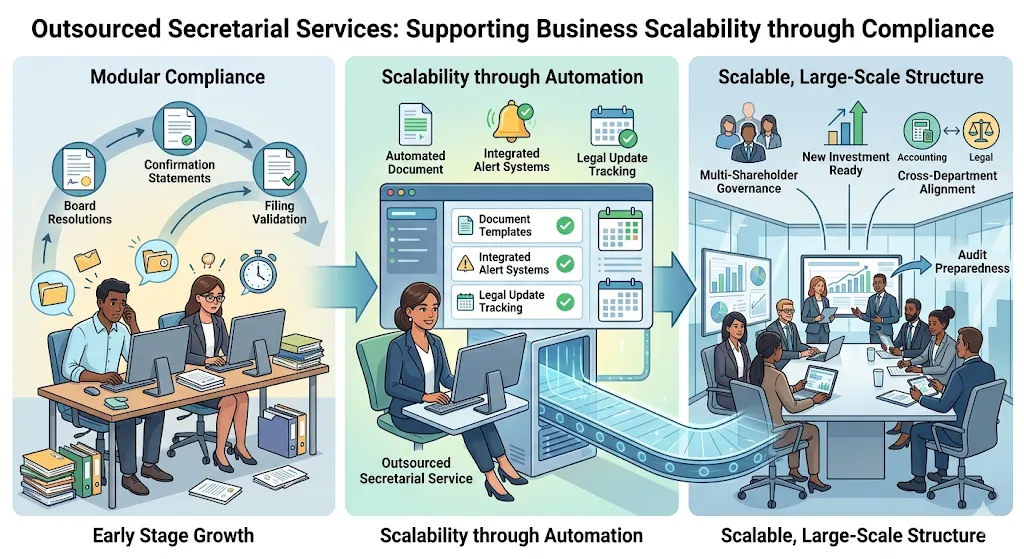
Outsourced secretarial services sustain scalability by automating compliance tasks and aligning documentation standards with evolving corporate structures.
As businesses grow, more filings, board resolutions, and confirmation statements accumulate. Outsourced providers scale these tasks using modular compliance systems.
They integrate renewal reminders, structure updates, and filing validation into standard workflows. This ensures each compliance cycle runs without manual tracking or deadline monitoring by the directors themselves.
Scalability factors include:
- Automated document templates for recurring filings.
- Integrated alert systems for legal updates.
- Uniform protocols for new share classes or director additions.
Providers manage the shift from small-company compliance to multi-shareholder governance smoothly, helping SMEs maintain transparency before large-scale structuring events or new investments.
Outsourced compliance also facilitates cross-department alignment, for instance, ensuring Accounting and Legal units access consistent secretarial records, reducing internal review friction and improving audit preparation.
Why is professional outsourcing the sustainable option for small business owners?
Professional outsourcing delivers continuous compliance oversight, predictable cost structure, and reliable governance protection, making it the sustainable long-term choice for SMEs.
While DIY offers control and cost savings during startup phases, its efficiency diminishes once filings multiply and record accuracy becomes critical. Outsourcing keeps the administrative foundation stable while freeing leadership from operational filings.
Governance consistency, real-time monitoring, and compliance standardisation collectively protect the business from legal risks and reputational setbacks.
Also explore
Why Outsource Company Secretarial Services is More Cost-Effective Than In-House Hiring
The Benefits of Hiring Professional Company Secretarial Experts for Your Growing Firm
How to Choose the Best Company Secretarial Service Provider for Your Business
Expert company secretarial providers ensure complete documentation integrity, efficient digital handling, and proactive compliance alignment, all essential for legitimate corporate operation within UK frameworks.
By integrating outsourced services through the Company Secretarial Service, small businesses sustain their compliance infrastructure while enabling focus on growth, revenue, and operational priorities.
DIY secretarial tasks fit early-stage companies managing minimal filings, while professional outsourcing delivers reliability, accuracy, and scalability as the business grows.
Small business owners aiming for sustained compliance and risk control benefit from outsourcing frameworks tailored to UK governance requirements.
For more information, also explore Understanding the Difference Between a Director and a Company Secretary in the UK and Secure Your Business with Our Expert Managed Company Secretarial and Filing Services
From My company delivers structured company secretarial competence through advanced compliance tools, ensuring every statutory action meets legal and documentation precision. The outcome is long-term continuity, legal soundness, and simplified corporate administration.
Frequently Asked Questions
What does a company secretarial service do for UK businesses?
A company secretarial service manages statutory filings, keeps accurate registers, and ensures compliance with the Companies Act 2006. From My company handles director appointments, PSC updates, and annual confirmation statements, supporting transparent governance and risk-free filings.
Why do small businesses outsource company secretarial tasks?
Small businesses outsource company secretarial tasks to reduce compliance errors and save time on complex legal filings. From My company provides structured management of registers and deadlines, ensuring consistency and regulatory accuracy.
How does From My company ensure companies meet legal compliance requirements?
From My company uses verified compliance frameworks aligned with UK corporate law. Its company secretarial specialists monitor filing obligations and review statutory documents to ensure continuous adherence to Companies House standards.
What records must a company secretary maintain in the UK?
A company secretary must maintain director registers, shareholder lists, PSC details, and meeting minutes. From My company keeps these records digitally, ensuring they remain updated and audit-ready for corporate inspections or investor reviews.
When should a business switch from DIY filings to professional company secretarial support?
When filings increase or governance complexity grows, switching to professional secretarial support prevents costly mistakes. From My company offers ongoing compliance oversight suited to scaling UK companies needing structured, monitored statutory management.