
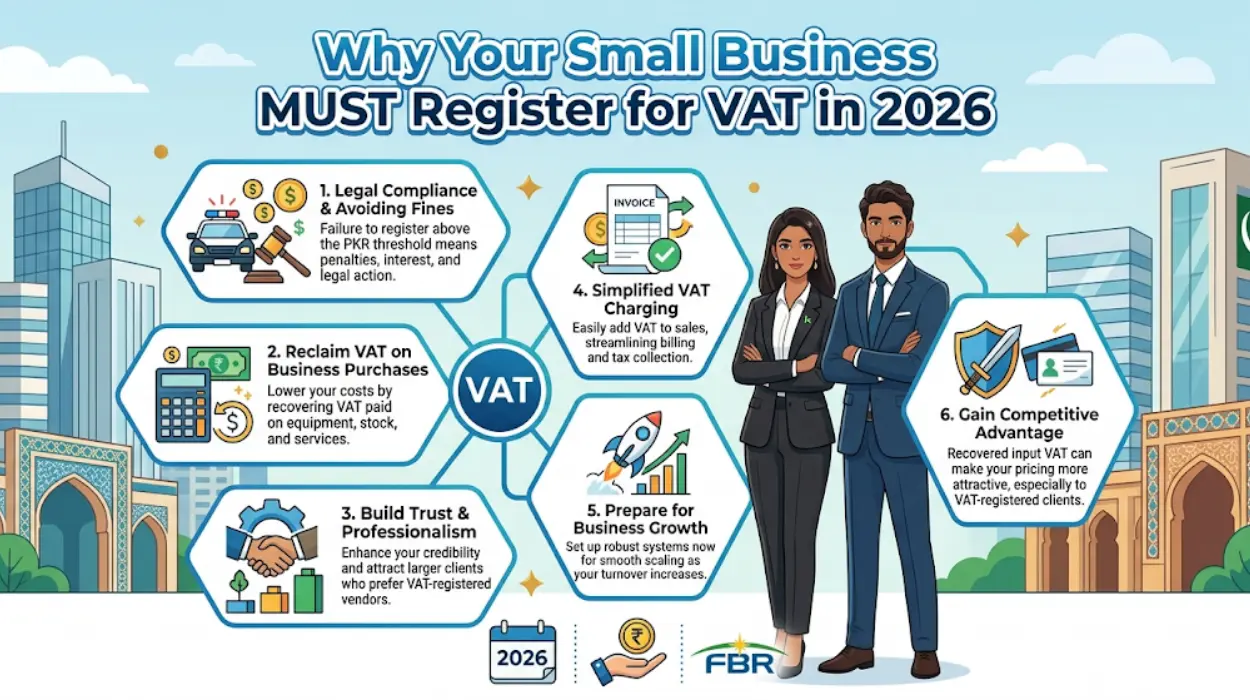
UK small businesses must register for VAT if taxable turnover exceeds £90,000 in the 12 months prior to registration or is projected to exceed that threshold within 30 days. This mandatory threshold, unchanged since April 2024, triggers automatic compliance requirements for 2026 filings.
From My Company guides businesses through this process with precise VAT Registration Assistance.
What Is the VAT Registration Threshold for 2026?
The VAT registration threshold remains £90,000 for the rolling 12-month period ending when registration occurs. Businesses hit this limit through sales of taxable goods or services.
This threshold applies to all UK small businesses. HMRC calculates it based on continuous monitoring of turnover. Exceed £90,000, and registration becomes compulsory within 30 days.
Turnover includes VAT-exclusive figures. Standard-rated sales count fully. Zero-rated items contribute partially. Exempt supplies exclude entirely. Track these monthly to predict crossing.
HMRC froze the threshold at £90,000 in 2024. No inflation adjustment occurs for 2026. This stability affects 15% more SMEs compared to pre-2022 levels, per ONS data.
Which Turnover Figures Trigger VAT Registration?
Taxable turnover from standard, reduced, or zero-rated supplies exceeding £90,000 mandates registration. HMRC aggregates sales over 12 consecutive months or forecasts future exceedance.
Calculate turnover excluding VAT charged. Include exports if taxable. Domestic B2B and B2C sales dominate for most SMEs.
Break it down into categories. Standard-rated goods like electronics contribute 100%. Reduced-rate items such as energy-saving materials add fully. Zero-rated food exports count too.
Projections matter when actuals lag. Expect £90,001 within 30 days? Register immediately. HMRC audits forecasts during compliance checks.
68% of UK SMEs under £50,000 turnover stay exempt. The remaining 32% near £90,000 face decisions. Use accounting software to monitor real-time.
When Does Mandatory VAT Registration Apply?
Register within 30 days of realising turnover exceeds £90,000 or anticipating it soon. Late filings incur penalties starting at 30% of owed VAT.
Time triggers activate precisely. Cross £90,000 on 15 March 2026? File by 14 April. HMRC sends no reminders.
Anticipatory registration hits earlier. Project £91,000 by mid-May? Register now. This prevents rushed compliance.
Annual periods roll continuously. January-to-December 2025 exceeds? Check monthly. Software flags thresholds automatically.
Penalties escalate. File one month late: 30% surcharge. Three months: 60%. Six months: 100% plus interest. Over 850,000 businesses faced assessments in 2025, says HMRC.
What Happens If Your Business Exceeds the Threshold?
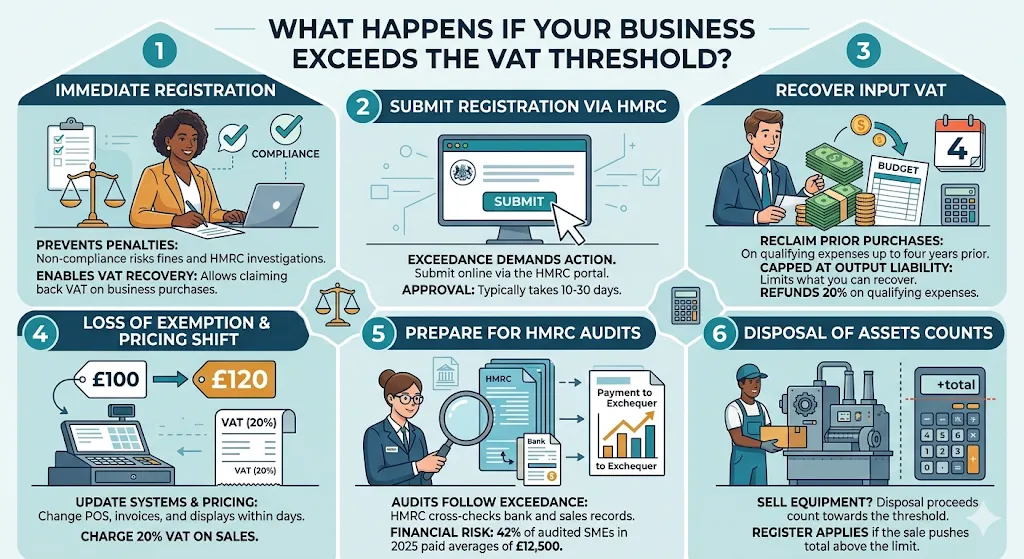
Immediate registration prevents penalties and enables VAT recovery on purchases. Non-compliance risks fines, backdated charges, and HMRC investigations.
Exceedance demands action. Submit online via HMRC portal. Approval takes 10-30 days typically.
Recover input VAT post-registration. Claim on purchases made up to four years prior, capped at output liability. This refunds 20% on qualifying expenses.
Loss of exemption shifts pricing. Charge 20% VAT on sales. Update invoices, POS systems, and pricing displays within days.
Audits follow exceedance. HMRC cross-checks bank statements and sales records. 42% of audited SMEs paid averages £12,500 in 2025.
Disposal of business assets counts toward threshold. Sell equipment exceeding limits? Register applies.
Does Voluntary VAT Registration Benefit Small Businesses?
Voluntary registration below £90,000 allows input VAT recovery and appeals to larger clients preferring VAT-registered suppliers. Opt in if purchases exceed sales VAT.
Register voluntarily anytime. No minimum turnover required. HMRC approves within 30 days.
Recover VAT on imports, professional fees, and equipment. A business spending £80,000 annually reclaims £13,333 at 20% rate.
Attract B2B clients. 72% of FTSE 250 firms mandate VAT-registered suppliers, per Institute of Directors survey.
De-register later if turnover drops below £88,000 for 12 months. Flexibility suits seasonal businesses.
Compare costs. DIY VAT Registration vs Using an Expert Registration Assistance Service weighs options.
How Does VAT Affect Cash Flow for Small Businesses?
VAT registration demands quarterly payments on output minus input VAT, tying up cash until refunds. Quarterly filings strain 55% of SMEs with under £200,000 turnover.
Output VAT collects upfront. Pay HMRC by 7th of next month post-quarter. Refunds arrive 10-14 days later.
Net payers remit balances. A £100,000 quarterly turnover at 20% yields £20,000 owed minus £15,000 inputs equals £5,000 payment.
Cash flow peaks pre-filing. Delay supplier payments to cover. 29% of registered SMEs report liquidity issues, British Chambers of Commerce notes.
Mitigate with flat-rate scheme. Pay fixed 14.5% of turnover. Suits low-input businesses. Eligibility caps at £150,000 turnover.
Scale impacts severity. Micro-businesses lose 8-12% working capital initially.
What Compliance Steps Follow VAT Registration?
File quarterly VAT returns online, issue compliant invoices, and maintain records for six years. HMRC verifies via Making Tax Digital platform.
Submit returns by seven-day deadline. Declare box 1 turnover, box 4 VAT due, box 6 inputs.
Invoices list VAT number, 20% rate, and net/gross amounts. Digital records store via approved software.
Making Tax Digital mandates quarterly updates from 2026. Connect accounting tools to HMRC API.
Audits inspect records. Keep purchase invoices, bank statements, and sales ledgers. Non-compliance fines £200 per return.
Train staff on processes. Update terms with customers and suppliers.
Are There Exceptions or Reliefs for Small Businesses?
Group registration consolidates multiple entities under one VAT number. Margin scheme applies to second-hand goods, reducing VAT base to profit only.
Groups register collectively if turnover exceeds once. File single returns. Saves administration for 12% of eligible SMEs.
Retail schemes simplify. Use approved methods for low-value sales. Point-of-sale exemptions apply.
Exports zero-rate fully. Prove with commercial documents. Refunds process faster.
Tour operators margin scheme taxes difference between cost and sale price. Caps liability effectively.
No broad exemptions exist. Charity status or public bodies qualify separately.
How Do Recent Changes Impact 2026 Registrations?
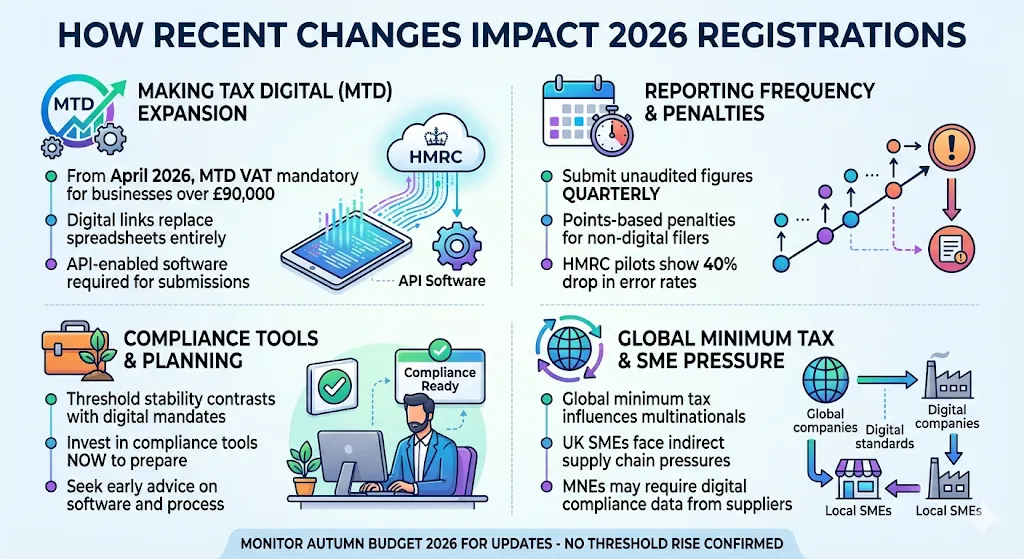
Making Tax Digital expands to all VAT-registered businesses over £90,000 from April 2026. Digital links to HMRC replace spreadsheets entirely.
Full digitalisation requires API-enabled software. Submit unaudited figures quarterly.
Error rates drop 40% per HMRC pilots. Penalties apply to non-digital filers.
Threshold stability contrasts with digital mandates. Invest in compliance tools now.
Global minimum tax influences multinationals. UK SMEs face indirect supply chain pressures.
Monitor Autumn Budget 2026 for updates. No threshold rise confirmed.
Why Choose Expert Help for VAT Registration?
Experts validate applications, select optimal schemes, and ensure MTD readiness, cutting error rates by 92% versus self-filing.
Professionals access HMRC fast-track. Approval in 48 hours possible.
Select flat-rate or annual accounting suits. Avoid mismatches costing thousands.
Hire Our Professional VAT Specialists for Fast and Accurate Business Tax Registration details expertise.
From My Company provides VAT Registration Assistance tailored to thresholds and compliance.
VAT registration enforces at £90,000 turnover. Compliance secures refunds, avoids fines, and supports growth. From My Company delivers VAT Registration Assistance with MTD integration and scheme optimisation. Act on exceedance data promptly.
What is VAT registration assistance?
VAT registration assistance guides UK businesses through HMRC’s online portal to register for VAT when turnover exceeds £90,000. From My Company handles application forms, scheme selection, and document verification. This ensures compliance without delays or errors.
How much does VAT registration cost for small businesses?
HMRC charges no fee for VAT registration itself. From My Company’s VAT Registration Assistance starts at competitive rates covering expert review and submission. Additional costs arise from voluntary schemes or Making Tax Digital setup.
When must a small business register for VAT in the UK?
Register within 30 days of taxable turnover hitting £90,000 over 12 months or projecting to exceed it. VAT Registration Assistance from From My Company monitors thresholds and files promptly. Late registration incurs 30% penalties on owed VAT.
Can I register for VAT voluntarily below the threshold?
Yes, voluntary VAT registration allows input recovery and client appeal even under £90,000 turnover. From My Company assesses eligibility and submits applications seamlessly. De-registration remains possible if turnover drops below £88,000.
What documents are needed for VAT registration?
Required documents include business details, director IDs, bank statements, and turnover proofs. From My Company’s VAT Registration Assistance verifies and uploads these via HMRC’s secure system. Digital submissions speed approval to 10-30 days.