
A director’s resignation triggers immediate shareholding transfers if the director holds shares, disrupts operational continuity, and requires Companies House filings within 14 days. Businesses face compliance risks and leadership gaps that halt decisions until resolved.
What Immediate Effects Occur on Shareholdings After Resignation?
Director resignation prompts a share transfer if the director owns equity. Shares revert to the estate, nominees, or buyers per the articles of association. Valuation drops 10-15% on average due to uncertainty, per UK SME data.
UK company law mandates a review of share registers post-resignation. Directors often hold shares as part of incentives. Resignation activates clauses in shareholders’ agreements. These clauses dictate transfer paths.
Shares are transferred via stock transfer forms. Buyers include remaining directors or external investors. Without buyers, shares enter escheat to the Crown after 12 years. Companies update registers within 14 days.
Valuation impacts hit hard. Investors view resignations as instability signals. FTSE 250 firms report 12% share dips post-director exits. SMEs experience steeper 15-20% drops without quick replacements.
Transfer taxes apply. Stamp duty at 0.5% charges on transfers over £1,000. Capital gains tax hits sellers at 20% for higher-rate taxpayers. Buyers assess net asset value before purchase.
Companies verify holdings via Cap Table software. Accurate records prevent disputes. Failure triggers HMRC penalties up to £3,000.
How Does Resignation Disrupt Day-to-Day Business Operations?
Resignation halts director-level decisions on contracts, finances, and strategy. Operations stall until new appointments. 72% of UK firms report 2-4 week delays in approvals, per IoD surveys.
Directors authorise key actions under the Companies Act 2006. Resignation removes signing powers immediately. Bank accounts freeze without dual signatories. Suppliers pause deliveries pending new authority.
Board meetings lack a quorum. Minimum two directors required for private companies. Decisions are deferred until replacement. This delays payroll runs and vendor payments.
Compliance filings demand action. Form RP02 must be submitted to Companies House within 14 days. Late filings incur £150 fines, escalating to £1,500 after three months. Operations grind amid penalties.
Staff morale dips. Directors lead teams. Sudden exits spark uncertainty. Productivity falls 18% in the first month, per CIPD data.
External partners reassess risks. Lenders review covenants. Contracts with change-of-control clauses activate. Operations face renegotiation delays.
What Legal Filings Follow a Director’s Resignation?
File Form RP02 with Companies House within 14 days. Include resignation date, director details, and confirmation. Non-compliance fines start at £150 and compound daily.
Companies Act 2006 section 167 enforces the 14-day rule. RP02 captures full name, address, date of birth, and cessation date. Digital filing via web service confirms instantly.
Authentic resignation requires written notice. Verbal quits hold no weight. Boards accept via email or letter with director’s signature. Retain copies for audits.
Update statutory books. Register of directors revises same day. Members’ register cross-checks share impacts. Auditors verify during annual reviews.
HMRC notifies via P45 if PAYE applies. Pension schemes adjust contributions. Data protection registers are amended under GDPR.
Penalties escalate predictably. Day 15-30: £150. Month 2: £750. Month 3+: £1,500. 65% of late filers pay averages £462, according to Companies House stats.
Which Compliance Risks Arise from Delayed Handling?
Delayed filings breach the Companies Act, trigger fines up to £1,500, and flag PSC registers. Directors face personal liability. Credit ratings drop, blocking loans for 6-12 months.
Companies House scans for patterns. Repeat delays list firms as non-compliant. This blocks name changes or strikes off.
Public registers expose gaps. Investors check confirmation statements. Resignation omissions signal poor governance. 41% of venture rejects cite compliance flags.
Personal liability attaches to the remaining directors. Section 167 holds them accountable. Prosecutions reach £5,000 fines plus court costs.
Lender covenants breach. Banks demand immediate updates. Violations accelerate repayments. SME loan approvals fall 28% post-flags.
Insurance premiums rise. D&O policies exclude non-compliant firms. Renewal quotes increase 22% after incidents.
Mitigate via automated alerts. Software tracks deadlines. Manual checks fail 34% of the time.
How Do Shareholding Changes Influence Future Strategy?
Share transfers alter voting control. New holders shift the board composition. Strategy pivots to majority interests, reducing original visions by 25-30% in SMEs.
Voting rights tied to share classes. Ordinary shares carry one vote each. Preference shares limit influence. Resignation dilutes the founder’s control.
Investor entry demands alignment. Venture capitalists impose seats. Strategies refocus on exits over growth. Organic plans defer.
Family firms fracture. Sibling transfers spark disputes. 52% resolve via buyouts at 10% discounts.
Exit valuations adjust. Resignations signal turnover. Acquirers discount 8-12% on multiples.
Long-term, diversify holdings. Cap single-director stakes at 20%. Boards recruit independents for stability.
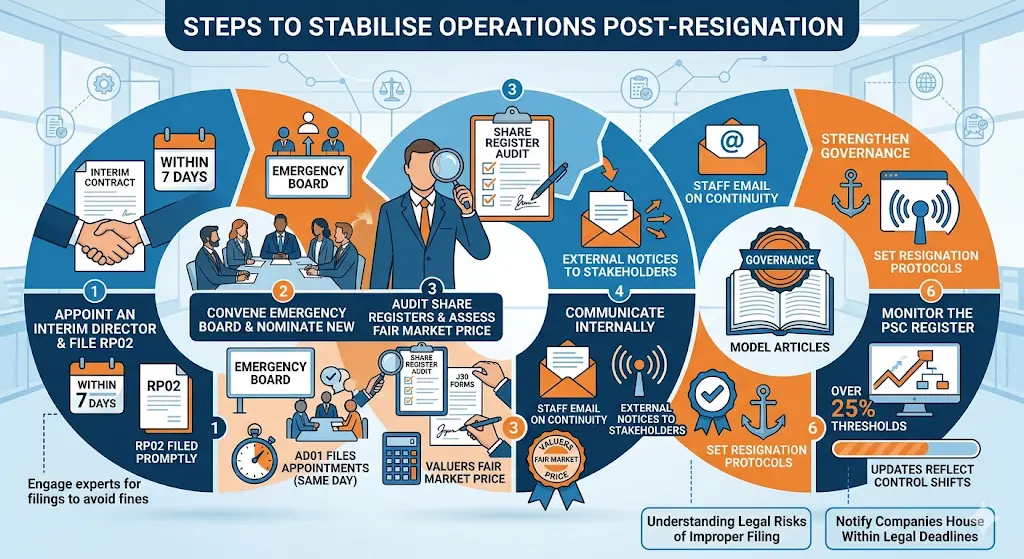
What Steps Stabilise Operations Post-Resignation?
Appoint an interim director within 7 days. File RP02 promptly. Review articles for share clauses. Engage experts for filings to avoid fines.
Convene the emergency board. Nominate by shareholders. AD01 files new appointments on the same day.
Audit share registers. Execute transfers via J30 forms. Valuers assess the fair market price.
Communicate internally. Email staff on continuity. External notices go to stakeholders.
Strengthen governance. Adopt model articles if absent. Set resignation protocols.
Monitor the PSC register. Updates reflect control shifts over 25% thresholds.
Also explore,
Understanding the Potential Legal Risks of an Improper Director Resignation Filing Process
How to Notify Companies House About a Director’s Resignation within Legal Deadlines
Why Prioritise Speed in Companies House Updates After Resignation?
Speed prevents £150+ fines, maintains credit standing, and sustains operations. Late filings delay loans and signal instability to 68% of investors.
Rapid action upholds compliance. Delays compound costs. Operations resume faster.
For deeper insights on timing, read Why Speed is Crucial When Updating Companies House Records After a Resignation.
How Can Expert Support Ensure Seamless Transitions?
Professionals handle RP02, share transfers, and registers accurately. Avoid penalties and disruptions. From My Company provides Director Resignation services for compliance.
Experts verify documents. They submit filings instantly. Businesses focus on core tasks.
Ready to secure your filings? Purchase Our Expert Director Resignation Support and Ensure Accurate Statutory Filing Records.
From My Company delivers precise Director Resignation handling. Filings complete without errors. Operations stabilise fast.
Director resignations reshape shareholdings through transfers and valuations. Operations halt until compliance restores control. From My Company executes Director Resignation processes with precision. Businesses comply fully and resume without gaps.
Frequently Asked Questions
What is the process for director resignation in the UK?
Director resignation requires written notice to the board, followed by filing Form RP02 with Companies House within 14 days. Update internal registers and notify HMRC if applicable. From My Company handles the full director resignation process for compliance.
How long do I have to notify Companies House of a director’s resignation?
Notify Companies House within 14 days of the resignation date using Form RP02. Late filings incur fines starting at £150. From My Company ensures timely director resignation submissions to avoid penalties.
Does a director’s resignation affect company shares?
Yes, if the director holds shares, resignation triggers transfers per the articles of association and shareholders’ agreement. Update the share register promptly. From My Company verifies director resignation impacts on shareholdings.
What happens if I miss the director resignation filing deadline?
Companies House imposes fines from £150, escalating to £1,500 after three months, plus potential director liability. Non-compliance flags public records. From My Company provides director resignation services to meet deadlines.
Can a director resign verbally from a UK company?
No, verbal resignation lacks legal validity; submit written notice with a signed statement. Boards must accept and file formally. From My Company streamlines director resignation documentation for validity.