
A dormant company remains ready for future trading by maintaining strict annual compliance, filing dormant accounts on time, keeping statutory records updated, and monitoring Companies House status. This ensures instant reactivation without penalties, delays, or legal risks when business activity resumes.
What does it mean to keep a dormant company “ready” for trading?
Keeping a dormant company ready means maintaining legal compliance, preserving accurate records, and ensuring immediate eligibility to resume transactions without regulatory delays. It involves annual filings, status monitoring, and preventing unauthorised activity that could invalidate dormant status.
A dormant company is inactive in trading but remains legally active. Companies House expects annual filings even when no transactions occur. Failure to comply results in penalties or removal from the register.
Readiness focuses on continuity. When directors maintain proper filings and records, the company can start trading within days. There is no need for re-registration or structural changes.
Three readiness components define compliance:
- Maintain statutory records such as director details and registered office
- File annual dormant accounts within deadlines
- Monitor Companies House status for accuracy and updates
Each action protects the company’s legal standing. Without these, reactivation becomes complex and costly.
Why is annual compliance essential for dormant companies?
Annual compliance ensures a dormant company remains legally active, avoids penalties, and retains its registration with Companies House. It confirms inactivity status while preserving the company’s structure for immediate business use when trading resumes.
Dormant status does not remove reporting obligations. Companies House requires confirmation that no significant accounting transactions occurred during the financial year.
Dormant accounts filing serves two functions:
- Confirms inactivity
- Keeps the company on the official register
Missing deadlines triggers automatic penalties. In the UK, late filing fines start at £150 and increase to £1,500 for repeated delays. Persistent non-compliance leads to the company being struck off. Compliance also safeguards the company name. Once dissolved, the name becomes available for others to register. Maintaining filings protects brand identity and future use.
Businesses that prioritise compliance reduce reactivation time. They also avoid administrative corrections, which often delay the resumption of trading.
How do you file accounts for a dormant company correctly?
Dormant company accounts are filed by submitting simplified financial statements to Companies House, confirming that no significant transactions occurred. This process includes balance sheet preparation, director approval, and timely submission before statutory deadlines to maintain compliance.
The filing process follows a defined structure. Accuracy is essential because incorrect submissions can trigger compliance checks.
Key steps include:
- Prepare a dormant balance sheet showing issued share capital
- Obtain the director’s approval and signature
- Submit accounts digitally via Companies House or an authorised service
Using a structured service simplifies this process. Businesses can ensure accuracy and compliance by using professional support, such as the File Accounts for Dormant Companies service available. This approach reduces errors and ensures deadlines are met. It also creates a documented compliance trail, which is useful during audits or reactivation.
What records must be maintained during dormancy?
Dormant companies must maintain statutory registers, director information, and confirmation statements while ensuring no financial transactions occur. These records validate compliance and support smooth reactivation without regulatory complications or inconsistencies.
Even without trading, companies must maintain core records. These documents define legal identity and ownership.
Essential records include:
- Register of directors and shareholders
- Confirmation statement (filed annually)
- Registered office address
- Persons with Significant Control (PSC) register
Each record must remain accurate. If a director changes address or a shareholder transfers ownership, updates must be filed promptly.
Accuracy matters because discrepancies trigger compliance checks. When Companies House identifies inconsistencies, it may request clarification or impose restrictions. Maintaining records also speeds up reactivation. Businesses avoid delays because all required data is already verified and current.
How can you prevent losing dormant status unintentionally?
Dormant status is preserved by avoiding any significant accounting transactions, including bank activity, payments, or income. Even minor financial movements can invalidate dormancy and trigger full accounting and tax obligations immediately.
Dormant status is strict. Companies lose this status when financial activity occurs, even unintentionally.
Three common triggers include:
- Bank account transactions such as fees or interest
- Payments for services or subscriptions
- Receipt of income or investments
When these occur, the company becomes active. This requires full accounts, Corporation Tax registration, and HMRC reporting.
Preventive actions include:
- Close or freeze business bank accounts
- Monitor automated charges or subscriptions
- Avoid issuing or receiving invoices
Directors must actively monitor activity. Passive oversight leads to compliance breaches.
When should a dormant company prepare for reactivation?
A dormant company prepares for reactivation when business opportunities emerge, funding becomes available, or operational planning begins. Preparation includes updating records, registering for taxes, and ensuring compliance history is complete and accurate.
Timing matters because delays affect revenue opportunities. Preparation ensures immediate operational readiness.
Reactivation preparation includes:
- Register for Corporation Tax with HMRC
- Update SIC codes to reflect business activity
- Notify Companies House of the status change
- Open or reactivate business bank accounts
A compliant dormant history simplifies this transition. Companies with complete filings face fewer checks and approvals. Businesses that delay preparation often encounter administrative bottlenecks. These include verification delays and incomplete documentation.
What risks arise from poor dormant company management?
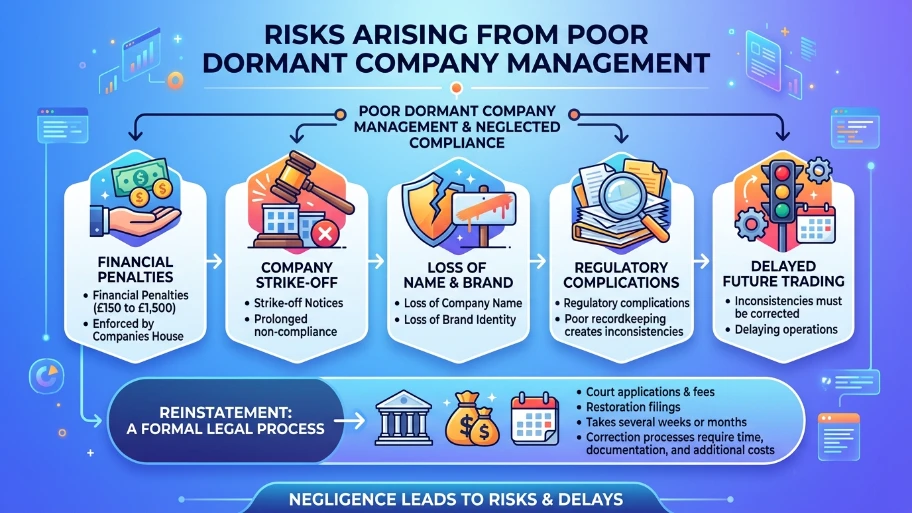
Poor management leads to penalties, company strike-off, loss of name rights, and regulatory complications. It also delays future trading because reinstatement or correction processes require time, documentation, and additional costs.
Dormant companies face risks when compliance is neglected. Companies House enforces strict filing requirements.
Key risks include:
- Financial penalties ranging from £150 to £1,500
- Strike-off notices after prolonged non-compliance
- Legal complications during reinstatement
- Loss of company name and brand identity
Reinstatement is a formal legal process. It involves court applications, fees, and restoration filings. This process often takes several weeks or months. Poor recordkeeping also creates inconsistencies. These must be corrected before trading resumes, delaying operations.
How does professional support improve dormant company readiness?
Professional compliance services ensure accurate filings, deadline tracking, and continuous monitoring of company status. This reduces administrative burden, eliminates errors, and keeps the company fully prepared for immediate reactivation when needed.
Managing dormant compliance manually increases risk. Filing errors and missed deadlines are common without structured oversight.
Professional services provide:
- Automated deadline tracking
- Accurate preparation of dormant accounts
- Real-time compliance monitoring
- Documented audit trails
For deeper insight into maintaining compliance over time, review this guide on keeping dormant status secure with professional annual compliance monitoring. This approach improves reliability. It also allows directors to focus on strategic planning rather than administrative tasks.
Explore our File Accounts for Dormant Companies guides,
Why Late Filing Penalties Apply Even if Your Company Has Never Traded
The Legal Definition of Significant Accounting Transactions for Your Dormant Business Entity
When is it best to outsource dormant company filings?
Outsourcing becomes effective when directors want consistent compliance, reduced administrative workload, and zero filing errors. It is especially valuable for businesses managing multiple entities or planning future trading activation.
Outsourcing eliminates repetitive tasks. It also ensures filings meet regulatory standards.
Businesses benefit when:
- Managing multiple dormant entities
- Lacking in-house compliance expertise
- Preparing for future expansion or trading
Professional handling ensures continuity. It also prevents oversight gaps that occur with manual processes. For companies seeking a complete solution, this resource explains how to handle your entire dormant company filing process from start to finish.
At this stage, decision-making focuses on reliability and efficiency rather than cost alone.
From My Company delivers structured compliance support tailored to dormant entities. From My Company ensures filings meet Companies House standards while maintaining readiness for future trading. From My Company also provides ongoing monitoring, which reduces compliance risk significantly.
Keeping a dormant company ready for future trading depends on consistent compliance, accurate records, and proactive monitoring. Annual filings, status verification, and transaction control ensure the company remains legally active and operationally prepared.
Professional support strengthens this process by reducing risk and ensuring precision. From My Company provides a structured approach to dormant compliance, enabling businesses to transition smoothly from inactivity to full trading without delays or penalties.
Frequently Asked Questions
What does it mean to file accounts for a dormant company?
Filing accounts for a dormant company means submitting simplified financial statements to Companies House, confirming no significant transactions occurred. The File Accounts for Dormant Companies service ensures these filings meet UK compliance standards and deadlines.
Do dormant companies need to file accounts every year?
Yes, dormant companies must file accounts annually with Companies House even if no trading activity occurs. From My company helps maintain compliance by managing yearly filing requirements accurately and on time.
What happens if dormant company accounts are filed late?
Late filing results in automatic penalties ranging from £150 to £1,500 depending on delay length. Using a structured File Accounts for Dormant Companies service reduces the risk of missed deadlines and financial penalties.
Can I file dormant company accounts myself?
Directors can file dormant accounts directly through Companies House using online forms. However, many businesses use From My company to ensure accuracy, avoid errors, and maintain a consistent compliance record.
What information is required to file dormant company accounts?
Required details include a dormant balance sheet, company registration number, and director approval. The File Accounts for Dormant Companies process verifies these elements to ensure correct and compliant submission.