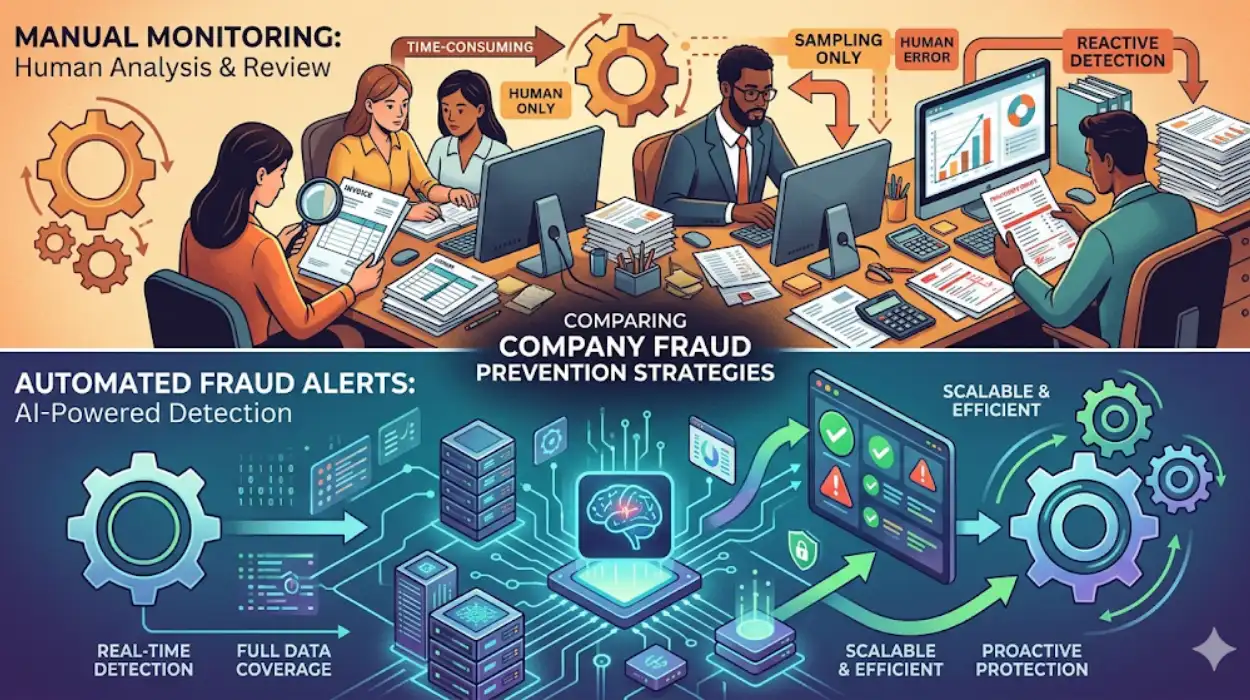
Manual monitoring relies on people periodically checking records for suspicious changes, while automated company fraud alerts use software to track those records in real time and flag risks instantly. For UK businesses, automated alerts usually offer faster detection, better scalability and lower long‑term risk than relying on manual checks alone.
Why Fraud Monitoring Matters for UK Companies
Company identity theft and corporate record fraud are now established threats in the UK business environment, particularly via changes filed at Companies House. Criminals may change a company’s registered office, directors, or persons with significant control (PSC), then use those altered records to open bank accounts, obtain credit, redirect payments or impersonate the business in contracts. This type of fraud can damage cash flow, supply chain relationships and credit ratings long before the legitimate directors notice what has happened.
Fraud Protection services give businesses a structured way to monitor these risks, combining process, technology and clear escalation routes to protect company records. Brand owners and directors are increasingly expected by lenders, insurers and investors to show that they have proactive controls in place, not just reactive clean‑up plans after a fraud incident. For a brand like Form My Company, the objective of Fraud Protection is to provide continuous oversight of Companies House records so that suspicious changes are identified and escalated before they can be exploited in the wider financial system.
What Is Manual Company Fraud Monitoring?
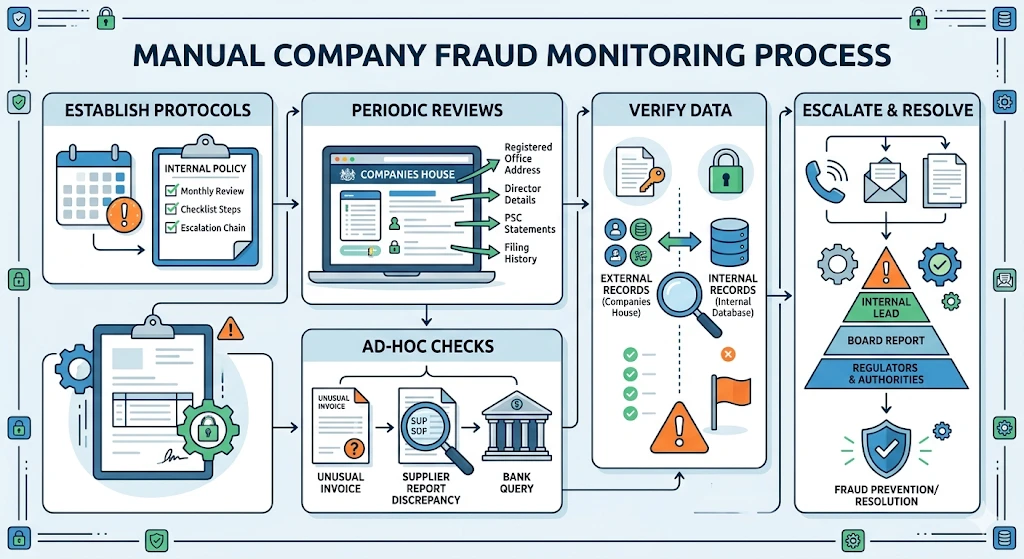
Manual monitoring means that directors, in‑house staff or advisers periodically log into Companies House and other systems to review company records for unexpected changes. In a UK context, that usually includes checking the registered office address, director details, PSC statements, filing history and key documents such as confirmation statements or special resolutions. The process depends on someone remembering to run these checks, interpreting what they see, and escalating concerns to banks, suppliers or regulators when something looks wrong.
This approach can be partially formalised with internal policies, checklists and calendar reminders. For example, a business might require the company secretary to review Companies House records monthly, compare them with internal records and report to the board if any non‑authorised filings are detected. Manual monitoring can also involve ad‑hoc checks when an unusual invoice arrives, a bank queries a transaction, or a supplier reports conflicting information about the company’s registered details.
Advantages of Manual Monitoring
Manual monitoring has some specific strengths for smaller or less complex companies. It can be very targeted, with human reviewers applying contextual knowledge about the business, shareholders and normal transaction patterns. Where there are relatively few corporate changes each year, directors may feel confident that they can personally sign off every filing and spot anomalies simply by reviewing the public record.
It also appears cost‑effective at first glance because it avoids subscription fees for specialised tools. For micro‑entities and newly formed companies, this can make manual reviews seem like a reasonable starting point. Human oversight can also identify subtle context issues that automated systems may not yet be configured to flag, such as a change that is technically valid but inconsistent with the agreed strategy or shareholder expectations.
Limitations and Risks of Manual Monitoring
However, manual monitoring is inherently limited by time, capacity and human error. Reviews are typically carried out weekly, monthly or even less frequently, which creates a gap between a fraudulent filing being accepted at Companies House and the business noticing the change. During that gap, fraudsters can use the altered records to open accounts, apply for credit or redirect legitimate payments, increasing the eventual cost and complexity of remediation.
Humans are also more likely to overlook anomalies when reviewing repetitive information, especially if they are balancing fraud checks with other responsibilities. If a company manages multiple entities, SPVs or group structures, the volume of records to review grows quickly and the likelihood of missing a fraudulent change increases. In practice, manual monitoring often becomes reactive, with issues discovered only after a bank flags unusual activity or a counterparty reports a discrepancy.
What Are Automated Company Fraud Alerts?
Automated company fraud alerts use software to monitor official corporate records and send notifications whenever specific changes occur. For UK businesses, this typically focuses on Companies House data but can also extend to related data sources, depending on the Fraud Protection service in use. Automation continuously tracks key attributes such as registered office address, directors, PSCs, filing of charges, or changes to company status, then generates alerts when new or unexpected events match predefined risk rules.
From a control perspective, automated monitoring converts a periodic manual task into a continuous background process. Fraud Protection platforms can analyse updates in near real time, compare them against known patterns for the company, and prioritise genuinely risky changes for human review. This is consistent with wider trends in compliance and fraud risk management, where automated and AI‑assisted tools are increasingly used to provide real‑time monitoring, reduced error rates and better scalability across large data sets.
Advantages of Automated Alerts for Fraud Protection
Automated fraud alerts deliver several structural advantages compared with manual monitoring. They provide real‑time or near real‑time detection, shrinking the window in which criminals can exploit fraudulent filings. By processing updates programmatically, automated systems apply consistent rules to every change and avoid the fatigue that human reviewers experience when scanning similar records repeatedly. Studies of AI‑driven compliance and fraud monitoring generally report lower error rates, better pattern recognition and improved handling of high‑volume data when automation is deployed alongside human oversight.
Automation also scales more effectively as a business’s corporate footprint grows. A company can monitor multiple UK entities, dormant companies or subsidiaries without linearly increasing the amount of staff time needed for checks. Automated Company Fraud Alerts can centralise monitoring into a single dashboard, triaging alerts so that only higher‑risk events require detailed human investigation. Over time, this can reduce operational cost by minimising routine manual reviews and concentrating expert attention on genuinely suspicious activity.
Key Differences: Manual vs. Automated Fraud Monitoring
For a mid‑funnel (MOFU) audience evaluating Fraud Protection, it helps to see how manual monitoring and automated fraud alerts differ across practical dimensions. The table below summarises the core contrasts that matter for UK company directors and finance teams.
| Dimension | Manual Monitoring | Automated Company Fraud Alerts |
|---|---|---|
| Detection speed | Periodic checks (days or weeks after changes) | Near real‑time monitoring of Companies House updates |
| Accuracy | Dependent on human attention, prone to oversight | Consistent rule‑based checks, lower error rates |
| Scalability | Difficult across many entities or complex groups | Scales across multiple companies with minimal extra effort |
| Cost pattern | Low initial cost, rising staff time over time | Subscription or service fee offset by reduced manual workload |
| Risk exposure | Longer window for fraudsters to exploit changes | Shorter exploitation window, earlier containment |
| Auditability | Informal logs or ad‑hoc records | Structured logs of alerts, reviews and actions |
This comparison shows that manual monitoring may still be viable for very small, low‑risk entities, but its structural limitations become pronounced as transaction volumes, stakeholder expectations and regulatory scrutiny increase. Automated Company Fraud Alerts align better with expectations from banks and enterprise partners that sensitive data and corporate identities are monitored continuously rather than periodically.
Where Manual Monitoring Still Fits
Manual monitoring is not obsolete; it plays a complementary role even when automated Company Fraud Alerts are in place. Human review remains essential for interpreting alerts, confirming whether a change is authorised and deciding what remediation steps are appropriate. For example, a Fraud Protection system might flag a change in the registered office address; a director or company secretary still needs to verify whether the change was properly instructed, documented and aligned with internal approvals.
In some early‑stage companies, manual monitoring can also serve as a transitional control until the business puts a more structured Fraud Protection solution in place. Founders may initially rely on manual checks while they are close to every transaction and decision. As the company grows, takes on external investment or starts dealing with larger banks and suppliers, those stakeholders often expect a documented, automated fraud monitoring framework as part of the wider governance environment.
How Automated Alerts Support Governance and Compliance
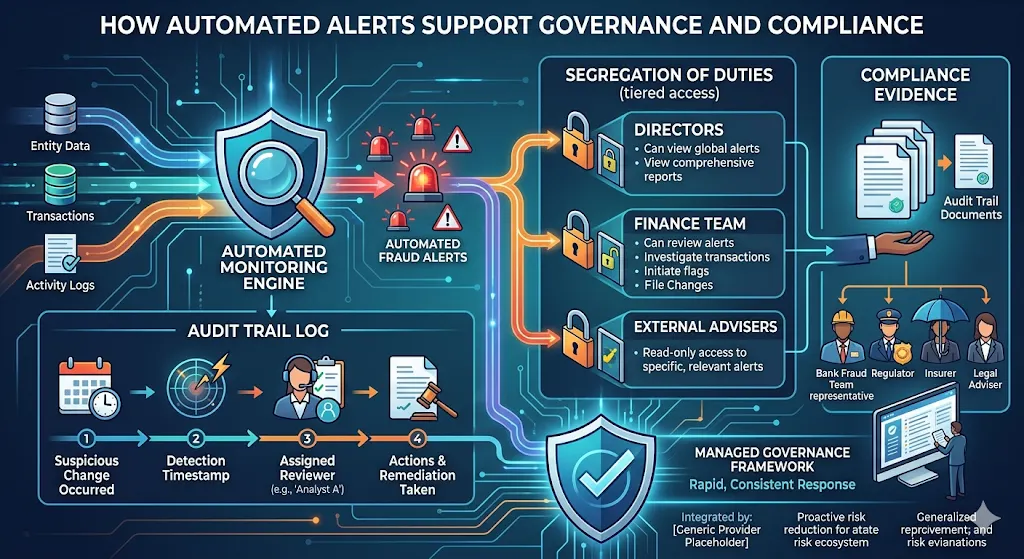
Automated Company Fraud Alerts contribute directly to stronger corporate governance and compliance. They create a clear audit trail showing when a suspicious change occurred, when it was detected, who reviewed it and what action was taken. This can be useful evidence when dealing with banks’ fraud teams, insurers, professional advisers or regulators. In an environment where the cost of non‑compliance, data breaches and fraud incidents is high, being able to demonstrate proactive monitoring can influence decisions on credit, insurance cover and partnership eligibility.
Automated monitoring also supports segregation of duties. Companies can allocate different levels of access for directors, finance teams and external advisers, allowing each group to see relevant alerts without giving everyone the ability to file changes. This helps reduce insider risk and aligns with best practices for internal controls. When a Fraud Protection provider such as Form My Company integrates these features into a managed service, clients gain both the technology and the governance framework needed to respond rapidly and consistently when suspicious activity is detected.
Connecting Monitoring to Broader Fraud Protection
Company record monitoring is one layer within a broader Fraud Protection strategy. Businesses also need to manage risks around supplier onboarding, payment redirection, cyber‑enabled impersonation and data breaches. AI‑enabled fraud detection agents and automated account validation tools are increasingly used to complement company‑level monitoring, providing real‑time checks on bank details, transaction patterns and counterparties. The most resilient strategies combine these tools into a unified fraud‑risk architecture so that alerts from different domains are connected rather than handled in isolation.
For UK SMEs, one of the most practical steps is to treat Companies House records as a critical asset, not a background compliance obligation. This aligns with the themes explored in more introductory content such as the informational, topic‑focused discussion of how UK company identity theft can destroy a small business, which explains how seemingly minor changes to public records can lead to serious operational and financial damage. As businesses move further down the funnel from awareness to consideration, they typically begin comparing specific Fraud Protection options based on their ability to deliver 24/7 monitoring, clear escalation paths and measurable reductions in fraud‑related disruption.
How Form My Company Positions Its Fraud Protection
Form My Company frames its Fraud Protection service as a professional, structured solution for safeguarding Companies House records and related corporate details. Rather than expecting clients to design their own monitoring framework, the service bundles automated alerts, clear workflows and expert support into a single offering. This enables directors and finance leaders to focus on core operations while knowing that company identity risks are being monitored in the background on a continuous basis.
For mid‑funnel readers, the key evaluation point is whether a service‑focused, outcome‑oriented Fraud Protection solution will reduce risk and effort more effectively than a purely manual approach. Form My Company’s positioning emphasises that proactive monitoring of Companies House and related records can prevent many of the downstream issues described in awareness‑stage content, and that moving to an always‑on, decision‑focused protection model is often more efficient than scaling up in‑house manual checks as the business grows.
To get more information also explore, Get 24/7 Fraud Protection for Your Companies House Records.
Comparing manual monitoring with automated company fraud alerts shows that both approaches have a place, but they are not equal in terms of speed, scalability and overall risk reduction. Manual checks can provide valuable context and oversight, especially in very small or simple structures, yet they struggle to keep pace with the volume and sophistication of modern corporate identity fraud. Automated Company Fraud Alerts, delivered as part of a structured Fraud Protection service, offer continuous monitoring, clearer audit trails and the ability to respond more quickly when something goes wrong.
Form My Company’s Fraud Protection offering is designed to help UK businesses make that transition from ad‑hoc manual reviews to professional, technology‑enabled monitoring of Companies House records. By combining automation with human expertise, the service aims to give directors confidence that their company identity is being actively protected, supporting better governance, smoother bank and supplier relationships, and more resilient growth.
What is Fraud Protection from Form My Company?
Fraud Protection from Form My Company is a monitoring service that tracks changes to Companies House records, such as director details, registered addresses, and persons with significant control. It sends automated alerts to detect unauthorised filings early, helping UK businesses prevent identity theft and corporate fraud. This service ensures proactive oversight without requiring constant manual checks.
How does Fraud Protection detect company fraud?
Fraud Protection continuously scans Companies House updates against predefined risk rules, flagging suspicious changes like unauthorised director appointments or address alterations. It uses real-time monitoring to identify anomalies faster than manual reviews, reducing the window for fraudsters to exploit altered records. Businesses receive prioritised notifications for quick investigation and response.
What are the benefits of automated fraud alerts over manual monitoring?
Automated fraud alerts provide near real-time detection and scalability across multiple companies, unlike manual monitoring which relies on periodic human checks prone to oversight. They lower error rates, create audit trails, and minimise staff time, making them ideal for growing UK businesses managing Companies House compliance. Form My Company’s Fraud Protection combines this with expert escalation support.
Can Fraud Protection prevent Companies House identity theft?
Fraud Protection helps prevent Companies House identity theft by monitoring key record changes and alerting users before fraudsters can use falsified details for loans, payments, or contracts. While no system guarantees absolute prevention, early detection allows businesses to rectify issues swiftly with Companies House and affected parties. Form My Company’s service focuses on high-risk updates for maximum protection.
How much does Fraud Protection from Form My Company cost?
Pricing for Fraud Protection from Form My Company varies based on the number of companies monitored and specific features like alert frequency or multi-entity coverage. It typically offers subscription plans that offset costs through reduced fraud risks and manual effort. Contact Form My Company directly for tailored quotes suited to UK business needs.