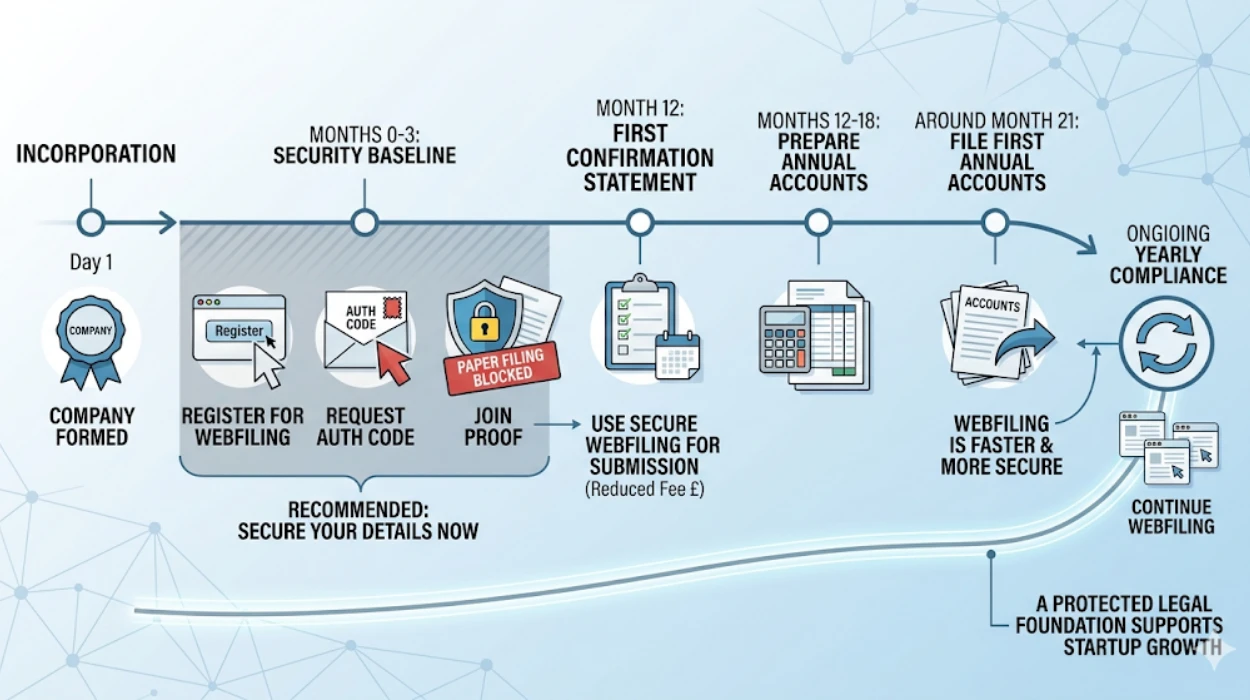
Companies House Webfiling protection is essential for startups because it significantly reduces the risk of corporate hijack and unauthorised changes to your company’s official records. It protects your business identity, your governance, and your stakeholder trust at the exact moment you are most vulnerable: early growth.
For UK startups, your Companies House listing is effectively your legal identity card. When that identity can be accessed and updated online, it becomes a target for fraudsters who understand how to exploit weak controls, inattentive founders, and hurried filing practices. Webfiling protection, combined with disciplined governance processes and secure meeting environments such as Interview Rooms, is now a core part of operating a credible and resilient company.
Understanding Companies House Webfiling and Protection
Companies House Webfiling is the online system that allows you to file accounts, confirmation statements, director and shareholder changes, and other statutory forms for your UK limited company. It is the default way most startups manage statutory compliance, because it is faster and more convenient than paper submissions.
Webfiling protection refers to the security controls and fraud-prevention measures that protect this channel from abuse. This includes secure authentication codes, digital authorisation processes, and optional anti‑fraud schemes designed to prevent unauthorised paper filings or rogue online submissions. For an early‑stage company, these measures are not just administrative preferences; they are a front‑line defence against corporate identity theft.
Startups are particularly exposed because founders often delegate filings informally, share credentials casually, or leave changes in company structure undocumented. If someone obtains your authentication code or exploits gaps in your governance process, they can alter the registered office, appoint or remove directors, or change significant control details without your knowledge. Webfiling protection, backed by clear internal controls, ensures that every change to your legal record can be traced, verified, and challenged where necessary.
Why Webfiling Protection Matters So Much for Startups
Corporate identity is a core asset
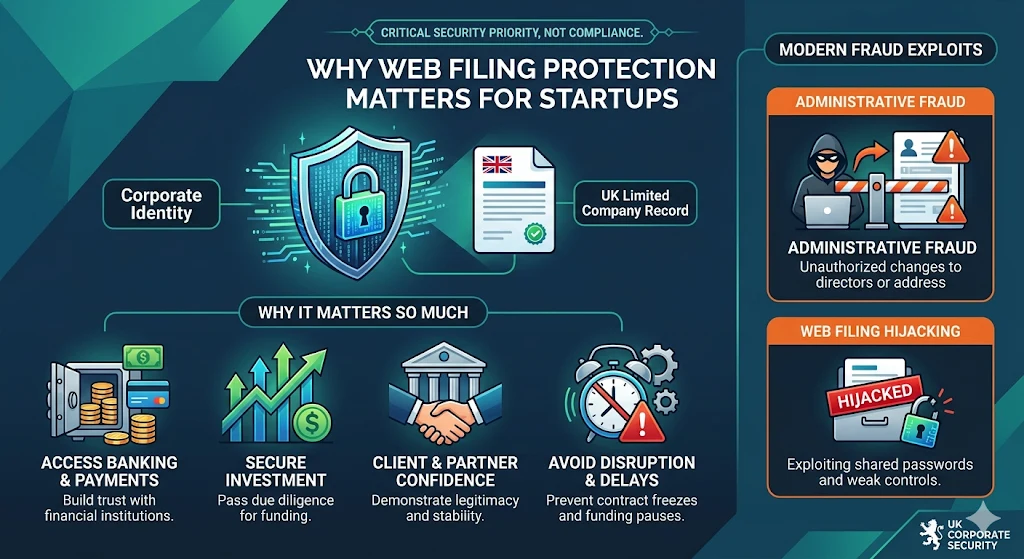
In the early stages, a UK limited company’s most valuable asset is often its identity: its name, registration number, and clean filing history. That identity underpins:
- Access to business banking and payment processors
- Trust from investors and lenders
- Confidence from clients, partners, and suppliers
If your company record is hijacked, a fraudster can create new bank or merchant accounts, issue invoices, or sign agreements using your registered details. Even if you eventually reverse the changes, the presence of suspicious filings or director movements can raise questions during due diligence and slow down funding or major contracts.
Fraud is increasingly sophisticated and administrative
Modern corporate fraud does not always involve dramatic hacks or forged passports. Often it exploits ordinary administrative processes. For example, a fraudster might request or intercept your authentication code, then file a change of registered office or director details that look plausible on the surface. This kind of fraud is particularly dangerous because it can remain invisible to founders who only check Companies House occasionally.
Webfiling protection is essential because it forces you to treat your corporate records as security‑sensitive data, not just compliance paperwork. By tightening control over who can file, how they access the system, and how changes are reviewed, you greatly reduce the window of opportunity for bad actors.
Startups move fast and create gaps
High‑growth ventures thrive on speed, but that same speed can leave compliance processes behind. Frequent director appointments, share allotments, or changes to registered addresses can create a high volume of filings and email traffic. In this environment, it is easy to:
- Share authentication details across multiple people
- Rely on informal instructions instead of written approvals
- Delay internal reviews of what has actually been filed
Webfiling protection becomes a stabilising layer. It encourages structured workflows, clear role separation, and documented approvals, so that statutory updates remain controlled even when the business is moving rapidly.
Common Fraud Risks Around Webfiling
While every case is different, certain patterns appear repeatedly when UK limited companies are targeted. These align closely with the broader topic often described as “ways fraudsters hijack UK limited company records”.
One common risk is unauthorised changes to the registered office address. Once a fraudster redirects your official correspondence to an address they control, they may intercept bank or supplier letters and use them to impersonate your company. Another is the stealthy appointment or removal of directors, creating the appearance that different individuals are in charge. In some cases, this is used to sign contracts or open facilities that you, as the founders, never approved.
There are also scenarios where share capital or person‑with‑significant‑control details are manipulated on paper, creating confusion about who actually owns or controls the business. Even if such changes are ultimately invalid, the existence of conflicting records can delay funding rounds, disrupt banking relationships, and force you into defensive explanations when you should be focusing on growth.
For founders who want to understand these patterns in more depth, it is helpful to read an informational, topic‑focused guide such as 5 Common Ways Fraudsters Hijack UK Limited Company Records, which explains typical attack routes and warning signs in more detail, and why proactive protection is so important for UK companies.
How Webfiling Protection Mitigates These Risks
Stronger control over who files what
At the heart of Webfiling protection is robust control over authentication and authorisation. A disciplined startup will treat the Companies House authentication code like a core security secret, store it securely, and restrict access to a very small number of trusted people. For example, you might assign a single internal owner for filings and require written approval from a director before any change is submitted.
This model mirrors the way professional corporate services firms manage filings for multiple entities. Every change is logged, every instruction is documented, and every approval can be produced if a filing is questioned later. Startups that adopt this mindset early enjoy smoother investor due diligence, because they can show not just what was filed but how it was controlled.
Reduced exposure to paper‑based manipulation
Where available, enhanced online‑only protection schemes reduce your exposure to fraudulent paper submissions that attempt to override digital records. When you are enrolled in such a scheme, most key changes must be made through authenticated digital channels, making it much harder for a fraudster to quietly submit alternative documents on paper.
This is particularly valuable for new companies that may not yet have a well‑resourced legal or compliance team. By narrowing the accepted filing routes and automatically rejecting certain paper forms, you reduce the number of attack surfaces you need to monitor.
Faster detection and remediation of suspicious changes
Webfiling protection also supports better monitoring. If you maintain a simple internal schedule such as a monthly check of your Companies House profile you can quickly spot unexpected filings, new documents, or changes to directors and addresses. When your processes are consistent, any deviation becomes easier to identify.
Many startups build this into their governance calendar alongside board meetings, investor reporting, and cash‑flow reviews. A short, documented review of your public record, combined with a disciplined approach to digital credentials, ensures that fraud attempts are detected early rather than months later in the middle of a funding round.
The Role of Secure Governance and Interview Rooms
Corporate security is not just digital; it is also physical and procedural. Sensitive topics such as authentication codes, banking changes, and director appointments should never be handled casually in open‑plan spaces or ad hoc coffee‑shop conversations. They belong in controlled, professional environments.
This is where Fraud protection and similar facilities become strategically important. Professional interview room services provide secure, private spaces designed for confidential meetings, formal interviews, and sensitive decision‑making sessions. When you hold key governance meetings such as approving director changes or discussing company security controls in a dedicated, access‑controlled room rather than in an informal setting, you reduce the risk of being overheard, shoulder‑surfed, or casually interrupted.
Form My Company’s Fraud Protection service is designed to offer startups a practical way to host such meetings in a professional, secure environment that reflects the seriousness of the decisions being made. Instead of relying on whichever space happens to be free, founders can schedule a structured session in which filings, security protocols, and access rights are discussed calmly and documented properly, supporting the overall integrity of your Webfiling protection strategy. Using an outcome‑oriented facility such as this also reassures investors and partners that you treat corporate governance with the same care as product development and sales.
When founders need a service‑focused, outcome‑oriented solution to host confidential governance and security discussions, a dedicated facility such as Form My Company’s Interview Rooms provides precisely the kind of professional setting that aligns with strong Webfiling protection and disciplined company administration.
Integrating Webfiling Protection into Your Governance Stack
For a startup, the most effective approach is to treat Webfiling protection as one part of a wider governance “stack”. At a practical level, this means combining:
- Technical controls over authentication codes and access
- Clearly defined filing workflows and approval rules
- Scheduled reviews of Companies House records
- Secure in‑person meetings in professional Interview Rooms when discussing high‑impact changes
By aligning these elements, you create a coherent security framework that investors, lenders, and regulators can understand. It shows that you manage not just your technology risks but also your corporate and administrative risks in a structured way. This can be a differentiator when your company is being compared to other early‑stage businesses in the same sector.
A medium‑of‑funnel reader who already understands the basic fraud risks will often be evaluating which partners, tools, and services can help them build such a framework. In this context, Form My Company’s blend of company‑formation expertise and professional space solutions offers a practical way to close the gap between abstract best practices and real‑world implementation.
For those exploring their options for more active, commercial, decision‑focused protection, a call‑to‑action article such as Activate Enhanced Fraud Protection for Your Limited Company Now can help clarify which specific services, add‑ons, or partner solutions to prioritise based on your company’s stage, risk profile, and administrative capacity.

How Form My Company Supports Resilient Startups
Form My Company specialises in helping UK founders create and manage limited companies that are structurally sound, compliant, and resilient against common fraud risks. The brand emphasises not only correct filings but also the broader environment in which those filings are made governance processes, secure meeting practices, and professional presentation to stakeholders.
By combining guidance on Webfiling security with access to well‑equipped Interview Rooms, Form My Company enables startups to move beyond theoretical advice and into concrete, repeatable practices. As your business grows, the stakes attached to your Companies House record will only increase; every funding round, every major contract, and every banking relationship will rely, in part, on the integrity and consistency of that record.
A soft but important conclusion is that Webfiling protection is not an optional add‑on for cautious founders. It is a startup essential that should sit alongside insurance, contracts, and banking as part of your basic operating toolkit. With the right mix of digital controls, structured governance, and professional facilities like Interview Rooms, Form My Company helps ensure that your official records remain accurate, trustworthy, and aligned with the business you are building.
What is Fraud Protection from Form My Company?
Form My Company’s Fraud Protection service secures UK startups’ Companies House Webfiling by implementing authentication controls and anti-fraud measures like PROOF. It prevents unauthorised changes to records such as registered office addresses or directors. This protects corporate identity during vulnerable early growth stages.
Why do startups need Companies House Webfiling protection?
Startups face high risks of corporate hijacking through exploited authentication codes or paper filings, which can alter directors or addresses undetected. Webfiling protection via Form My Company enforces secure digital authorisation and rejects suspicious paper submissions. It maintains trust with investors and banks by ensuring record integrity.
How does Form My Company Fraud Protection work?
Form My Company’s service uses Companies House PROOF to block unauthorised paper forms for key changes like officer details or registered offices. It combines secure authentication codes, digital workflows, and access controls for verified filings only. Startups gain faster detection of anomalies through regular profile reviews.
What are common fraud risks for UK limited companies?
Fraudsters often target Webfiling by stealing authentication codes to change registered addresses or appoint fake directors, enabling impersonation for banking or contracts. Form My Company’s Fraud Protection mitigates this with online-only filing schemes and governance best practices. Proactive measures reduce exposure in fast-moving startup environments.
How to activate Fraud Protection for Companies House?
Enrol in Form My Company’s Fraud Protection through their service, which sets up PROOF via WebFiling account after entering your authentication code. Confirm via email to lock the padlock icon, restricting paper filings for sensitive changes. Pair it with secure processes like documented approvals for resilient compliance.