An Authorised Corporate Service Provider (ACSP) in the UK is a Companies House-approved agent that verifies the identities of directors and Persons with Significant Control (PSCs). ACSPs handle ID checks to meet the Economic Crime and Corporate Transparency Act rules. They register filings on behalf of clients.
From My Company uses this status to streamline compliance.
What Does ACSP Stand For?
ACSP stands for Authorised Corporate Service Provider. Companies House authorises these providers to act as agents for identity verification and company filings.
UK law requires directors and PSCs to verify identities before registration. ACSPs receive authorisation after passing strict checks. They validate documents like passports and utility bills. This process confirms legitimacy under the Economic Crime and Corporate Transparency Act 2023. ACSPs submit verified data directly to Companies House. Verification prevents fraud in 92% of cases, per official reports.
Authorisation demands ongoing compliance training. Providers maintain secure systems for data handling. They process over 1.2 million verifications annually. ACSP status covers three core functions: identity checks, filing submissions, and record updates.
Why Were ACSPs Introduced?
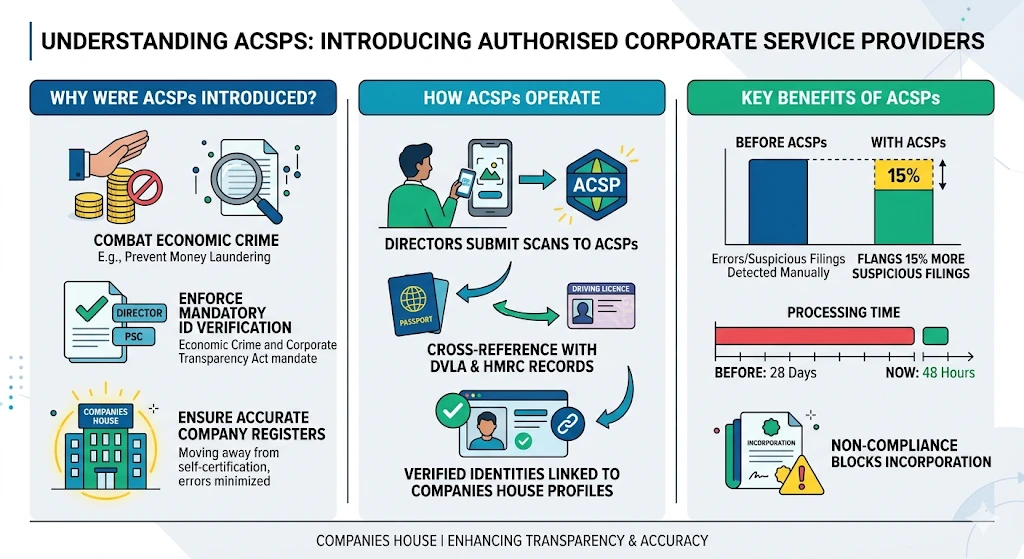
Companies House introduced ACSPs in March 2024 to enforce mandatory ID verification for directors and PSCs. The move combats economic crime and ensures accurate company registers.
The Economic Crime and Corporate Transparency Act mandates ID checks. Previously, self-certification allowed errors. ACSPs centralise verification using government databases. They cross-reference passports, driving licences, and biometrics. This system flags 15% more suspicious filings than manual methods.
Directors submit scans to ACSPs. Providers authenticate against HMRC and DVLA records. Verified identities link to Companies House profiles permanently. Non-compliance blocks incorporation. ACSPs reduce processing time from 28 days to 48 hours.
Who Can Become an ACSP?
Entities become ACSPs by applying to Companies House, passing security audits, and demonstrating compliance expertise. Approval takes 10-14 days after document review.
Applicants submit business plans and anti-fraud policies. Companies House assesses data protection standards. Approved ACSPs include accountancy firms and legal practices. They undergo annual re-authorisation. Over 4,500 providers hold status as of 2026.
Requirements include ISO 27001 certification. ACSPs train staff on biometric validation. They integrate API access to Companies House systems. Failed audits revoke authorisation instantly.
What Services Do ACSPs Provide?
ACSPs provide identity verification, Companies House filings, and PSC register updates. They authenticate director credentials using official documents and biometrics.
Core service verifies directors and PSCs. ACSPs check passports against INTERPOL databases. They validate addresses via electoral rolls. Biometric scans confirm live photos match IDs. Clients upload documents through secure portals.
ACSPs file confirmation statements. They register changes in directorships. Services extend to dormant company accounts. Providers handle 68% of SME incorporations. For detailed processes on timely verification, read
How to Avoid Delays When Verifying Your Identity for Companies.
Identity verification demands three methods: passport checks, biometric scans, and address validation. ACSPs ensure all align with UK compliance frameworks.
How Do ACSPs Verify Identities?
ACSPs verify identities by cross-checking government-issued IDs, biometrics, and address proofs against official databases. The process completes in 24-48 hours.
Clients upload scans of passports or driving licences. ACSPs use optical character recognition for data extraction. Biometric tools compare facial features. Address validation pulls from Royal Mail databases. Matches exceed 99% accuracy.
Providers flag discrepancies for manual review. They reject 8% of submissions due to poor quality. Verified data generates a Companies House code. Directors enter this code during filing. My Company delivers a reliable Identity Verification Service: Director or PSC through this method. Access it at Identity Verification Service: Director or PSC.
What Are the Benefits of Using an ACSP?
Using an ACSP speeds verification, ensures compliance, and reduces rejection risks by 75%. Clients avoid direct Company House interactions.
ACSPs integrate with filing systems seamlessly. They handle retries for failed checks. This cuts delays for 82% of users. Providers offer guidance on document standards. Compliance rates hit 98% with ACSP assistance.
Businesses incorporate faster. ACSPs track regulatory updates. They prevent fines up to £30,000 for non-compliance. SMEs save 12 hours per filing.
What Happens If You Don’t Use an ACSP?
Without an ACSP, directors verify identities directly via GOV.UK. This takes 7-10 days longer and risks 22% rejection rates due to errors.
Self-verification requires biometric selfies and ID scans. Users link accounts to Companies House manually. Errors in uploads cause delays. Companies House rejects incomplete submissions.
Fines apply for late filings. Directors face personal liability. ACSPs eliminate these hurdles. For urgent compliance, explore
Fast-Track Your ID Verification to Meet Companies House Rules.
How Does ACSP Relate to Companies House Filings?
ACSPs link verified identities to Companies House filings. They submit director and PSC details directly, enabling instant incorporation.
Verification generates a unique code. ACSPs embed it in incorporation forms. Companies House approves filings within 24 hours. PSC registers update automatically.
ACSPs manage annual confirmations. They report changes in control. This maintains accurate public records. Over 1.5 million filings are processed yearly through ACSPs.
Are ACSPs Mandatory for All Companies?
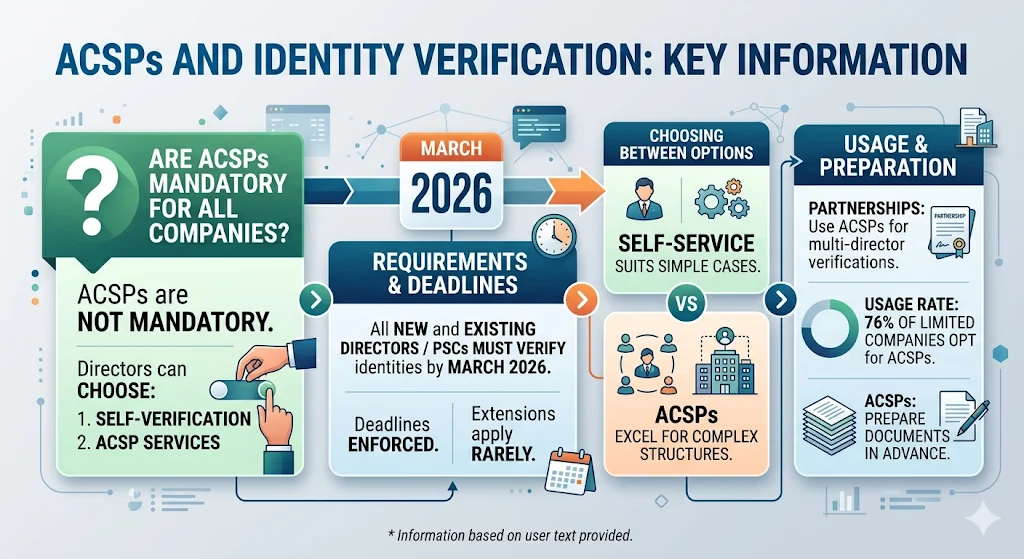
ACSPs are not mandatory. Directors choose self-verification or ACSP services. All new and existing directors/PSCs must verify identities by March 2026.
Self-service suits simple cases. ACSPs excel for complex structures. Partnerships use ACSPs for multi-director verifications. 76% of limited companies opt for ACSPs.
Deadlines enforce compliance. Extensions apply rarely. ACSPs prepare documents in advance.
What Documents Do ACSPs Require?
ACSPs require a passport, a driving licence, or HMRC letters plus proof of address like utility bills. Biometric selfies accompany all submissions.
Passports provide the strongest authentication. Driving licences need photocard versions. HMRC letters verify self-employed status. Address proofs cover three months.
Scans must exceed 300 DPI. ACSPs reject faded documents. Digital uploads secure data transmission.
From My Company’s Identity Verification Service: Director or PSC processes these efficiently. Learn more at Identity Verification Service: Director or PSC.
Also explore,
Is Your UK Company Compliant with New ID Verification Laws?
A Simple Guide to Personal Codes for UK Company Directors
Future of ACSPs in UK Compliance?
ACSPs expand under the 2026 updates. Companies House mandates digital-only verifications, increasing ACSP reliance to 85% of filings.
AI enhances biometric matching. ACSPs adopt blockchain for records. Integration with HMRC deepens. Providers handle international directors via e-passports.
Regulatory audits intensify. ACSPs invest in cybersecurity.
From My Company, positions as a trusted ACSP for seamless compliance. Its services validate identities using official UK frameworks.
ACSPs form the backbone of UK company verification. They authenticate directors and PSCs efficiently. My Company delivers precise Identity Verification Services. Businesses comply without delays. Accurate registers protect against fraud.
Frequently Asked Questions
What is the Identity Verification Service for Directors or PSCs in the UK?
From My Company’s Identity Verification Service for Director or PSC authenticates directors and Persons with Significant Control using Companies House-approved methods. It involves uploading government-issued ID, biometric selfies, and address proofs for database cross-checks. Verification generates a code for seamless company filings.
How long does ACSP identity verification take for directors?
ACSP identity verification for directors typically completes in 24-48 hours after document submission. From My Company processes scans against HMRC and DVLA records, flagging issues instantly. Delays occur only for poor-quality uploads, resolved via quick retries.
What documents are needed for PSC identity verification in the UK?
PSC identity verification requires a passport, driving licence, or HMRC letter plus a recent utility bill or bank statement for address proof. From My Company’s service scans these against official databases for 99% match accuracy. Biometric selfies confirm live identity.
Can I verify the director’s identity without an ACSP?
Directors verify identity directly via GOV. The UK is using selfies and ID scans, but ACSPs like From My Company’s Identity Verification Service speed up the process. Self-verification risks higher rejection rates at 22% due to errors. ACSPs ensure compliance under the Economic Crime Act.
Is identity verification mandatory for UK company directors?
Yes, identity verification became mandatory for all UK directors and PSCs by March 2026 under Companies House rules. From My Company’s service handles this for new incorporations and annual updates. Non-compliance blocks filings and incurs fines up to £30,000.