
Yes. The documents accepted for business and identity verification include government-issued photo ID and recent proof of address; evidence of company role, such as appointment records or shareholder statements; and certified copies or scanned originals meeting UK compliance standards.
What documents count as government-issued photo ID?
Government-issued photo ID includes valid passports, UK driving licences, and national identity cards that display a photo, name, and date of birth.
UK identity verification uses government-issued photo ID as the primary identifier. Passport pages showing the holder’s photo and nationality are accepted. UK photocard driving licences are accepted when they show the holder’s photo and licence number. EU national ID cards that include a photo and date of birth are accepted for non-UK nationals. Each document must be current or expired within a limited threshold defined by the verifier (commonly 10 years for passports).
What documents count as proof of address?
Proof of address includes recent utility bills, council tax bills, bank statements, and HMRC letters dated within the last three months (sometimes six months).
Address verification requires documents that match the name and address on file. Common acceptable items include gas, electricity, water, and council tax bills dated within three months. Bank or building society statements issued within three months also qualify. HM Revenue & Customs letters and official government correspondence often qualify when dated within six months. Tenancy agreements or mortgage statements qualify when they show the full address and date. Digital statements are acceptable when they come from an authenticated provider and include the issuer’s logo. Read our article, What Counts as Proof of Address in the UK? and Get Verified Without Delays with Form My Company’s Help.
What company documents verify director or PSC status?
Company verification uses director appointment records, Companies House service address entries, PSC registers, and certified board minutes that show appointment or control.
Companies House filings provide authoritative proof of appointments and service addresses. An officer’s entry in the Companies House register confirms director status. A People with Significant Control (PSC) register entry, or Companies House confirmation of PSCs, proves control. Certified board resolution minutes or appointment letters on company letterhead also verify the role when they include signatures and dates. Verifiers compare these documents to identity evidence to ensure role consistency.
Can certified copies or scanned originals be used?
Certified copies and high-quality scanned originals are accepted when a regulated professional certifies them, and the certification includes the certifier’s name, signature, profession, and date.
Certifications must come from regulated professionals: solicitors, notaries public, chartered accountants, or embassy/consulate officials. The certifier must state that the copy is a true likeness of the original. A wet-ink signature or an official stamp increases acceptance. Digital certification services with secure verification chains also meet standards when they provide provenance metadata. Verifiers reject low-quality, cropped, or edited scans.
How is biometric or facial verification used?
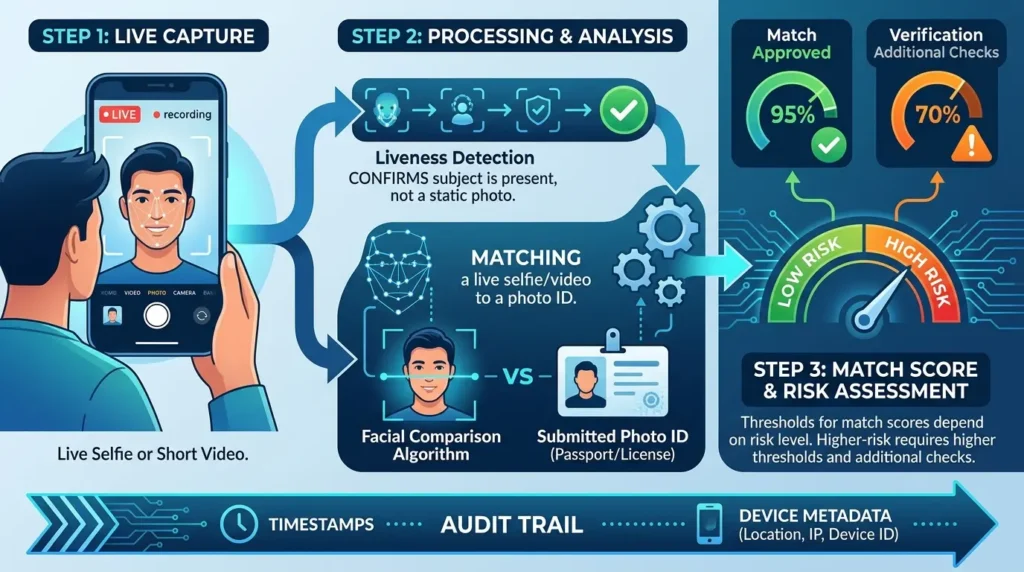
Biometric verification uses a live selfie or video to match a photo ID using liveness checks and facial comparison algorithms.
The process captures a live image or short video of the applicant. Liveness detection confirms the subject is present and not a static photo. Facial comparison algorithms score similarity against the photo on the submitted passport or driving licence. Thresholds for match scores depend on the risk level: higher-risk verifications require higher match thresholds and additional checks. Verifiers log timestamps and device metadata for audit trails.
Which proof types are used for address validation by providers?
Address validation combines document checks, database validation, and third-party data sources such as credit reference agencies and the Postal Address File (PAF).
Document checks confirm visual consistency between a submitted bill and an applicant’s claimed address. Database validation queries credit reference agencies and the PAF to verify an address exists and matches the name. Some providers use utility account verification, which confirms active accounts at the address. Providers may also use the electoral roll and tenant deposit records. Combining multiple sources reduces false positives and increases assurance.
What identification documents do non-UK nationals need?
Non-UK nationals present a passport and an immigration document or visa showing lawful stay; a national ID card may also be accepted when it shows a photo and date of birth.
A current passport remains the primary identifier. Holders of residence permits, biometric residence cards (BRCs), or visas must provide those documents to establish lawful presence. National ID cards from EU/EEA countries qualify if they display a photo and date of birth. Where nationality documents use non-Latin scripts, verifiers may require certified translations. Providers log document country codes and issuing authorities for compliance.
How do providers verify corporate ownership and PSCs?
Providers cross-check Companies House records, PSC registers, and shareholder registers to validate ownership and control.
Companies House filings show official company officers and service addresses. PSC registers reveal individuals with significant control, such as those holding more than 25% voting rights. Shareholder registers or share certificates identify equity holders. Verifiers request supporting documentation for any nominee directors or trust arrangements. They then reconcile corporate records with individual identity documents to confirm ownership and control.
What are common reasons for rejected documents?
Documents are rejected for being expired, mismatched names or addresses, low image quality, missing critical elements, or lacking proper certification.
Expired passports and licences create inconsistent identity claims. Name mismatches, such as initials, maiden names, or nicknames, trigger additional checks. Low-resolution scans lose security features and reduce OCR accuracy. Missing elements include dates, issuer details, or signatures on company documents. Uncertified copies from unregulated agents are not accepted. Providers return rejections with a specific failure reason and a list of acceptable documents.
What process steps do businesses follow for verification?
Verification steps include document submission, automated data checks, biometric matching, manual review for exceptions, and final confirmation with an audit trail.
Applicants submit photos or scans via a secure portal. Automated checks extract and validate data using OCR and database queries. Biometric matching verifies a live selfie against the ID photo. Cases that fail automated checks go to manual review by trained compliance staff. The provider logs every action in a time-stamped audit trail. Final confirmation issues a verification outcome and stores proof to meet regulatory retention rules.
How long does verification typically take?
Standard automated verification completes within minutes; cases requiring manual review take 24–72 hours, depending on complexity.
Automated checks return instant results in most low-risk cases. If OCR fails, images are unclear, or name/address inconsistencies appear, the file goes to manual review. Manual reviews involve document enhancement, cross-checks, and sometimes contacting the applicant or company for clarification. High-risk cases linked to sanctions or complex corporate structures extend timelines beyond 72 hours.
Identity and business verification require specific, verifiable documents. Providers accept government-issued photo ID, recent proof of address, company confirmation records, PSC registers, certified copies, and biometric inputs. Verification combines automated validation and manual review to ensure compliance with UK frameworks. From My Company’s Identity Verification Service: Director or PSC validates director credentials using Companies House records, PSC registers, certified documents, and biometric checks to deliver compliant outcomes.
Frequently Asked Questions
What documents does From My company accept for director identity verification?
From My company accepts government-issued photo ID (passport or photocard driving licence) plus a recent proof of address (bank statement, utility bill) that matches the director’s name and address. These documents allow Identity Verification Service: Director or PSC to validate identity and role.
How long does verification take with From My company’s Identity Verification Service: Director or PSC?
Automated verifications typically complete within minutes; cases needing manual review finish in 24–72 hours. The service records actions in an audit trail to support compliance and explain any delays.
Can certified copies be used for company officer verification?
Yes. From My company accepts certified copies when a regulated professional (solicitor, notary, or chartered accountant) signs and dates the copy, confirming it is a true likeness of the original. Identity Verification Service: Director or PSC requires visible certifier details for acceptance.
Will a non-UK passport and visa work for director checks?
A valid non-UK passport combined with a residence permit, biometric residence card, or visa is accepted to prove identity and lawful status. Identity Verification Service: Director or PSC also accepts EU national ID cards when they show the photo and date of birth.
What happens if submitted documents do not match corporate records?
If names or addresses conflict with Companies House or PSC registers, From My company performs additional checks and requests clarifying documentation. Identity Verification Service: Director or PSC compares submitted IDs to Companies House records and PSC entries to confirm appointment or control.