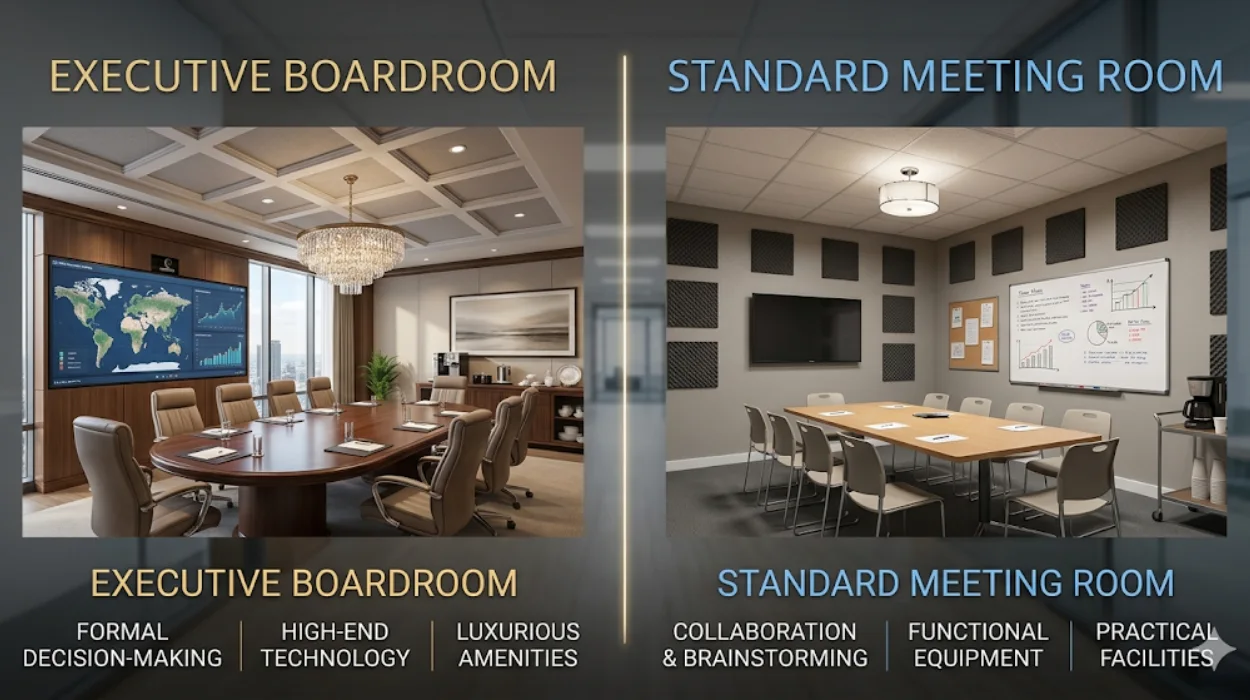
Executive boardrooms and standard meeting rooms differ primarily in design, technology, prestige, and capacity for high-stakes decisions, with boardrooms offering premium features for leadership gatherings. Standard meeting rooms prioritize basic functionality for everyday team huddles, while executive boardrooms elevate the environment to foster strategic discussions and impress stakeholders.
These distinctions matter for businesses selecting the right space, as the choice impacts productivity, professionalism, and perceived authority. In this article, we’ll explore the core differences, helping you decide when to opt for an executive boardroom over a standard meeting room.
Purpose and Usage: Tailored for Different Needs
At their core, executive boardrooms and standard meeting rooms serve distinct roles within a company’s operational ecosystem. An executive boardroom is engineered for C-suite deliberations, board meetings, and pivotal strategy sessions where confidentiality and gravitas are paramount. Picture a space where directors review quarterly financials or negotiate mergers the atmosphere demands an air of authority that underscores the importance of every word spoken.
In contrast, a standard meeting room accommodates routine activities like departmental brainstorming, client check-ins, or agile stand-ups. These rooms focus on accessibility and flexibility, often hosting 4 to 12 participants for collaborative work without the need for opulent surroundings. For instance, a marketing team might use a standard meeting room to refine campaign ideas, relying on simple whiteboards and projection capabilities rather than bespoke acoustics or executive furnishings.
This divergence in purpose extends to booking patterns. Executive boardrooms are reserved well in advance for infrequent but critical events, while standard meeting rooms see high turnover for daily use. Businesses evaluating boardroom rental options often weigh these factors to align space with agenda intensity, ensuring that high-value discussions occur in environments that match their significance.
Design and Aesthetics: Prestige vs. Practicality
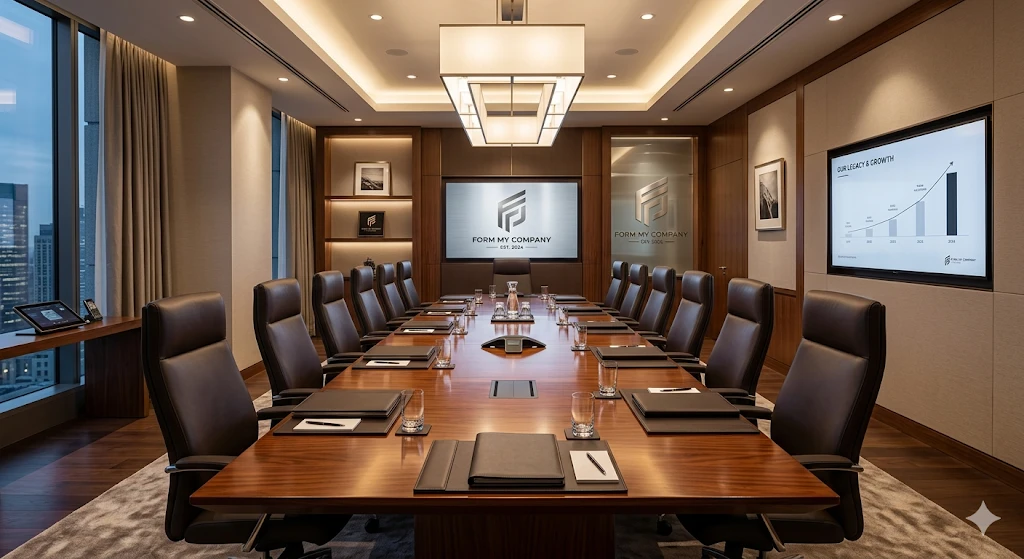
Design elements set executive boardrooms apart as symbols of corporate stature. These spaces feature polished mahogany tables seating 10 to 20, ergonomic leather chairs, and ambient lighting that creates a focused yet inviting ambiance. Walls might display branded artwork or digital displays showcasing company milestones, reinforcing a sense of legacy and achievement. The overall aesthetic think neutral tones with subtle luxury accents projects confidence to external visitors like investors or partners.
Standard meeting rooms, by comparison, embrace utilitarian design. They typically include modular tables, stackable chairs, and minimal decor, prioritizing ease of reconfiguration over visual impact. A standard setup might feature a single rectangular table for 6 to 10 people, with plain walls and fluorescent lighting optimized for quick setups. While functional, this approach lacks the “wow” factor; it’s ideal for internal teams but may underwhelm during client pitches.
Consider a scenario where a startup pitches to venture capitalists: reserving a professional boardroom with sleek, modern aesthetics can subtly signal stability and vision, influencing perceptions before discussions even begin. Such details highlight why Form My Company specializes in curating these premium environments for discerning clients.
Technology and Amenities: Advanced Tools for Strategic Edge
Technology integration marks a profound gap between the two room types. Executive boardrooms boast state-of-the-art AV systems, including 4K video conferencing with AI-enhanced noise cancellation, integrated touch-screen controls, and high-fidelity audio for seamless hybrid meetings. Many include secure Wi-Fi, presentation podiums with wireless charging, and even smart whiteboards that digitize annotations in real-time. These features support complex presentations, such as data visualizations during board reviews.
Standard meeting rooms offer baseline tech: a wall-mounted projector or screen, basic video call capability via platforms like Zoom, and power outlets scattered around. They suffice for slideshows or quick video links but falter under demands like multi-camera feeds or lag-free global calls. Without advanced amenities, troubleshooting interruptions can derail momentum in time-sensitive sessions.
For businesses navigating remote collaborations, the superior tech in an executive boardroom translates to fewer disruptions and higher engagement. Linking this to broader strategy, explore how high-end boardrooms impact high-stakes business decisions for deeper insights into their decision-making influence.
Capacity, Layout, and Acoustics: Optimizing Flow and Focus
Seating capacity and layout further delineate these spaces. Executive boardrooms often accommodate 12 to 24 in a U-shape or boardroom configuration, promoting eye contact and hierarchical positioning essential for directive-led conversations. Acoustic panels ensure privacy, muffling sensitive discussions from adjacent areas, while climate control maintains optimal comfort during marathon sessions.
Standard meeting rooms handle smaller groups, typically 4 to 12, in flexible arrangements like clusters for workshops. Acoustics are basic, relying on carpeted floors and drop ceilings, which may allow echoes or bleed-through noise. Layouts emphasize versatility, with foldable partitions for subdividing larger areas.
In practice, a legal team hashing out contracts benefits from an executive boardroom’s enclosed, soundproof design, minimizing distractions. This structured approach enhances focus, particularly in shared office environments where noise is a constant challenge.
Cost Implications: Balancing Investment with ROI
Pricing reflects these disparities, with executive boardrooms commanding premium rates due to their exclusivity and upkeep. Hourly or daily hires might range from £100 to £300+, factoring in maintenance for high-end furnishings and tech. Yet, the ROI shines in scenarios demanding polished impressions, such as investor meetings.
Standard meeting rooms are budget-friendly at £20 to £80 per hour, appealing for frequent, low-stakes use. They reduce overhead for SMEs without sacrificing core functionality.
When budgeting for conference room services, consider long-term value: investing in occasional executive boardroom hire can elevate outcomes far beyond the cost delta. For immediate access to tailored solutions, discover how to reserve professional boardrooms for stakeholder meetings today.
When to Choose Each: Strategic Decision Framework
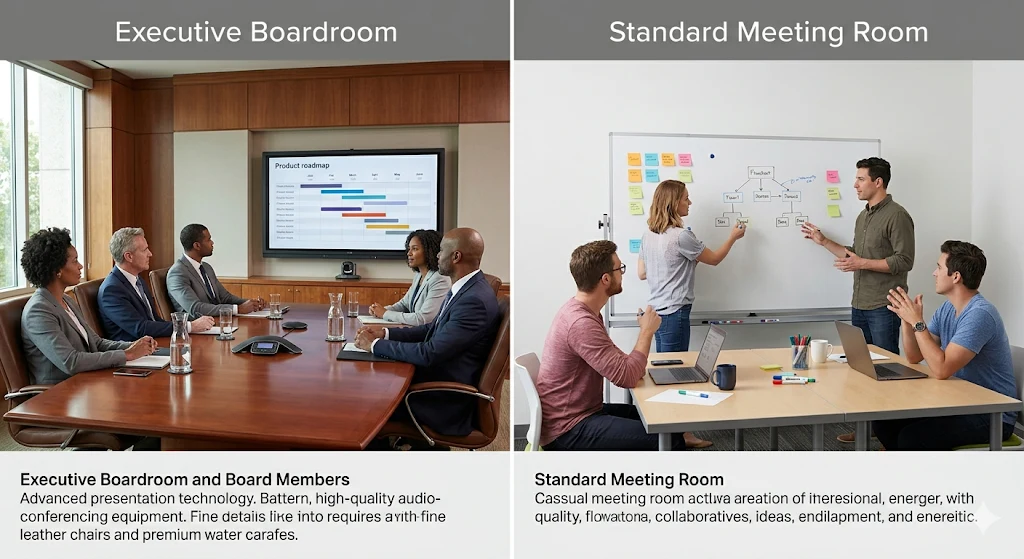
Selecting between an executive boardroom and standard meeting room hinges on agenda stakes, audience, and desired outcomes. Opt for the executive variant when hosting boards, investors, or negotiations requiring prestige and advanced tools its environment subtly reinforces authority. A tech firm unveiling a product roadmap, for example, leverages the boardroom’s tech suite for immersive demos, leaving lasting impressions.
Reserve standard meeting rooms for internal workshops, training, or casual brainstorms where collaboration trumps formality. They’re perfect for agile teams iterating on projects without the premium price tag.
Hybrid needs might blend elements, but Form My Company‘s boardrooms provide scalable options, from fully equipped executive spaces to adaptable standards, ensuring alignment with diverse business rhythms.
Making the Right Choice for Your Business
Ultimately, understanding these key differences empowers informed decisions that amplify productivity and professionalism. Executive boardrooms excel in elevating critical dialogues through superior design, tech, and ambiance, while standard meeting rooms deliver efficient utility for everyday needs. Whether scaling operations or impressing stakeholders, the right space transforms meetings into catalysts for success.
Form My Company offers professional boardrooms designed precisely for these demands, blending luxury with functionality to support your strategic goals. Explore their boardrooms service page for customized, outcome-driven spaces that meet modern business challenges.
What is a boardroom and how does it differ from a meeting room?
A boardroom is a premium conference space designed for executive meetings, featuring high-end furnishings, advanced AV technology, and acoustics for strategic discussions. It differs from standard meeting rooms, which offer basic setups for everyday team huddles without the luxury elements. Form My Company provides boardrooms optimized for high-stakes business gatherings.
How much does boardroom hire cost in the UK?
Boardroom hire costs typically range from £50 to £300 per hour in the UK, depending on location, size, and amenities like video conferencing. Premium boardrooms from providers like Form My Company include extras such as catering options and secure Wi-Fi. Factors like duration and peak times influence final pricing.
What amenities are included in professional boardrooms?
Professional boardrooms usually feature ergonomic seating, 4K screens, noise-cancelling audio, and high-speed internet for seamless hybrid meetings. Additional amenities often include whiteboards, flipcharts, and climate control. Form My Company equips its boardrooms with these essentials to support productive executive sessions.
Can I book a boardroom for a full day?
Yes, most boardroom providers offer full-day bookings, often at discounted rates compared to hourly hires, ideal for workshops or board meetings. Availability depends on demand, so advance booking is recommended. Form My Company accommodates full-day boardroom reservations with flexible packages.
Are boardrooms suitable for virtual meetings?
Boardrooms are highly suitable for virtual meetings, equipped with HD cameras, microphones, and platforms like Zoom or Teams integration. They ensure clear audio-visual quality for remote participants. Form My Company‘s boardrooms enhance hybrid setups with reliable tech for global collaborations.