

The right payroll software for your UK startup streamlines PAYE compliance, automates tax calculations, and scales with growth, saving time and reducing errors. Focus on HMRC-approved tools with real-time reporting, employee self-service portals, and integration with UK tax systems to meet legal requirements efficiently.
Selecting payroll software marks a pivotal step for UK startups navigating the complexities of employment law and financial management. As your business hires its first employees, accurate payroll processing becomes non-negotiable under HMRC guidelines. The ideal solution handles Pay As You Earn (PAYE) deductions, National Insurance contributions, and pension auto-enrolment seamlessly, allowing founders to prioritize innovation over administrative burdens.
Why UK Startups Need Tailored Payroll Software
UK startups face unique payroll challenges due to evolving regulations like Making Tax Digital (MTD) for payroll, which mandates quarterly real-time reporting starting from April 2024. Generic software often falls short, lacking localisation for UK-specific elements such as Real Time Information (RTI) submissions. A tailored payroll software for UK startups ensures compliance, minimising penalties that can reach £3,000 per incorrect return.
Consider a tech startup in London onboarding five developers. Manual spreadsheets lead to miscalculations in student loan deductions or statutory sick pay, eroding trust and inviting audits. Robust software automates these, integrating with accounting platforms like Xero or QuickBooks for a unified financial view. This not only boosts accuracy HMRC reports error rates drop by up to 80% with automated systems but also frees CFOs for strategic tasks.
Payroll software also addresses scalability. Early-stage ventures might manage 10 employees, but rapid growth demands handling 100 without proportional cost hikes. Solutions with modular pricing adapt, adding features like multi-currency support for international hires, essential for ambitious UK startups eyeing global expansion.
Key Features to Prioritise in Payroll Software
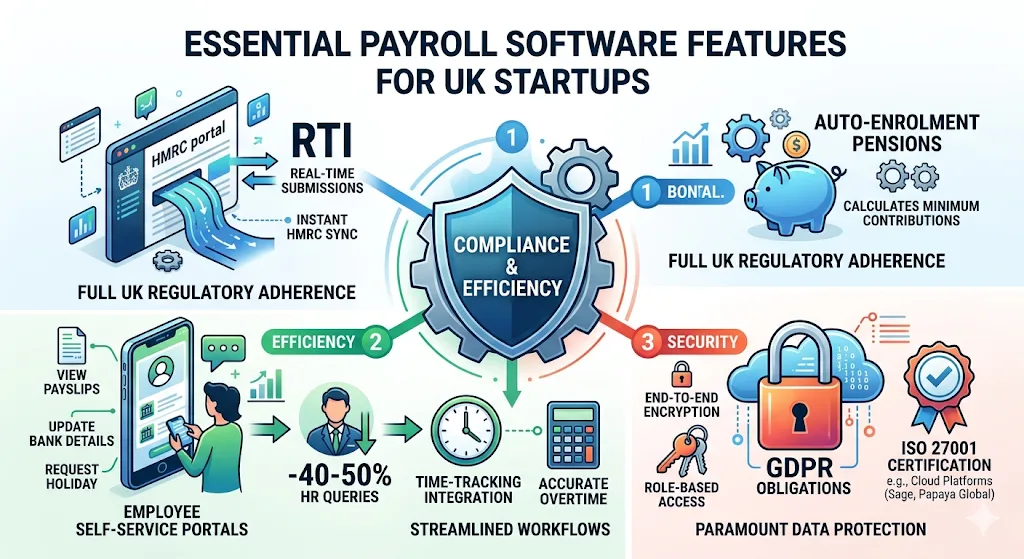
When evaluating options, startups should demand features aligned with UK regulatory demands. Real-time RTI submissions to HMRC form the core, ensuring payroll runs sync instantly with government portals. Look for built-in pension compliance tools that calculate minimum contributions under auto-enrolment rules, a legal must for eligible workers.
Employee self-service portals rank high for efficiency. These allow staff to view payslips, update bank details, and request holiday accruals via mobile apps, reducing HR queries by 40-50% according to industry benchmarks. Integration with time-tracking tools prevents disputes over overtime, particularly in shift-based startups like delivery services.
Data security stands paramount, given GDPR obligations. Choose software with end-to-end encryption and role-based access, protecting sensitive data like NI numbers from breaches. For instance, cloud-based platforms from providers like Sage or Papaya Global offer ISO 27001 certification, safeguarding startups against cyber threats that cost UK businesses £21 billion annually.
Step-by-Step Guide to Evaluating Payroll Providers
Begin by assessing your startup’s size and complexity. Sole-director companies might delay full setups, but as discussed in our guide on whether you need PAYE if you’re the only director of your UK company, hiring triggers immediate requirements. Map needs: number of employees, remote workers, and industry-specific rules like construction’s CIS deductions.
Next, request demos from shortlisted vendors. Test usability intuitive interfaces cut training time from weeks to days. Scrutinise pricing models; per-employee fees suit small teams, while flat rates benefit scaling firms. Hidden costs like setup fees or add-ons for MTD compliance can inflate budgets by 20-30%.
Compliance verification follows. Confirm HMRC recognition and audit history. User reviews on platforms like G2 reveal real-world reliability; a score above 4.5 stars signals dependable uptime. Finally, trial integrations with your existing stack CRM, HRIS to ensure seamless data flow.
Comparing Top Payroll Software Options for UK Startups
| Feature | Sage Payroll | Xero Payroll | BrightPay | Papaya Global |
|---|---|---|---|---|
| RTI Submissions | Yes, automated | Yes, real-time | Yes, batch | Yes, global-compliant |
| Pricing (per employee/month) | £5-£10 | £6+ | £2-£8 | Custom |
| Self-Service Portal | Advanced | Basic | Yes | Full-featured |
| Best For | Mid-size growth | Solopreneurs | SMEs | International hires |
Sage excels for established startups with complex needs, offering robust reporting for investor scrutiny. Xero suits bootstrapped teams via its affordable, accounting-linked model. BrightPay provides cost-effective UK focus, ideal for PAYE-heavy operations. Papaya Global shines for ventures with overseas talent, handling currency conversions effortlessly.
A fintech startup in Manchester, for example, switched to BrightPay after outgrowing spreadsheets. Monthly payroll for 20 staff dropped from 15 hours to two, with RTI errors eliminated. Such transitions underscore how the right choice enhances cash flow predictability, vital for runway extension.
Integrating Payroll Software with PAYE Registration
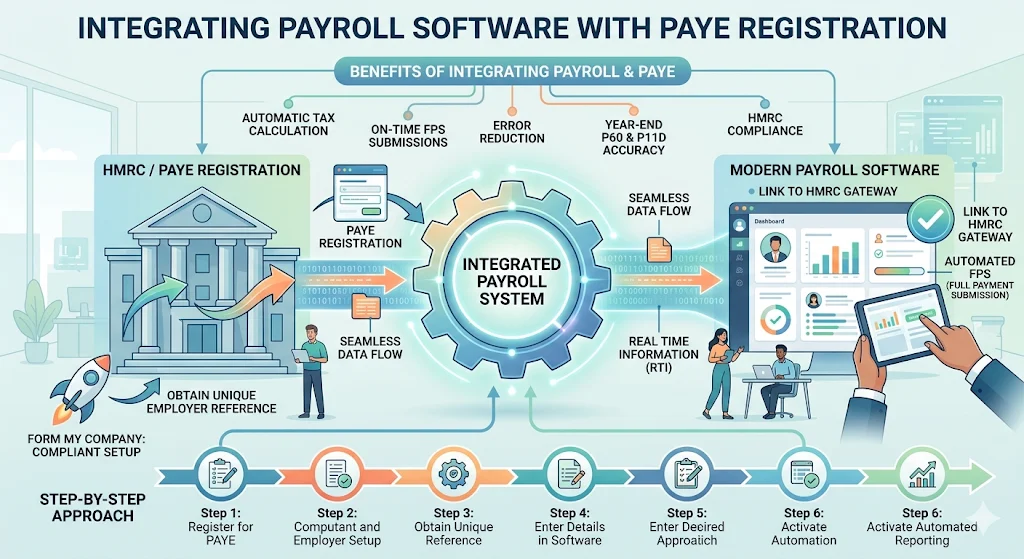
No payroll system operates in isolation; seamless PAYE setup is foundational. Startups must register for PAYE via HMRC within three months of hiring, obtaining a unique employer reference. Form My Company‘s PAYE Registration Assistance simplifies this, delivering compliant setup so software integrations proceed without hitches.
Post-registration, link your software to the HMRC gateway. This enables FPS (Full Payment Submission) for each pay run, ensuring deductions reach the Exchequer on time. Delays risk fines, but automated tools flag issues pre-submission. For expanding teams, software handles P11D filings for benefits-in-kind, maintaining year-end accuracy.
Common Pitfalls and How to Avoid Them
Overlooking mobile accessibility trips many founders. Desk-bound admins miss out, but responsive apps empower field teams to approve timesheets remotely. Another trap: ignoring pension dashboards. Non-compliance with auto-enrolment staging costs £400 per worker, per Pensions Regulator data.
Scalability oversights compound issues. Software capping at 50 employees strands growing startups mid-year. Vet expansion paths early. Vendor support lags in free tiers opt for 24/7 UK-based helpdesks to resolve RTI glitches swiftly.
Future-Proofing Your Payroll Choice
As UK payroll evolves with MTD Phase 2, select software with quarterly update commitments. AI-driven anomaly detection, emerging in 2026 tools, flags fraud like ghost employees, protecting lean budgets. Global compliance for post-Brexit hires adds resilience.
Form My Company supports startups through these shifts, offering expert PAYE registration assistance alongside ready-to-deploy payroll strategies. Whether you’re fine-tuning selections or accelerating compliance, get your employer PAYE reference number fast with our team to stay ahead.
In summary, choosing payroll software for UK startups demands balancing compliance, usability, and growth potential. With HMRC-approved tools and professional guidance from Form My Company, you transform payroll from a chore into a competitive edge.
What is PAYE registration for UK employers?
PAYE, or Pay As You Earn, is the UK system for deducting income tax and National Insurance from employees’ wages before paying them. Employers must register for PAYE with HMRC within three months of hiring their first employee to comply with legal requirements. Form My Company’s PAYE Registration Assistance handles the full process, ensuring timely submission and obtaining your unique employer reference number.
How long does PAYE registration take in the UK?
PAYE registration typically takes 5-10 working days once HMRC receives a complete application via their online portal. Delays occur if details like company UTR or employee NI numbers are missing, so accurate submission is key. With Form My Company’s PAYE Registration Assistance, startups avoid errors and receive confirmation faster.
Do sole directors need to register for PAYE?
Sole directors without employees generally do not need PAYE registration, as it applies only when paying salaries subject to income tax and NI deductions. However, registering becomes mandatory upon hiring staff or paying yourself a salary above the personal allowance. Form My Company’s PAYE Registration Assistance clarifies your specific obligations under HMRC rules.
What documents are required for PAYE registration?
Key documents include your company’s Unique Taxpayer Reference (UTR), VAT number if applicable, director and employee details, and bank information for payments. HMRC also requires proof of business address and employee start dates. Form My Company’s PAYE Registration Assistance compiles and submits these securely for seamless approval.
What happens if you don’t register for PAYE on time?
Failing to register for PAYE within three months of hiring can result in HMRC fines up to £100 per employee, plus interest on late tax payments and potential enforcement actions. Non-compliance disrupts payroll processing and RTI submissions. Form My Company’s PAYE Registration Assistance prevents penalties by managing deadlines and documentation efficiently.