
If you need to apply for an employer PAYE reference for your UK business, you must register as an employer with HM Revenue and Customs before your first payday. HMRC issues an employer PAYE reference after processing your registration, allowing you to identify your payroll scheme when reporting employee payments and deductions.
Obtaining this reference is an important step for new UK employers, including limited companies hiring their first employees and businesses preparing to pay directors through payroll. The process involves providing accurate company and employment information, completing the HMRC registration and setting up appropriate payroll procedures.
Form My Company provides PAYE Registration Assistance to help businesses prepare their applications, check registration details and understand the steps involved. This guide explains how to apply, what information you need, how long the process takes and where professional assistance can help.
What Is an Employer PAYE Reference Number?
An employer PAYE reference number is a unique identifier HMRC assigns to a business when it registers as an employer. It identifies the employer’s PAYE scheme and is used for payroll administration, tax reporting and correspondence with HMRC.
The reference is different from your company registration number and Corporation Tax Unique Taxpayer Reference. It is also separate from the Accounts Office reference, which HMRC uses to identify employer payments.
Once your employer registration has been processed, HMRC sends the relevant references in a letter. You will need these details when managing your PAYE obligations and enrolling for PAYE Online.
Employer PAYE Reference vs Accounts Office Reference
Both identifiers are important, but they serve different purposes.
| Reference | Main purpose |
|---|---|
| Employer PAYE reference | Identifies your employer PAYE scheme for payroll reporting and HMRC correspondence |
| Accounts Office reference | Identifies your employer’s payment account when paying PAYE liabilities to HMRC |
| Company registration number | Identifies your limited company at Companies House |
| Corporation Tax UTR | Identifies your company for Corporation Tax purposes |
Keeping these details separate helps prevent mistakes when submitting payroll information or making payments.
How to Apply for Employer PAYE Reference
To apply for an employer PAYE reference, you must complete the employer registration process through HMRC. Most eligible UK limited companies can use the online registration service, providing the necessary business information and details about their intended payroll arrangements.
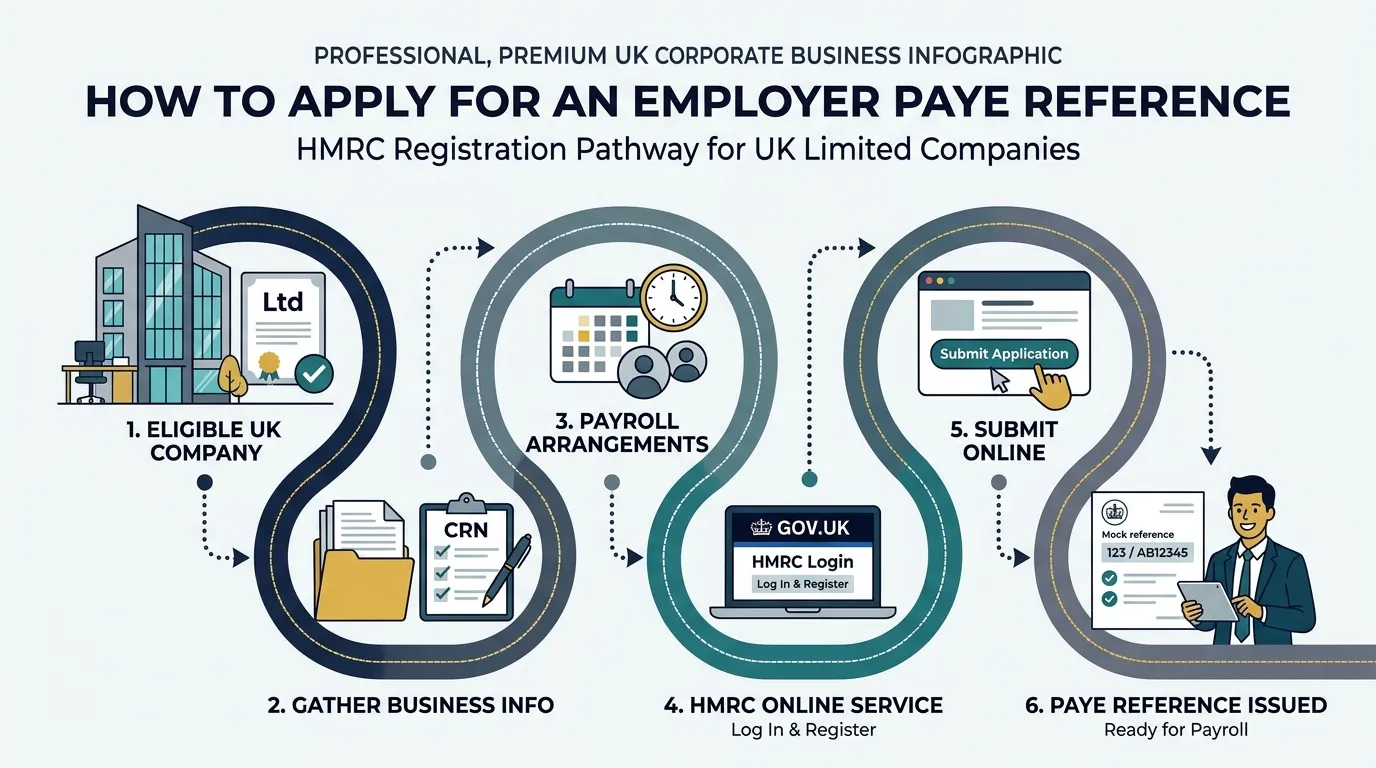
The application should be submitted before the first payday. HMRC does not normally allow employers to register more than two months before they intend to start paying employees.
Step 1: Confirm Your PAYE Registration Requirements
Before applying, establish whether your company needs to register as an employer.
You will generally need to register if you start employing staff or have other circumstances requiring an employer PAYE scheme. This can include employing yourself as the only director of a limited company.
The requirement depends on the nature of payments and applicable HMRC rules. Dividends alone do not normally require PAYE processing.
Step 2: Prepare Your Company Information
Gather the information needed for the application before starting.
Depending on your business circumstances, this may include:
Registered company name and address.
Companies House registration number.
Corporation Tax UTR, where applicable.
Employer contact information.
Expected first payday.
Number of employees you intend to pay.
Details of the person responsible for payroll.
Relevant employment and payment information.
Accurate information helps ensure that your employer registration is submitted correctly.
Step 3: Complete the HMRC Employer Registration
Use the official GOV.UK employer registration service to begin your application.
Select the appropriate business registration route and provide the information requested by HMRC. Limited companies with one to nine directors can generally register online.
Review the details before submission, particularly the company information and intended first payday.
Step 4: Submit Your Application and Await HMRC Confirmation
Once the application has been submitted, HMRC processes the registration and issues the employer PAYE reference.
The reference is sent by letter. Keep the correspondence safely because it also contains the Accounts Office reference required for employer payments.
If you need help understanding the application process, read our guide on how to register for PAYE with HMRC.
Step 5: Set Up PAYE Online and Payroll
After receiving your employer references, enrol for PAYE Online if you have not already done so.
You can then establish your payroll arrangements using suitable payroll software or an accountant. Your payroll process should support accurate calculations, employee records and Real Time Information submissions to HMRC.
What Do You Need to Apply for an Employer PAYE Reference?
Preparing the correct information before registration makes the process easier to manage. Although HMRC determines the information required for each application, the following checklist covers the main details businesses should have available.
| Required information | Why it matters |
|---|---|
| Company name | Identifies the employer |
| Company registration number | Connects the application to Companies House records |
| Business address | Provides the relevant employer details |
| Corporation Tax UTR | Helps identify the company’s tax records where applicable |
| First payday | Establishes when payroll is expected to begin |
| Employee information | Helps establish the employer’s payroll arrangements |
| Contact details | Allows HMRC to communicate about the application |
Not every business will be asked for identical information or supporting documents. Follow the specific instructions provided during HMRC registration rather than assuming that every applicant needs to upload the same identification or address documents.
How Long Does It Take to Receive an Employer PAYE Reference?
The time required to receive an employer PAYE reference depends on HMRC processing and the circumstances of the application. HMRC advises that it can take up to 30 working days to issue the reference, although many registrations are completed sooner.
Businesses should therefore avoid relying on guaranteed 24–48-hour delivery times when planning their first payroll.
Submitting accurate information and applying within the permitted registration window helps businesses prepare for their first payday.
What Happens If Your PAYE Reference Has Not Arrived?
If your reference has not arrived, check the expected processing time through the relevant HMRC service.
If you need to pay an employee before receiving the reference, GOV.UK provides a procedure:
Run payroll using the available information.
Store the Full Payment Submission.
Send a late Full Payment Submission to HMRC when you receive the necessary reference.
Employers should follow the current HMRC instructions for their circumstances rather than delaying payroll or ignoring reporting obligations.
When Should a New UK Limited Company Apply for PAYE?
A new UK limited company should assess its PAYE requirements before making its first relevant employee payment.
Registration is not automatically required simply because Companies House has incorporated the business. The need for an employer PAYE scheme depends on whether the company employs staff or has payments and circumstances that require PAYE.
Companies planning to recruit employees should allow enough time for registration and payroll preparation before the first payday.
For a more detailed explanation of registration timing, read our guide on when a new UK limited company needs to register for PAYE.
Do Sole Directors Need an Employer PAYE Reference?
A sole director does not automatically need an employer PAYE scheme simply because they own or manage a limited company.
However, if the company pays the director through payroll or has other circumstances that require employer registration, it must meet the applicable HMRC requirements.
Dividends are treated differently from employment earnings and are not processed through PAYE.
Read our detailed guide on whether you need PAYE if you are the only director of your UK company to understand how director-only arrangements affect registration.
What Happens After Receiving Your Employer PAYE Reference?
Receiving your employer PAYE reference is an important milestone, but employers must also establish the procedures needed to manage payroll correctly.
Enrol for PAYE Online
Use your employer PAYE reference and Accounts Office reference to enrol for PAYE Online through HMRC.
If you already have a business tax account, follow the instructions for adding the employer service. HMRC sends an activation code by post where required.
Choose Suitable Payroll Software
Select payroll software that supports UK payroll calculations, Real Time Information reporting and the employment arrangements within your business.
Consider the number of employees, reporting requirements, accounting integrations, support and ongoing costs before selecting a solution.
Our guide to choosing the right payroll software for your UK startup explains the main features and considerations.
Submit Payroll Information to HMRC
Employers generally need to submit a Full Payment Submission on or before each payday. An Employer Payment Summary may also be necessary in relevant circumstances, such as reporting statutory payment recoveries or periods without employee payments.
Maintain accurate payroll records and make the required PAYE payments by the applicable deadlines.
Keep Your Employer References Secure
Store your employer PAYE reference and Accounts Office reference with your important business records.
These details are needed for payroll administration, HMRC correspondence and employer payments. Avoid confusing the two references when completing payroll or payment instructions.
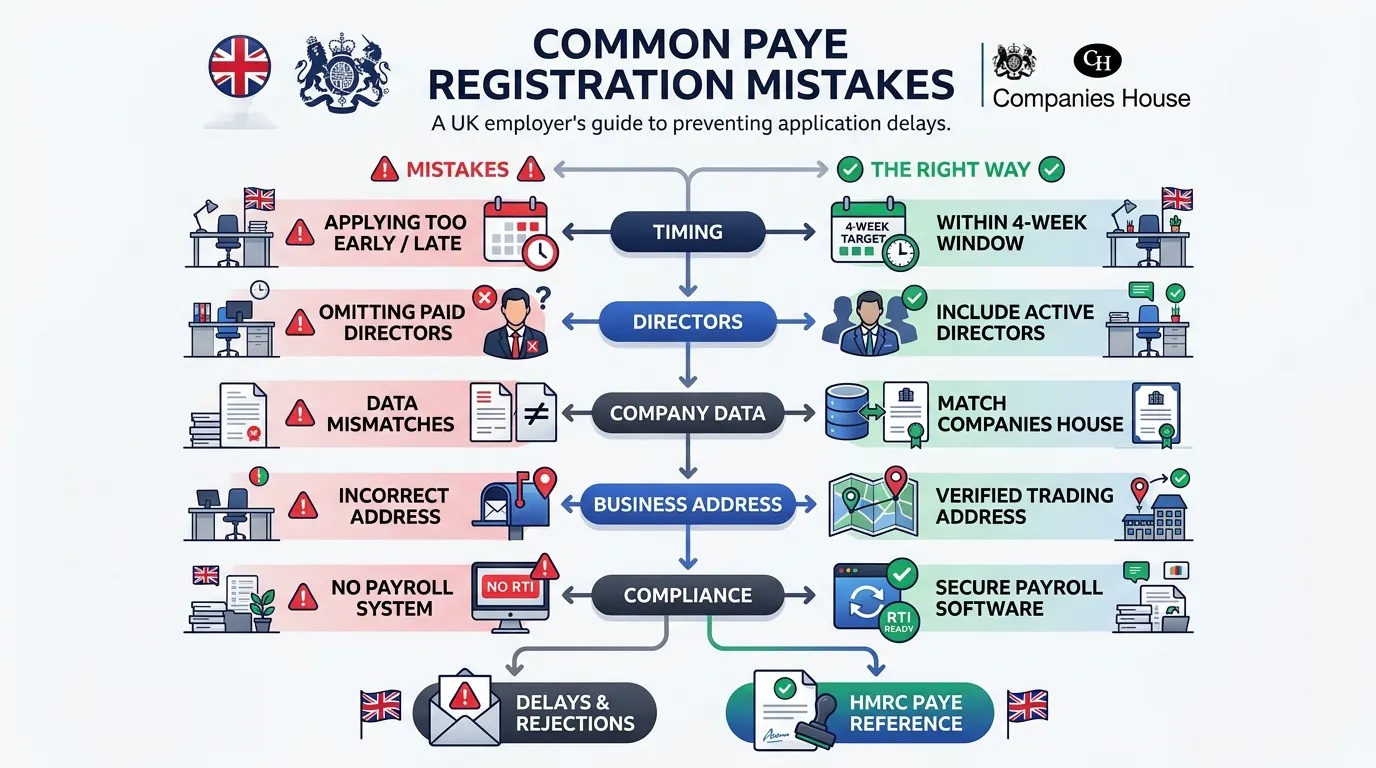
Common Mistakes When Applying for an Employer PAYE Reference
Errors during employer registration can create avoidable administrative difficulties. Businesses should review their information and understand their responsibilities before submitting an application.
Providing Incorrect Company Information
Incorrect company names, registration numbers or addresses can create inconsistencies in the application. Check your details against your official company records before submitting.
Applying Too Late
Waiting until the first payday is approaching can create unnecessary pressure. HMRC requires registration before the first payday, so employers should prepare and submit their applications in advance.
Confusing PAYE and Accounts Office References
The employer PAYE reference identifies the payroll scheme, while the Accounts Office reference is used for payments. Using the wrong identifier can delay payment allocation or create administrative problems.
Assuming Every Director Needs PAYE
A company does not automatically need PAYE merely because it has a director. Consider the actual salary, employment payments and applicable HMRC requirements before registering.
Relying on Guaranteed Processing Times
Professional assistance can help prepare and review an application, but HMRC controls the registration process and the issue of employer references. No service should guarantee that HMRC will issue a reference within a particular number of hours.
Apply for Employer PAYE Reference with Form My Company
Obtaining an employer PAYE reference is an important step when preparing a UK business to employ staff or operate a payroll scheme. Form My Company helps businesses understand the registration requirements, prepare their information and complete the relevant application process.
What Is Included in PAYE Registration Assistance?
Form My Company’s PAYE Registration Assistance service provides support with:
PAYE registration form provision.
Guidance on completing the application.
Review of company and registration information.
Checks for missing details and inconsistencies.
Guidance throughout the registration process.
Information about receiving employer PAYE and Accounts Office references.
Advice on the next steps after registration.
Pricing and Service Information
HMRC does not charge a fee for standard employer registration. Form My Company’s professional assistance is a separate paid service.
For the current service price, inclusions and purchase details, visit the PAYE Registration Assistance service page.
The service helps businesses prepare their applications, but HMRC retains responsibility for processing registration and issuing employer references.
Why Choose Professional PAYE Registration Assistance?
New employers may find HMRC registration unfamiliar, particularly when establishing payroll for the first time. Professional assistance provides an additional review of the application details and helps businesses understand the registration process.
Form My Company supports UK company owners, new employers and directors who want guidance with PAYE registration and related compliance arrangements.
Apply for Your Employer PAYE Reference Today
Preparing your employer PAYE reference application early helps establish the foundation for accurate payroll administration and HMRC reporting. By confirming your registration requirements, gathering the correct information and following the official process, your business can prepare for its first payday more effectively.
Form My Company provides PAYE Registration Assistance to support businesses throughout the application process. Explore the service, review what is included and take the next step towards establishing your employer payroll arrangements.
Frequently Asked Questions
How do I apply for an employer PAYE reference?
You apply by registering as an employer with HMRC through the official GOV.UK service. Provide the requested company and payroll information before your first payday. HMRC processes the application and sends your employer PAYE reference by letter.
How long does it take to get an employer PAYE reference?
HMRC advises that it can take up to 30 working days to receive your employer PAYE reference, although many applications are processed sooner. The timing depends on HMRC processing and the individual application.
Is an employer PAYE reference the same as an Accounts Office reference?
No. The employer PAYE reference identifies your payroll scheme, while the Accounts Office reference identifies your employer payment account. HMRC provides both following successful registration.
Can I apply for an employer PAYE reference online?
Yes. Most limited companies with one to nine directors can register online through the GOV.UK employer registration service. Other business structures may have different registration routes.
Do I need an employer PAYE reference if I am the only director?
It depends on your circumstances. A sole director may need an employer PAYE scheme when receiving salary payments or where other relevant employer requirements apply. Dividends alone do not normally require PAYE registration.
Can I pay employees before receiving my PAYE reference?
Yes, HMRC provides a procedure for employers who need to pay employees before receiving their reference. You should run payroll, store the Full Payment Submission and send it to HMRC when the reference becomes available, following official instructions.
Does HMRC charge a fee for PAYE registration?
No. Standard employer registration with HMRC is free. Businesses choosing professional assistance from a private company pay the separate service fee charged by that provider.
What happens if I use the wrong Accounts Office reference?
Using an incorrect Accounts Office reference can delay a payment or cause it to be allocated to another tax liability. Check the reference carefully before making an employer PAYE payment.