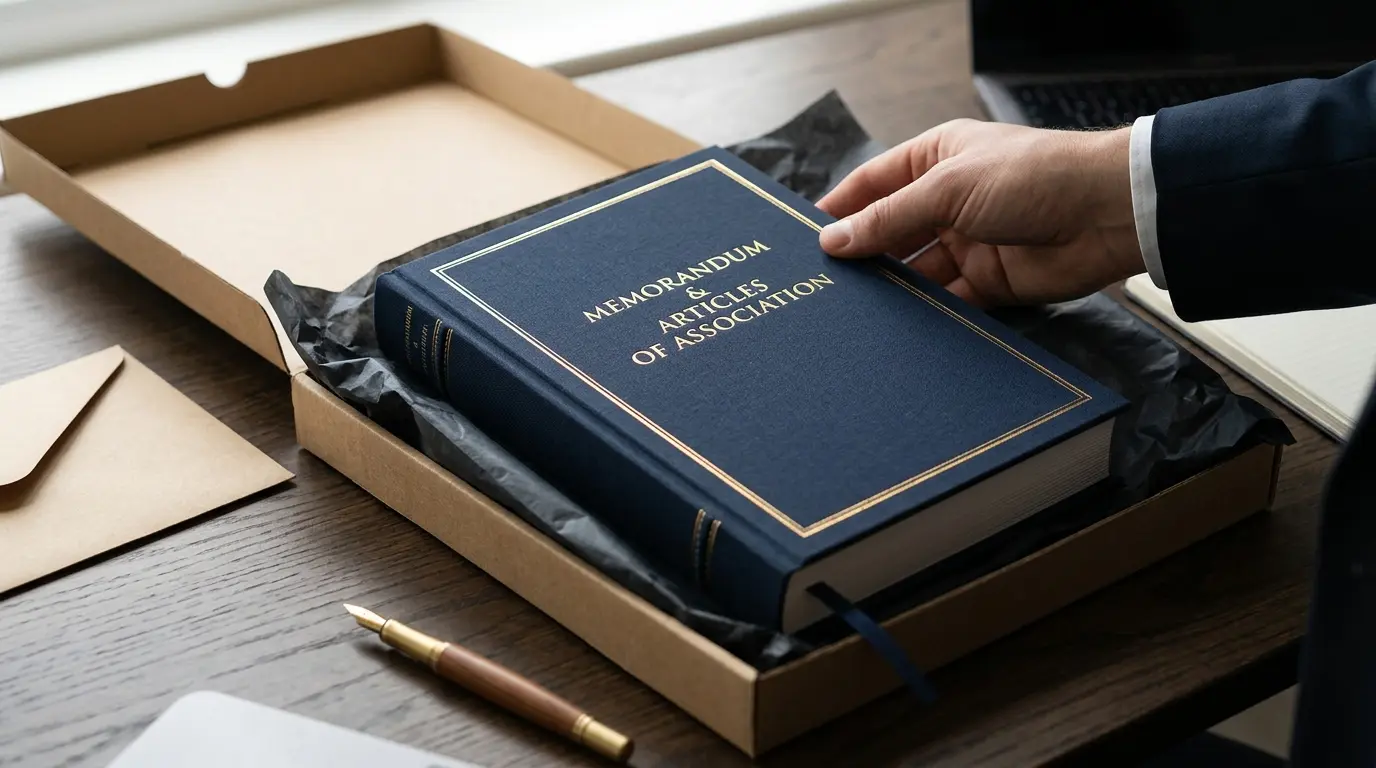
A bound company constitution demonstrates permanent structural integrity, prevents unrecorded page substitutions, and signal regulatory diligence to institutional lenders, investors, and corporate auditors. Physical binding ensures long-term statutory compliance, presents a clean aesthetic, and establishes immediate operational credibility during formal commercial transactions.
Why Is the Physical Format of a Corporate Constitution Important?
The physical presentation of statutory documents directly influences how banking institutions, investors, and regulatory authorities evaluate corporate legitimacy during initial compliance checks and formal due diligence processes.
Corporate constitutions serve as the primary legal framework governing internal management, director authority, and shareholder rights. Loose-leaf documents create immediate operational risks regarding page loss, accidental destruction, and unauthorized alterations. When financial institutions request corporate records for account opening or credit assessments, physical document quality reflects corporate governance standards. Lenders evaluate physical presentation alongside statutory compliance to determine operational risk levels.
A hardbound format provides physical durability across decades of commercial use. Corporate secretaries access these founding documents frequently during shareholder meetings, director appointments, and share transfers. Loose-leaf pages deteriorate quickly through repeated handling, staple removal, and ring-binder friction. Thread-sewn or hardbound finishes protect essential corporate records against physical degradation. Maintaining pristine constitutional records ensures immediate compliance readiness during sudden legal or financial audits.
Corporate entities present bound constitutional books to external auditors, regulatory inspectors, and legal counsel during formal transactions. A bound volume confirms structural completeness without requiring manual page counts or sequence checks. Professional binding demonstrates a company’s commitment to rigorous record-keeping standards from inception.
How Does Document Binding Prevent Statutory Fraud and Tampering?
Permanently binding constitutional pages eliminates unauthorized page replacements, secures key shareholder provisions, and maintains an unalterable physical audit trail for corporate governance compliance.
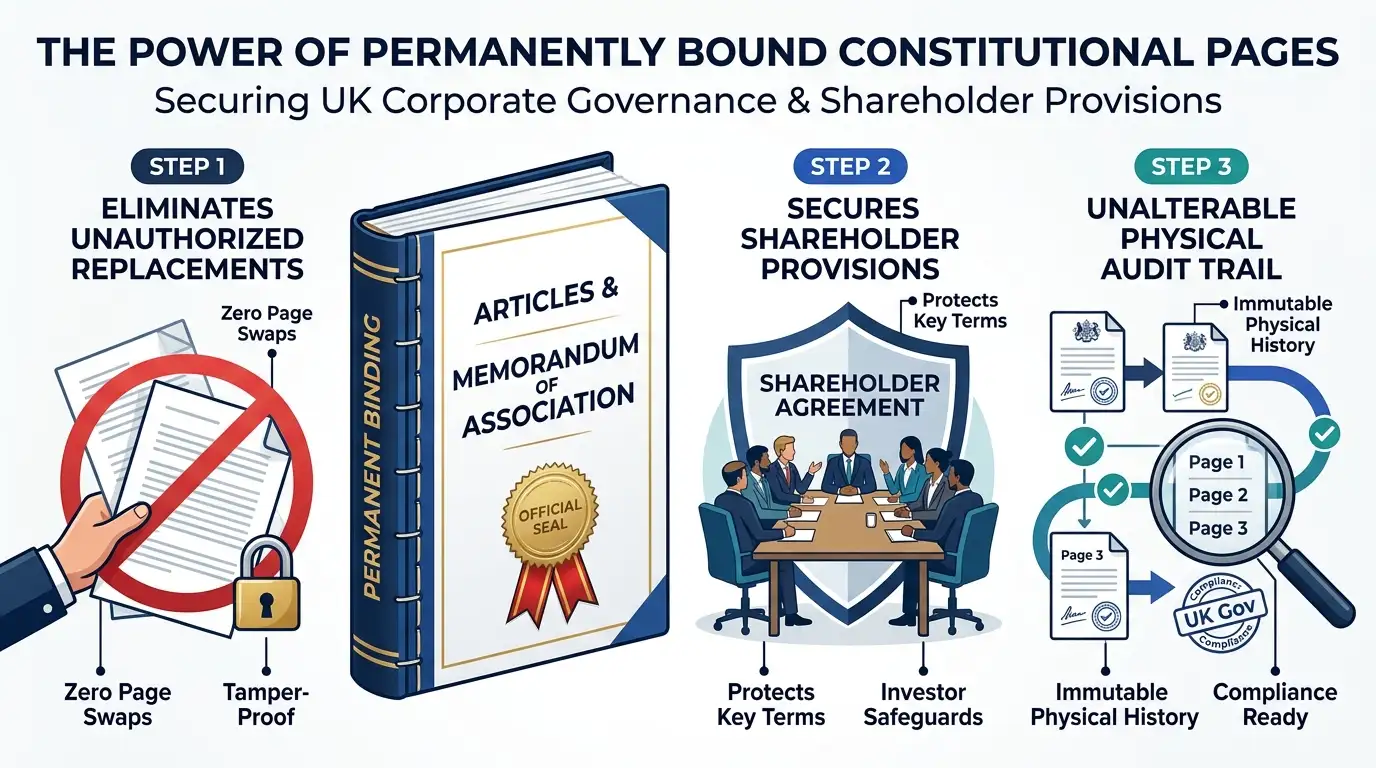
Legal disputes often center on internal governance rules and shareholder rights clauses. Loose-leaf binders permit silent page removals or additions without leaving physical evidence. A single altered page regarding share transfer restrictions or voting rights alters corporate control. Permanently bound volumes prevent silent document modifications between official filings. Thread-sewn bindings, tamper-evident spine adhesives, and heat-sealed edges ensure physical integrity.
Statutory compliance requires accurate maintenance of historical constitutional amendments. Three core corporate documents require absolute physical security: Articles of Association, Memorandum of Association, and Shareholder Agreements. Loose-leaf filings risk accidental mix-ups between draft revisions and final statutory resolutions. Bound constitutional volumes preserve exact resolution wording passed by board members.
Court proceedings require authenticated evidence of corporate regulations. Judges and legal officers scrutinize loose pages for signs of physical manipulation or missing schedules. Bound statutory volumes carry higher evidentiary weight in legal disputes due to tamper-resistant construction. Securing founding records in bound form mitigates legal exposure during shareholder disputes.
Why Do Lenders and Investors Prefer Bound Constitutional Documents?
Institutional investors and commercial banks require bound corporate constitutions to streamline legal due diligence, verify operational authority rapidly, and reduce legal transactional risks.
Commercial lenders process thousands of corporate financing applications annually. Underwriters review constitutional authority before approving loan facilities or issuing corporate credit lines. Loose-leaf constitutional submissions raise compliance flags regarding completeness and accuracy. Bound statutory books allow legal teams to verify director borrowing powers without delay. Streamlining preliminary due diligence accelerates financing approvals and transaction closing timelines.
Professional investors demand absolute clarity on share classes, pre-emption rights, and voting thresholds before injecting equity. Venture capital firms and private equity funds analyze founding documents for structural risks. Three key transaction milestones rely on constitutional review: initial term sheet execution, debt syndicate formation, and final equity drawdown. Bound documentation signals disciplined corporate management, reassuring institutional equity partners.
International business partners and overseas corporate registries require authenticated company records for cross-border joint ventures. Foreign jurisdictions frequently demand notarized or apostilled constitutional copies. Binders or stapled sets complicate official embassy authentication and notarization processes. Bound corporate books accept official notary ribbons and embossed seals without damaging paper edges.
What Are the Key Structural Features of a Premium Bound Constitution?
A premium bound company constitution features durable hardback covers, gold-foil foil embossing, thread-sewn bindings, and acid-free archive paper designed for permanent corporate record storage.
Statutory document binders utilize archival-grade material to withstand decades of handling. Premium constitutional books combine structural durability with clear typographic hierarchy. High-density board covers shield internal pages against moisture, sunlight exposure, and surface wear. Foil-stamped titles on front covers identify corporate names and registration numbers instantly.
Internal page construction requires specific technical standards:
Print statutory text on 100gsm to 120gsm acid-free archival paper
Secure internal signatures using thread-sewn casing mechanisms
Apply gold foil embossing for official company name titling
Include tabbed divider pages for distinct statutory sections
Constitutional volumes group core governance documents into organized structural sub-sections. Bookbinders sequence the Memorandum of Association first, followed by the Articles of Association and subsequent special resolutions. Clear structural boundaries prevent confusion during rapid document reviews. Professional indexing ensures directors locate specific operational clauses instantly during board meetings.
Companies maintaining high operational standards order durable statutory books through professional document printing services. Accessing specialized supplementary company documents ensures statutory compliance, proper page sequencing, and professional hardback binding for statutory filings.
How Does a Bound Constitution Improve Corporate Governance Audits?
Bound statutory volumes simplify annual governance reviews by providing a centralized, permanent, and complete physical record of all active articles and official statutory amendments.
Internal auditors inspect statutory registers annually to ensure alignment with current UK company law. Managing multiple loose-leaf statutory amendments creates administrative chaos and version control errors. Directors risk acting outside their statutory powers when relying on outdated loose-leaf revisions. Bound constitutional books centralize active rules within a single, secure volume.
Maintaining accurate constitutional records supports seamless administrative transitions when company secretaries or legal officers change. Incoming management teams review bound statutory books to understand existing operational constraints instantly. Three administrative functions benefit from centralized binding:
Verify director execution limits during contract negotiations
Confirm shareholder notification periods for annual general meetings
Validate share transfer procedures during executive buyouts
Company secretaries maintain master bound volumes alongside public Companies House filings. While digital filings satisfy statutory notification requirements, physical bound volumes remain the official reference point for internal governance. Comparing physical bound records against online registries ensures total alignment across external and internal corporate databases.
Corporate leadership teams assessing physical record formats often evaluate bound vs loose-leaf articles: which should your company keep? to select appropriate documentation standards for long-term administration.
When Should a Company Order a Professionally Bound Constitution?
Businesses should order bound constitutional volumes immediately after incorporation, following major statutory restructuring, or prior to initiating institutional fundraising and debt financing.
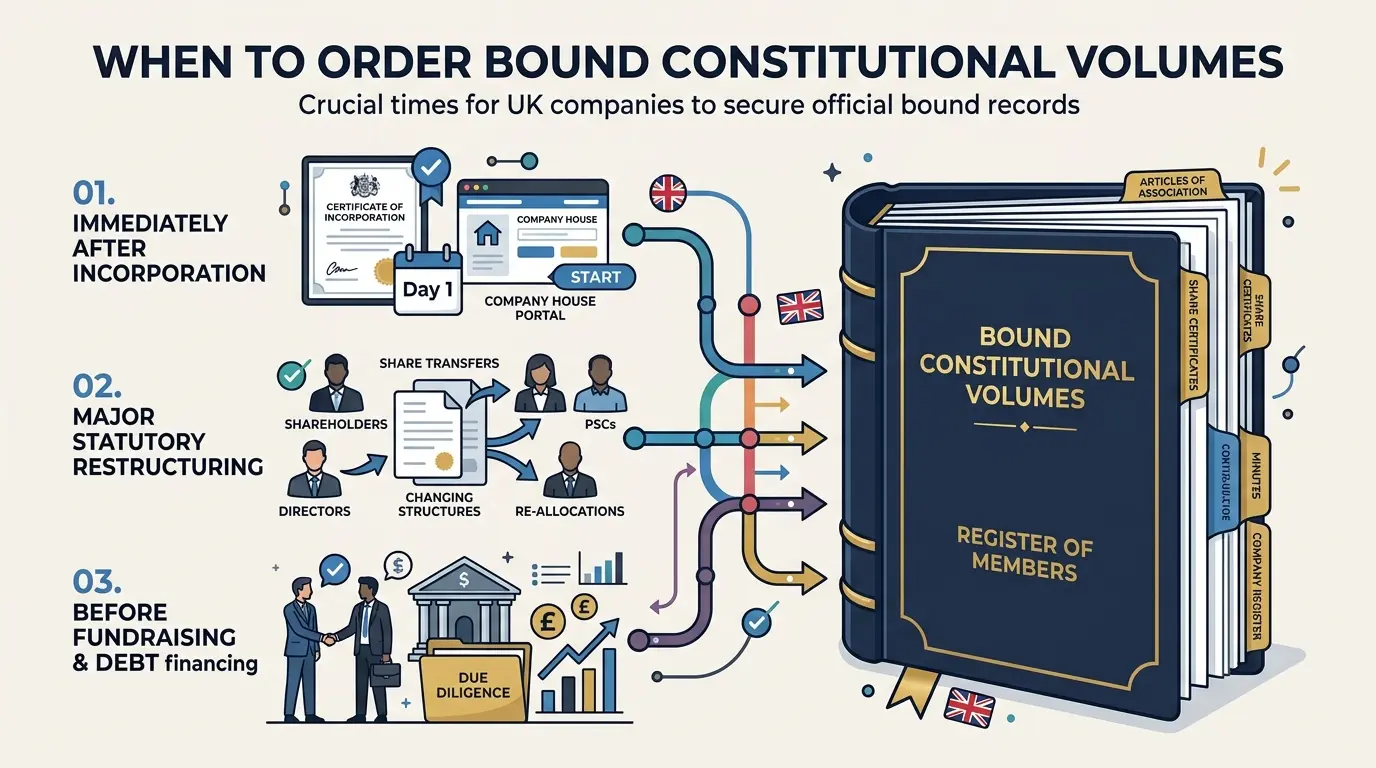
Newly incorporated companies set their operational tone during initial board meetings. Presenting founding directors with professionally bound constitutional books reinforces fiduciary responsibilities. Early-stage businesses frequently present bound documents to establish credibility when negotiating terms with early suppliers, landlords, and strategic partners.
Established companies require rebinding whenever shareholders pass special resolutions altering core articles. Appending loose resolution sheets to old binders creates cluttered, unprofessional records. Rebinding constitutional volumes incorporates updated clauses cleanly into a unified statutory document. Key corporate events triggering documentation updates include:
Creating new share classes or altering dividend distribution rules
Changing official company names or statutory business objects
Restructuring board appointment powers and voting quorums
Preparing corporate entities for initial public offerings
Executing major corporate restructuring requires pristine physical records for legal counsel. Management teams can order a premium bound memorandum & articles from Form My Company to secure durable, professionally bound statutory books tailored to updated corporate filings.
Maintaining bound constitutional books demonstrates long-term commitment to operational excellence. Premium bound volumes safeguard statutory records, protect internal governance integrity, and project authority throughout every stage of corporate growth.
A bound company constitution provides essential document security, ensures statutory compliance, and projects corporate professionalism during critical financial transactions. Replacing fragile loose-leaf papers with durable bound volumes eliminates missing pages, prevents unauthorized modifications, and streamlines legal due diligence for banks and institutional investors. Professional document presentation reflects strong internal governance and operational discipline. Form My Company delivers hardbound corporate constitutions and statutory books designed to meet rigorous regulatory and legal standards
Explore More Supplementary Company Documents Guide,
What Do Investors Look for in Your Articles of Association?
What Are the Share Transfer Rules in Articles of Association?
Frequently Asked Questions
What are supplementary company documents for a UK business?
Supplementary company documents are official statutory records—such as a bound Memorandum and Articles of Association, hard copy certificate of incorporation, and official share certificates—that support a business’s legal foundation. These statutory files are essential for verifying internal governance, confirming director authority, and maintaining regulatory compliance under UK company law. Services like Form My Company supply printed and bound supplementary documentation to complement digital Companies House filings.
Why do banks require physical statutory company documents?
Commercial banks and financial institutions request physical supplementary company documents during due diligence to verify corporate identity and prevent document tampering. Permanently bound constitutional documents and official printed certificates ensure that corporate records have not been altered or pages fraudulently substituted. Ordering certified supplementary company documents through Form My Company allows businesses to satisfy stringent Know Your Customer (KYC) and anti-money laundering (AML) checks quickly.
What is included in a company supplementary documents package?
A comprehensive supplementary company documents package typically includes a hardbound Memorandum and Articles of Association, printed certificate of incorporation, customized share certificates, and first board minutes. These physical statutory records provide a centralized physical audit trail for corporate governance and shareholder management. Providers like Form My Company compile and bind these official documents to ensure professional presentation for legal and corporate audits.
How do bound articles of association differ from loose-leaf copies?
Bound articles of association are permanently stitched or hardback-bound to prevent page removal, unauthorized edits, or physical loss over long-term administrative use. Loose-leaf documents lack tamper-evident security and wear out quickly when frequently reviewed by directors, auditors, and legal counsel. Obtaining professionally bound supplementary company documents from Form My Company ensures long-term statutory compliance and projects operational credibility to external investors.
When should a business order supplementary company documents?
A business should order supplementary company documents immediately after incorporation, following major corporate restructuring, or when preparing for institutional fundraising and debt financing. Having hard-copy statutory records ready prevents delays during contract negotiations, bank account openings, and cross-border notarization processes. Form My Company offers tailored supplementary company documents to help corporate entities maintain accurate and secure physical governance records at every stage of growth.