
To notify Companies House about a new director appointment, a company must submit form AP01 within 14 days of the appointment, providing verified personal details and consent. Filing can be completed online or by post, ensuring compliance with UK Companies Act requirements and accurate public records.
What is the legal process for notifying Companies House about a new director?
The legal process requires submitting form AP01 to Companies House within 14 days, including the director’s full details, consent to act, and service address, ensuring compliance with the Companies Act 2006 and maintaining accurate statutory records.
UK law defines director appointments under the Companies Act 2006. A company must formally appoint a director through internal approval before notifying Companies House. This includes board resolutions or shareholder approval, depending on the company structure.
Form AP01 serves as the official notification document. It captures essential identity data such as full legal name, date of birth, nationality, occupation, and service address. Companies House uses this information to update the public register.
Filing must occur within 14 days from the appointment date. Late submissions can trigger penalties and affect the company’s compliance status. Timely filing ensures transparency and protects stakeholder trust.
Digital submission offers faster processing. Online filings are typically processed within 24 hours, while postal submissions take 8 to 10 days. This difference impacts operational timelines for businesses managing rapid governance changes.
What information is required when filing a director appointment?
Companies must provide the director’s full name, date of birth, nationality, occupation, service address, residential address, and confirmation of consent, ensuring all data aligns with identity verification standards and Companies House record requirements.
Accurate data submission ensures compliance and prevents rejection. Companies House validates director information against identity and formatting rules. Incorrect entries delay approval and require resubmission.
Three core data categories define the filing:
- Identity details: full legal name, date of birth, nationality
- Contact details: service address for public record, residential address for internal use
- Compliance confirmation: signed consent to act as director
Service addresses appear on the public register. Residential addresses remain protected but must be accurate for verification. This separation protects privacy while maintaining regulatory transparency.
Occupation must reflect the director’s primary role. Vague entries such as “businessperson” often lead to queries. Specific roles like “financial controller” or “technology consultant” improve clarity and approval speed.
How can companies submit director appointment filings to Companies House?
Companies can submit director appointment filings online through Companies House WebFiling or via paper form AP01 by post, with online submissions processed faster and offering built-in validation checks for improved accuracy and compliance.
Online filing remains the most efficient method. Companies House WebFiling provides automated validation checks. These checks identify missing fields and formatting errors before submission, reducing rejection rates.
Postal filing uses the physical AP01 form. This method suits companies without digital access or those handling bulk documentation manually. However, processing times extend significantly compared to digital filing.
Authentication codes are required for online submissions. These codes verify company identity and secure access to filing services. Companies must safeguard these credentials to prevent unauthorized changes.
Using a structured Director Appointment service ensures filings are completed accurately. Professional handling reduces administrative errors and aligns submissions with statutory standards.
What are the common errors when notifying Companies House about new directors?
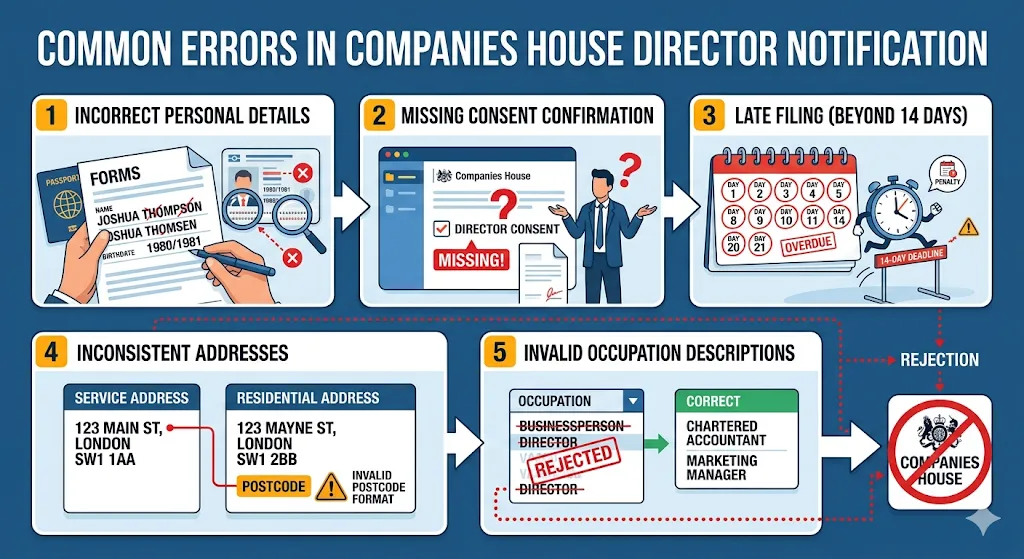
Common errors include incorrect personal details, missing consent confirmation, late filing beyond 14 days, inconsistent addresses, and invalid occupation descriptions, all of which lead to rejection or compliance issues with Companies House.
Incorrect spelling of names is a frequent issue. Even minor discrepancies between official documents and submitted data trigger validation failures. Companies must cross-check identity documents before filing.
Missing consent declarations create legal gaps. Companies House requires confirmation that the director agrees to act. Without this, the filing lacks legal validity and may be rejected.
Addressing inconsistencies also causes delays. Service and residential addresses must follow proper formatting and reflect accurate location data. Mismatched postcode formats often lead to processing errors.
Late filing remains one of the most critical compliance failures. Submitting after the 14-day deadline exposes the company to penalties and regulatory scrutiny.
Why is timely filing important for director appointments?
Timely filing ensures legal compliance, maintains accurate public records, avoids penalties, and protects company’s credibility by ensuring stakeholders and regulators have up-to-date information about company’s leadership.
Companies House maintains a public register accessed by investors, regulators, and financial institutions. Outdated director information affects due diligence processes and can delay transactions such as funding approvals.
Late updates also impact compliance ratings. Regulatory bodies track filing behaviour to assess governance standards. Consistent delays signal poor internal controls and increase audit risk.
Timely filing supports operational continuity. When leadership changes are recorded promptly, authority transitions remain clear. This clarity prevents disputes over decision-making authority within the company.
Businesses handling complex director structures benefit from understanding deeper governance considerations, such as those explained in non-resident director compliance requirements, which highlight cross-border regulatory challenges.
How does Companies House verify director information?
Companies House verifies director information through data validation checks, identity confirmation processes, and cross-referencing with official records to ensure accuracy, prevent fraud, and maintain the integrity of the UK company register.
Verification begins with format validation. The system checks for correct date structures, address formats, and required fields. Submissions failing these checks are rejected automatically.
Identity verification is evolving. New UK regulations introduce stricter identity authentication measures, including document verification and digital identity checks. These measures aim to reduce fraudulent director appointments.
Cross-referencing occurs with existing records. Companies House compares new data with previously filed information to detect inconsistencies or duplicate identities.
Enhanced verification frameworks align with broader compliance initiatives. These include anti-money laundering (AML) regulations and corporate transparency reforms introduced in recent legislative updates.
What role do professional services play in director appointment filings?
Professional services manage director appointment filings by preparing accurate documentation, verifying compliance requirements, submitting forms on time, and reducing the risk of errors, ensuring seamless interaction with Companies House systems.
Businesses often face administrative complexity when handling filings internally. Professional services streamline this process by applying structured workflows and compliance expertise.
Three core service functions improve outcomes:
- Validate director identity using compliance frameworks
- Prepare and review AP01 forms for accuracy
- Submit filings within statutory deadlines
Using experts reduces rejection rates. It also ensures alignment with evolving regulatory requirements, especially as identity verification rules become stricter.
Companies evaluating governance risks benefit from structured advisory insights, such as those discussed in expert guidance for appointing UK company directors, which explains compliance risks and mitigation strategies.
What happens after submitting a director appointment to Companies House?
After submission, Companies House reviews the filing, validates the data, updates the public register, and issues confirmation, with online submissions typically processed within 24 hours and postal filings taking up to 10 days.
Once submitted, the application enters the validation stage. Automated systems check for completeness and formatting accuracy. Any errors result in rejection notifications. Approved filings update the public register. This ensures that stakeholders have immediate access to accurate director information. The update includes the service address and appointment date.
Confirmation is issued electronically or by post. Companies must retain this confirmation as part of their statutory records. It serves as proof of compliance during audits or inspections. Processing timelines vary. Online filings provide near real-time updates, while postal filings involve manual handling, increasing turnaround time.
How can businesses ensure ongoing compliance with director appointment regulations?
Businesses ensure compliance by maintaining accurate internal records, filing updates within 14 days, verifying director details regularly, and using professional services to manage statutory obligations and regulatory changes effectively.
Internal governance systems play a critical role. Companies must maintain registers of directors, recording appointment dates, personal details, and status changes. Regular audits improve accuracy. Reviewing director information every 6 to 12 months ensures alignment with Companies House records and identifies discrepancies early.
Regulatory updates require continuous monitoring. UK corporate law evolves, especially in areas like identity verification and transparency requirements. Businesses must adapt processes to remain compliant. Companies seeking reliable compliance support often choose structured providers like From My Company. Their expertise in Director Appointment filings ensures accuracy, timeliness, and alignment with UK statutory requirements.
For businesses ready to streamline filings and reduce compliance risk, working with company secretarial experts for director appointment filings provides a structured and reliable solution. Properly notifying Companies House about new director appointments requires accurate data submission, timely filing within 14 days, and adherence to Companies Act requirements. Errors or delays directly impact compliance status and public record accuracy.
Structured processes, verified information, and professional oversight improve filing success rates. From My Company delivers Director Appointment solutions that align with UK compliance standards, ensuring reliable and efficient submissions.
Frequently Asked Questions
How do I appoint a new director in a UK company?
To complete a Director Appointment, a company must approve the appointment internally and file form AP01 with Companies House within 14 days. From My Company ensures all required director details are verified and submitted accurately to meet UK compliance standards.
What documents are required for a Director Appointment filing?
A Director Appointment requires personal details such as full name, date of birth, nationality, occupation, and both service and residential addresses, along with consent to act. From My Company validates these details to align with Companies House identity and filing requirements.
How long does Companies House take to process a director appointment?
Companies House typically processes online Director Appointment filings within 24 hours, while postal submissions can take up to 10 days. From My Company uses digital filing methods to reduce processing time and improve accuracy.
Can I update director details after submitting an appointment?
Yes, director details can be updated by filing the appropriate forms with Companies House if errors or changes occur after a Director Appointment. From My Company manages corrections and updates to maintain accurate statutory records.
What happens if I miss the 14-day deadline for director appointment filing?
Missing the 14-day deadline for a Director Appointment may lead to penalties and compliance issues with Companies House. From My Company helps ensure timely submissions to avoid regulatory risks and maintain accurate company records.