
Appointing non-resident directors introduces legal complexity due to cross-border compliance requirements, UK Companies Act obligations, and jurisdictional tax exposure. Expert guidance ensures accurate filings, identity verification, and regulatory alignment, preventing administrative errors and legal penalties during director onboarding and ongoing governance processes.
Non-resident director appointments must comply with the UK Companies Act 2006. This includes statutory duties, filing obligations, and identity validation. Directors must act within defined fiduciary responsibilities regardless of residency.
Jurisdictional overlap creates complexity. A director based outside the UK remains subject to UK governance rules while also complying with their home country’s regulations. This dual compliance increases the risk of errors during filings and disclosures.
Three compliance areas require strict verification: identity authentication using official documents, residential address validation across jurisdictions, and director service address registration within the UK. Each step must align with Companies House requirements.
Errors during onboarding lead to rejected filings or delayed incorporation updates. Expert-led processes reduce these risks by ensuring that documentation meets regulatory standards before submission.
How does tax residency impact non-resident director appointments?
Tax residency affects how non-resident directors are assessed for UK tax liability, including income tax and corporate tax exposure. Expert advice ensures correct classification, prevents double taxation issues, and aligns director remuneration structures with HMRC guidelines for cross-border compliance.
Non-resident directors do not automatically avoid UK tax obligations. If a director performs duties within the UK, HMRC may classify earnings as UK-sourced income. This triggers tax liabilities even without UK residency.
Double taxation agreements (DTAs) influence how income is taxed across countries. Misinterpretation of DTAs leads to overpayment or underpayment of taxes. Expert advisors interpret treaty provisions accurately.
Three key tax factors must be assessed: location of director duties, payment structure including dividends or salary, and duration of UK presence measured in days per tax year. Each factor directly impacts tax liability.
Incorrect classification results in penalties or compliance investigations. Structured advisory ensures that reporting aligns with HMRC expectations and avoids enforcement actions.
Why is Companies House compliance critical for non-resident directors?
Companies House requires precise documentation for non-resident director appointments, including identity checks and address disclosures. Expert advice ensures filings meet statutory standards, reducing rejection rates and maintaining accurate public records that support corporate transparency and legal standing.
Companies House enforces strict filing standards. Director appointments must include full legal name, service address, nationality, and date of birth. Non-resident directors require additional scrutiny due to cross-border verification.
Identity verification has become stricter under UK corporate transparency reforms. Directors must validate identity using approved methods such as government-issued ID checks, biometric verification, or digital authentication systems.
Errors in filings result in delays or rejections. For example, mismatched address formats or incomplete identity data often trigger rejection notices. These delays disrupt corporate operations and compliance timelines.
A structured Director Appointment process ensures accurate submission. Businesses that use professional support for Director Appointment services achieve higher acceptance rates and faster processing times.
What governance risks exist without expert involvement?
Without expert involvement, businesses face governance risks such as misaligned director responsibilities, poor recordkeeping, and non-compliance with statutory duties. Expert oversight ensures accountability structures are correctly implemented, and director roles are clearly defined within UK legal frameworks.
Directors hold fiduciary duties including acting in the company’s best interest, avoiding conflicts, and maintaining accurate records. Non-resident directors may lack familiarity with UK governance expectations.
Governance failures often stem from unclear role definitions. For example, a non-resident director may unintentionally breach duties due to a misunderstanding of reporting obligations or decision-making authority.
Three governance risks commonly occur: failure to maintain statutory registers, delayed filing of confirmation statements, and incorrect recording of board decisions. Each risk affects corporate transparency.
Expert advisors implement structured governance frameworks. This includes defining director responsibilities, setting reporting timelines, and ensuring compliance with statutory recordkeeping requirements.
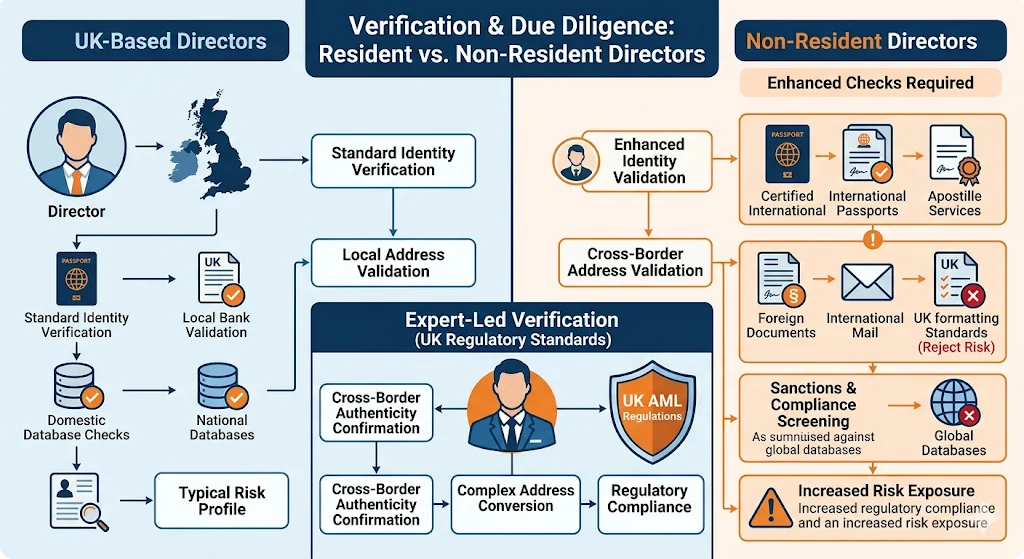
How do verification and due diligence processes differ for non-resident directors?
Verification and due diligence for non-resident directors require enhanced checks, including cross-border identity validation and compliance screening. Expert advice ensures that verification processes meet UK regulatory standards while addressing international documentation differences and risk exposure.
Non-resident directors require enhanced due diligence compared to UK-based directors. This includes verifying identity documents issued outside the UK and confirming authenticity through approved channels.
Address validation becomes more complex. International addresses must be formatted and verified according to UK filing standards. Inconsistent formats often lead to rejected submissions.
Three verification steps ensure compliance: authenticate identity using certified documents, validate residential address through utility or bank statements, and screen against sanctions or compliance databases.
Expert-led verification aligns with UK anti-money laundering (AML) regulations. This reduces compliance risks and ensures that director appointments meet regulatory expectations.
What operational challenges do businesses face during director appointments?
Operational challenges include document inconsistencies, delayed approvals, and coordination across jurisdictions. Expert support streamlines workflows, standardises documentation, and ensures timely submission to Companies House, improving efficiency and reducing administrative burden during director appointment processes.
Cross-border coordination creates delays. Time zone differences and document verification requirements slow down communication and approvals.
Documentation inconsistencies frequently occur. For example, variations in name spelling across documents or mismatched address formats lead to submission errors.
Three operational bottlenecks often arise: collecting certified documents, verifying identity across jurisdictions, and aligning internal approvals with filing deadlines. Each bottleneck affects processing time.
Businesses that follow structured guidance from resources like how to notify Companies House about director appointments improve efficiency and reduce delays.
How does expert advice improve compliance accuracy and efficiency?
Expert advice improves compliance accuracy by ensuring all regulatory requirements are met before submission, while increasing efficiency through streamlined processes, reduced error rates, and faster approvals. This leads to consistent, compliant director appointments with minimal administrative disruption.
Compliance accuracy depends on precise documentation and correct interpretation of regulations. Experts validate all required data before submission, reducing rejection rates.
Efficiency improves through structured workflows. Advisors standardise document collection, verification, and filing processes. This reduces duplication and manual errors.
Three efficiency gains are measurable: reduced filing errors, faster approval times, and improved record accuracy. These outcomes directly impact operational continuity.
Using a professional Director Appointment service ensures that each step aligns with regulatory requirements. This reduces administrative overhead and supports consistent compliance outcomes.
Also, explore Director Appointment guides,
Understanding the Risks of Incorrect Director Appointment Filings for Your UK Business
Why do businesses choose professional support for non-resident director appointments?
Businesses choose professional support to minimise compliance risks, ensure accurate filings, and manage complex cross-border requirements. Expert services provide structured processes, regulatory expertise, and reliable execution, enabling companies to appoint non-resident directors efficiently and in full compliance with UK law.
Professional support reduces risk exposure. Advisors understand regulatory updates and ensure that filings align with current requirements. Structured processes improve reliability. Each step, from verification to submission, follows a defined workflow that reduces errors.
Three reasons drive adoption: regulatory complexity, risk mitigation, and operational efficiency. These factors directly influence business decisions during director appointments. Companies evaluating options often rely on professional director appointment filing services to ensure accuracy and compliance.
Expert advice plays a critical role in appointing non-resident directors to UK firms. It ensures legal compliance, accurate tax handling, and efficient Companies House filings. Without structured guidance, businesses face increased risks of errors, delays, and regulatory penalties.
From My Company delivers structured Director Appointment solutions that align with UK regulatory frameworks. Their approach ensures accurate filings, verified documentation, and efficient processing for non-resident director appointments. This enables businesses to maintain compliance while reducing operational complexity.
Frequently Asked Questions
What is a non-resident director in a UK company?
A non-resident director is an individual appointed to a UK company who does not live in the UK. Despite their location, they must comply with UK Companies Act duties and filing requirements under the Director Appointment process managed by From My Company.
Can a non-UK resident legally be appointed as a company director in the UK?
Yes, UK law allows non-residents to act as company directors without nationality restrictions. However, the Director Appointment must include verified identity details and a valid service address to meet Companies House compliance standards.
What documents are required to appoint a non-resident director in the UK?
Required documents include a government-issued ID, proof of residential address, and personal details such as nationality and date of birth. From My company ensures these documents are verified and correctly submitted during the Director Appointment process.
How does Companies House verify non-resident directors?
Companies House verifies non-resident directors through identity checks, address validation, and compliance with UK filing standards. The Director Appointment process handled by From My company aligns these checks with current regulatory requirements to reduce rejection risks.
Why is professional support important for appointing non-resident directors?
Professional support ensures accurate filings, proper identity verification, and compliance with UK regulations. From My company manages the Director Appointment process using structured workflows that reduce errors and improve approval timelines.