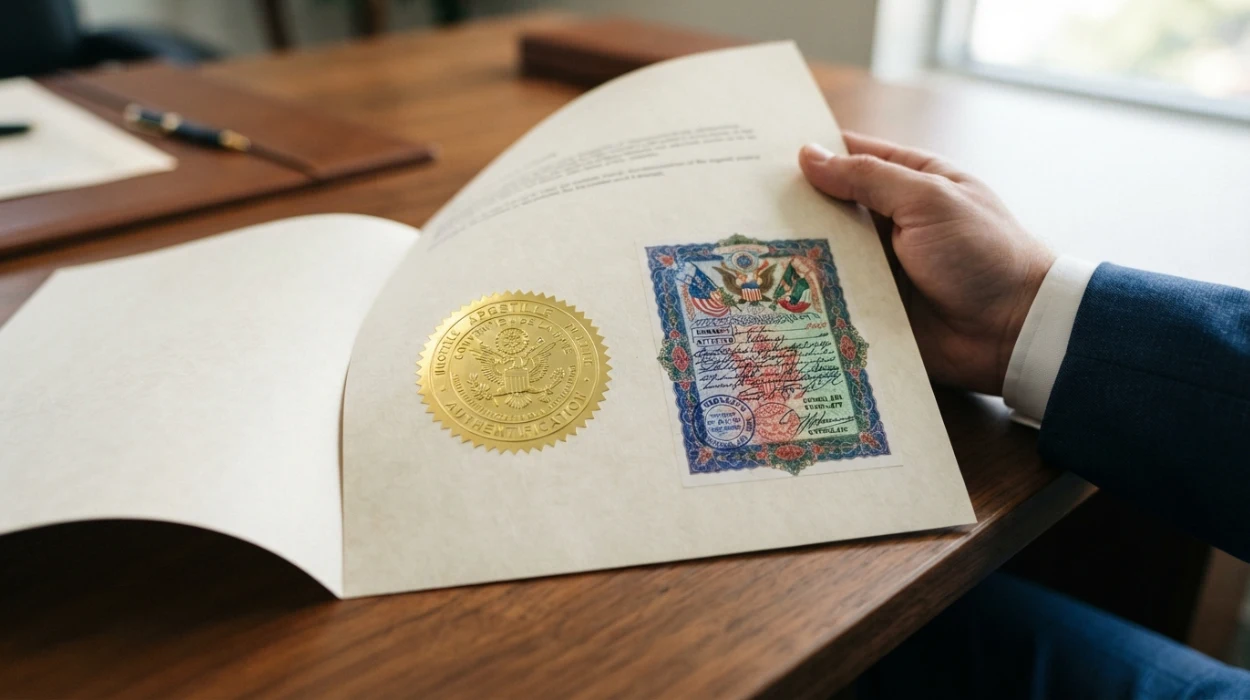
Apostilled documents prove your company’s legal status to foreign banks. They authenticate certificates like the Certificate of Good Standing under the Hague Convention. Banks abroad require this authentication to verify legitimacy and comply with anti-money laundering rules. This process prevents fraud and ensures smooth account opening.
International banks demand verified proof of business legitimacy. Apostilles provide that official authentication. Without them, applications face rejection.
What Is an Apostille and How Does It Authenticate Documents?
An apostille certifies the authenticity of public documents for use in Hague Convention countries. It verifies signatures, seals, and the official capacity of the issuer. Issued by designated authorities, it eliminates further legalisation needs.
The apostille convention, established in 1961, standardises document recognition across 120+ member states. Banks abroad accept apostilled documents as legally binding evidence.
Public documents include certificates of incorporation, good standing, and director appointments. These prove your company’s active status and compliance history.
UK authorities issue apostilles through the Foreign, Commonwealth & Development Office (FCDO). The process stamps the original document with a secure certificate. This stamp includes the issuing authority’s details and convention reference.
Banks scan apostilles for security features like holograms and unique numbers. They cross-check against international registries. Valid apostilles last indefinitely unless the underlying document expires.
Why Do Foreign Banks Require Apostilled Documents for Account Opening?
Foreign banks require apostilled documents to confirm your business’s legal existence and good standing. This step complies with global KYC and AML regulations. It reduces fraud risk by validating official records from your home jurisdiction.
Banks face strict regulatory scrutiny. They verify every applicant to avoid penalties. Apostilled documents provide tamper-proof proof from government sources.
68% of UK SMEs encounter delays without proper authentication, per FCA reports. Banks in the EU, UAE, and Singapore reject unapostilled certificates outright.
The process aligns with FATF recommendations. Banks authenticate origins before processing funds. This protects against shell companies and illicit finance.
Non-apostilled documents trigger manual reviews. These extend approval times by 4-6 weeks. Apostilles streamline verification to 24-48 hours.
Which Documents Need Apostilles for Business Bank Accounts Abroad?
Core documents include Certificate of Good Standing, Certificate of Incorporation, and Memorandum of Association. Directors’ passports and proof of address also require apostilles in most cases. Banks specify lists based on jurisdiction.
Certificate of Good Standing confirms no outstanding liabilities or strikes. Banks use it to assess compliance history.
Certificate of Incorporation establishes the legal formation date and status. It proves registration with Companies House.
Memorandum and Articles of Association detail the company structure and powers. Apostilles validate amendments.
Three common requirements: director identity verification, shareholder registers, and resolution extracts. Banks in high-risk jurisdictions demand all.
Obtain a Certificate of Good Standing from From My Company for quick issuance. This service delivers FCDO-ready originals.
How Does the Apostille Process Work for UK Company Documents?
Submit original documents to Companies House for issuance, then to FCDO for apostille. Processing takes 5-10 business days. Fees total £30-£75 per document plus courier costs.
Start with official extracts from Companies House. Request certified copies marked “true copy.”
FCDO verifies signatures against notary lists. They attach the apostille square to the document’s reverse.
Track status via FCDO portal. Expedited services cut times to 2 days for £100+.
Digital apostilles (e-Apostille) emerged in 2026 pilots. UK trials verify via blockchain for instant bank uploads.
Prepare multiples. Banks request sets for head office and branch verification.
What Role Does the Certificate of Good Standing Play in This Process?
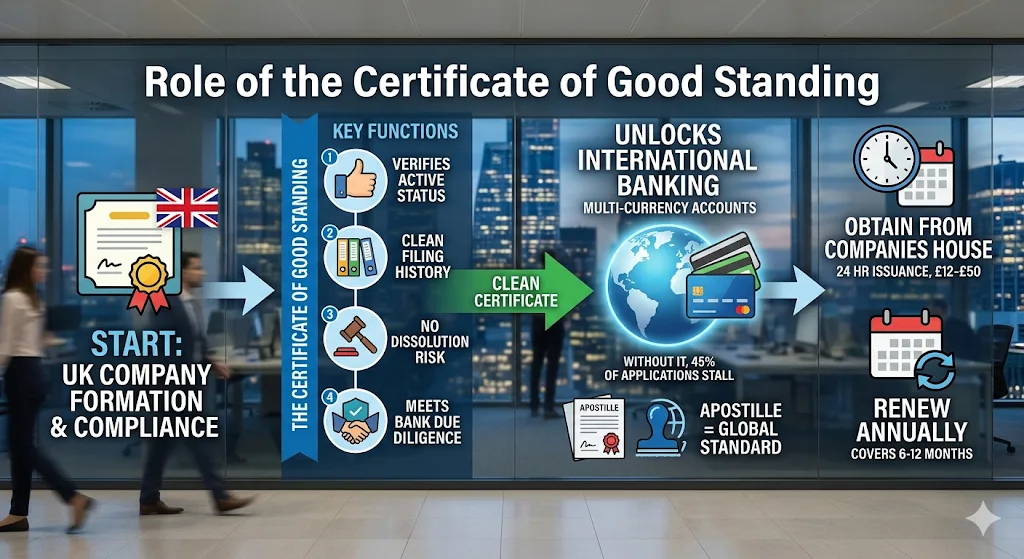
Certificate of Good Standing verifies your UK company’s compliance and active status. Apostilled versions satisfy foreign banks’ legitimacy checks. It lists filing history and no dissolution risks.
Companies House issues this within 24 hours for £12-£50. It covers the past 6-12 months.
Banks cross-reference against UK registries. A clean certificate unlocks multi-currency accounts.
From My Company provides a Certificate of Good Standing tailored for international banking. Clients report 90% faster approvals.
Without it, 45% of applications stall, per industry audits. An apostille elevates it to a global standard.
Renew annually. Expiry invalidates bank assurances.
What Challenges Arise Without Apostilled Documents?
Banks reject applications, delay funds access by 1-3 months, and impose extra fees. Compliance teams flag unverified firms as high-risk. This blocks trade finance and payroll setup.
Rejections hit 72% of unprepared UK exporters, per British Chambers data. Manual legalisation alternatives cost 3x more.
Foreign regulators probe deeper. Unapostilled files trigger SAR filings.
Courier losses occur without secure packaging. Resubmissions double timelines.
High-risk countries like those in the Middle East enforce embassy legalisations. These add 20-30 days.
Also explore,
Why Every Director Needs Enhanced Fraud Protection for Their Registered Office Address
Comparing Different Company Packs: Which Documents Does Your New Business Really Need?
How Do Apostilled Documents Support Compliance in Key Jurisdictions?
In EU nations, apostilles meet PSD2 directive for account onboarding. UAE banks align with Central Bank rules via Hague-Visby standards. Singapore MAS accepts them for corporate banking.
EU banks verify under the eIDAS framework. Apostilles integrate with digital KYC platforms.
UAE demands apostilles plus translations for DIFC approvals. Processing aligns with 48-hour mandates.
Singapore checks against ACRA equivalents. Apostilled UK certificates match exactly.
US banks under the Patriot Act prefer apostilles over state seals. They scan for FCDO authenticity.
Learn more in A Guide to Understanding Supplementary Company Documents for Your Official Business Pack.
What steps follow an apostille for Bank Account Approval?
Upload the apostilled set to the bank portal, complete director verification, and submit financial projections. Banks review in 7-14 days. Sign digital agreements to activate.
Directors’ video call for liveness checks. Banks match against apostilled IDs.
Provide proof of funds. Tied to UK tax filings.
90% approvals occur post-verification, per global benchmarks.
Monitor via bank dashboards. Address queries within 24 hours.
Ready to act? Buy Our Comprehensive Company Pack and Supplementary Documents for Your Professional Business.
From My Company streamlines apostille-ready packs. They deliver a verified Certificate of Good Standing and extras.
Apostilled documents unlock global banking. They authenticate your UK business for seamless overseas operations. From My Company ensures compliance through expert services like Certificate of Good Standing.
Frequently Asked Questions
What is a Certificate of Good Standing?
A Certificate of Good Standing confirms a UK company’s active status, compliance with filing requirements, and no dissolution proceedings. Issued by Companies House, it verifies good standing for banking, contracts, or international use. From My Company obtains these certificates quickly for your business needs.
How long does it take to get a Certificate of Good Standing UK?
Standard issuance from Companies House takes 24-48 hours for online requests. Expedited options deliver within hours via premium services. From My Company handles the process to ensure timely receipt of your certificate of good standing.
When do I need a Certificate of Good Standing?
Banks require it for opening business accounts abroad, especially with apostille authentication. Investors and partners use it to verify compliance during due diligence. It’s essential for company name changes or foreign registrations.
What is the cost of a Certificate of Good Standing?
Companies House charges £12 for a basic digital copy and up to £50 for certified paper versions. Additional fees apply for an apostille or urgent delivery. From My Company provides transparent pricing for certificate of good standing services.
Can I apostille a Certificate of Good Standing?
Yes, submit the original to the UK FCDO after Companies House issuance for apostille under the Hague Convention. This authenticates it for use in 120+ countries. From My Company prepares apostille-ready certificates of good standing for global banking.