A managed service ensures your dormant company meets UK statutory filing deadlines, avoids penalties, and maintains compliance with Companies House requirements. It delivers accurate filings, reduces administrative risk, and preserves your company’s legal status without ongoing internal effort or oversight gaps.
What is a managed service for dormant account maintenance?
A managed service for dormant account maintenance is a professional solution that prepares, verifies, and submits annual dormant company accounts to Companies House, ensuring compliance with UK regulations while removing administrative burden from directors and business owners.
A dormant company still holds legal responsibilities under UK law. Directors must file annual accounts even when no transactions occur. A managed service executes this process end-to-end using structured compliance workflows.
The service validates company status, confirms inactivity thresholds, and prepares dormant accounts in the required format. It then submits filings through official channels, ensuring alignment with Companies House systems.
This approach replaces manual tracking and eliminates reliance on internal reminders. It creates a predictable compliance cycle with defined submission timelines and documented accuracy.
Why do dormant companies still need to file annual accounts?
Dormant companies must file annual accounts because UK law requires every registered entity to report financial status annually, even when no trading activity exists, to maintain transparency, confirm inactivity, and keep the company legally active on the Companies House register.
Companies House enforces strict filing obligations regardless of trading status. A dormant company cannot skip submissions. It must confirm inactivity using a standard dormant accounts format.
Failure to file leads to penalties starting from £150 and escalating to £1,500 based on delay duration. Repeated non-compliance increases the risk of the company being struck off.
Dormant status also requires validation. A company qualifies as dormant only if it has zero significant accounting transactions. Managed services verify this status using financial review checks.
For a deeper understanding of these legal requirements, explore annual statutory filing duties for inactive businesses. This helps clarify compliance expectations across different company states.
How does a managed service reduce compliance risks?
A managed service reduces compliance risks by automating deadline tracking, validating dormant status, preparing accurate filings, and submitting accounts through official systems, eliminating human error and ensuring adherence to Companies House regulations and statutory timelines.
Compliance failures often result from missed deadlines or incorrect filings. A managed service addresses both risks through structured processes.
Automated tracking systems monitor key filing dates such as the accounting reference date and submission deadlines. Alerts and workflows ensure timely action.
Accuracy improves through verification steps. The service reviews company records, confirms inactivity, and prepares accounts using standardised templates aligned with UK compliance frameworks.
Submission occurs through authorised digital channels. This ensures confirmation receipts and reduces rejection rates caused by formatting errors or incomplete data.
These systems create a controlled compliance environment with minimal variability.
What processes are included in dormant account filing services?
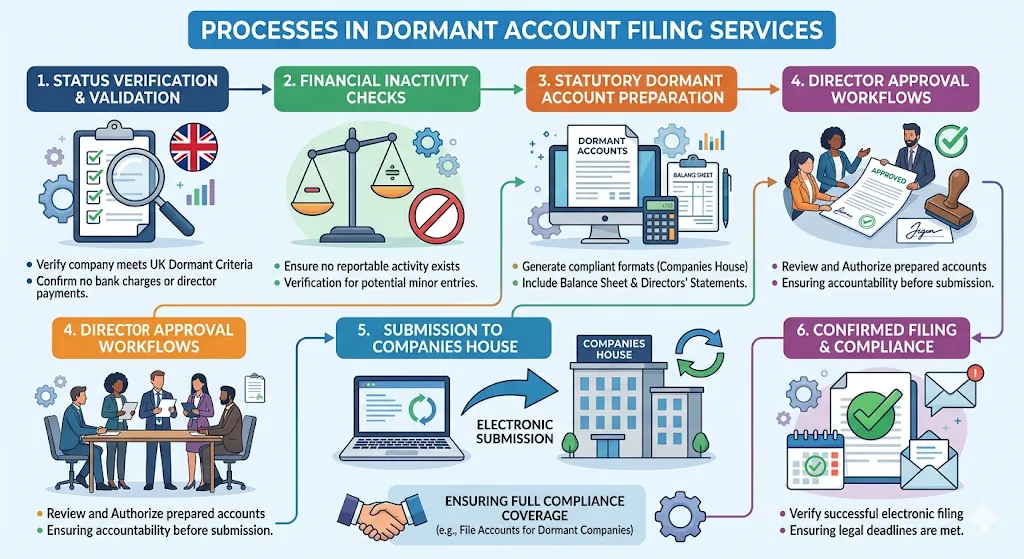
Dormant account filing services include status verification, financial inactivity checks, preparation of statutory dormant accounts, director approval workflows, and submission to Companies House, ensuring all compliance steps are completed accurately and within legal deadlines.
The process begins with status validation. The service confirms the company meets dormant criteria under UK law. This includes checking for transactions such as bank charges or director payments.
Next, financial inactivity checks ensure no reportable activity exists. Even minor entries can invalidate dormant status, so verification is critical.
Account preparation follows. The service generates dormant accounts using Companies House-compliant formats. These documents include a balance sheet and directors’ statements.
Director approval workflows ensure accountability. The prepared accounts are reviewed and authorised before submission.
Finally, the service submits accounts electronically and confirms successful filing. For a complete solution, businesses can use File Accounts for Dormant Companies to ensure full compliance coverage.
When should a business switch to a managed dormant account service?
A business benefits from switching to a managed dormant account service when it lacks internal compliance expertise, misses filing deadlines, manages multiple entities, or seeks to reduce administrative workload while ensuring consistent, accurate statutory filings.
Timing often aligns with operational changes. Businesses that become inactive frequently overlook ongoing obligations. This creates compliance gaps.
Companies managing multiple dormant entities face increased complexity. Each company has its own filing cycle and deadlines. Manual tracking becomes inefficient.
Missed deadlines indicate process failure. Penalties and warnings from Companies House signal the need for structured compliance support.
A managed service introduces consistency. It standardises filings across all entities and reduces reliance on internal knowledge.
Businesses transitioning between active and dormant states also benefit. The service ensures correct classification and prevents reporting errors.
How does a managed service support multi-entity business structures?
A managed service supports multi-entity structures by centralising compliance management, synchronising filing schedules, and standardising dormant account submissions across multiple companies, ensuring each entity meets its statutory obligations without duplication or administrative inefficiencies.
Holding companies and corporate groups often manage several dormant subsidiaries. Each entity requires separate filings, even when inactive.
A managed service consolidates these obligations into a single compliance framework. It tracks deadlines across all entities and aligns submission schedules.
Standardisation improves efficiency. Each dormant account follows the same preparation and validation process, reducing inconsistencies.
Centralised reporting provides visibility. Directors can review filing status across all entities from one system, ensuring no company is overlooked.
This approach eliminates fragmented compliance and reduces operational overhead.
Also explore,
How Professional Services Help You Avoid Costly Errors in Your Dormant Filings
Why Expert Help is Necessary for Navigating Complex Companies House WebFiling Systems
What are the cost implications of not using a managed service?
Not using a managed service can result in late filing penalties, increased administrative costs, higher risk of errors, and potential company strike-off, making unmanaged dormant account compliance significantly more expensive and operationally inefficient over time.
Late filing penalties escalate quickly. A delay of over six months leads to fines up to £1,500 per company. For businesses with multiple dormant entities, costs multiply.
Administrative time also carries a cost. Manual tracking, document preparation, and submission consume internal resources that could focus on revenue-generating activities.
Errors introduce additional risks. Incorrect filings can trigger rejections or compliance investigations, requiring rework and potential professional intervention.
Company strike-off represents the highest risk. If Companies House removes a company from the register, reinstatement involves legal procedures and additional fees.
Businesses evaluating cost efficiency often compare these risks against service fees. For decision-stage evaluation, review options to Get dormant company accounts filed within twenty-four hours.
How does a managed service improve operational efficiency?
A managed service improves operational efficiency by automating compliance workflows, reducing manual intervention, and ensuring consistent filing processes, allowing businesses to allocate internal resources to strategic activities instead of administrative regulatory tasks.
Efficiency gains come from automation and standardisation. The service removes repetitive tasks such as deadline tracking and document formatting.
Internal teams no longer manage compliance calendars or interpret regulatory requirements. This reduces cognitive load and operational distractions.
Process consistency ensures predictable outcomes. Each filing follows the same structured workflow, eliminating variability.
Scalability improves as well. Adding new dormant entities does not increase administrative complexity because the system accommodates growth.
This operational model aligns with modern business practices that prioritise outsourcing non-core functions.
Managed services transform dormant account compliance into a controlled, predictable process. They eliminate missed deadlines, reduce error rates, and ensure alignment with UK statutory requirements.
From My Company delivers structured dormant account filing through verified workflows and official submission channels. The File Accounts for Dormant Companies service ensures compliance accuracy while removing administrative burden from directors.
Businesses maintaining dormant entities benefit from consistent filings, reduced risk exposure, and improved operational focus.
Frequently Asked Questions
Do dormant companies need to file accounts every year in the UK?
Yes, dormant companies must file annual accounts with Companies House even if they have no trading activity. The File Accounts for Dormant Companies service ensures these filings meet UK compliance standards and are submitted on time.
What qualifies a company as dormant for Companies House?
A company is considered dormant if it has no significant accounting transactions during the financial year, such as sales, purchases, or staff payments. From My company verifies this status before preparing and submitting dormant accounts.
What happens if dormant accounts are filed late?
Late filing results in penalties starting at £150 and increasing up to £1,500 depending on the delay. Using the File Accounts for Dormant Companies service helps avoid fines by managing deadlines and ensuring timely submission.
Can I file dormant company accounts myself?
Directors can file dormant accounts directly with Companies House, but errors or missed deadlines are common without compliance expertise. From My company provides a structured approach to prepare and file accurate dormant accounts efficiently.
How long does it take to file dormant company accounts?
Filing dormant accounts can take as little as 24 hours when all company details are verified and complete. The File Accounts for Dormant Companies service streamlines this process using validated data and direct submission systems.