
The 2026 filing rules introduce stricter verification, tighter deadlines, and enhanced data accuracy requirements for UK companies. Businesses must now validate ownership details, submit confirmation statements more precisely, and align filings with updated Companies House compliance standards to avoid penalties and maintain legal standing.
What changes were introduced in the 2026 filing rules?
The 2026 rules enforce identity verification for directors, require more accurate shareholder reporting, and introduce stricter filing timelines. These updates aim to improve transparency, reduce fraud, and ensure that Companies House records reflect real-time, verified company data.
The UK government updated Companies House requirements under the Economic Crime and Corporate Transparency framework. These changes directly impact how companies submit their annual confirmation statements. Every data point must now align with verified records.
Identity verification now applies to three roles: directors, persons with significant control (PSCs), and company presenters. Each individual must authenticate identity using approved methods such as biometric ID checks, digital verification platforms, or official document validation.
Data accuracy rules have tightened. Companies must confirm that shareholder structures, SIC codes, and registered office details match current records. Even minor discrepancies trigger rejection or compliance flags.
Filing deadlines remain annual, but enforcement has become stricter. Late or incorrect submissions now lead to faster penalties and potential company strike-off actions.
How do the new rules impact your annual confirmation statement?
The updated rules require businesses to submit more detailed and verified information within stricter deadlines. Companies must ensure all ownership, control, and operational data is accurate at the time of filing, not just annually reviewed.
The confirmation statement now acts as a real-time compliance document rather than a simple annual check. Businesses must confirm that all details are correct on the filing date. This includes share allocations, PSC status, and company activities.
Verification requirements increase the preparation workload. Directors must ensure identity checks are completed before submission. This step adds an extra compliance layer that did not exist in earlier filing cycles.
Errors now carry higher consequences. Companies House systems automatically flag inconsistencies between submitted data and existing records. This includes mismatched addresses, outdated shareholder percentages, or incorrect SIC classifications.
Digital filing systems now integrate validation checks. These systems reject submissions that fail verification protocols. As a result, businesses must prepare documentation in advance rather than correcting issues after submission.
Why is identity verification now mandatory for company filings?
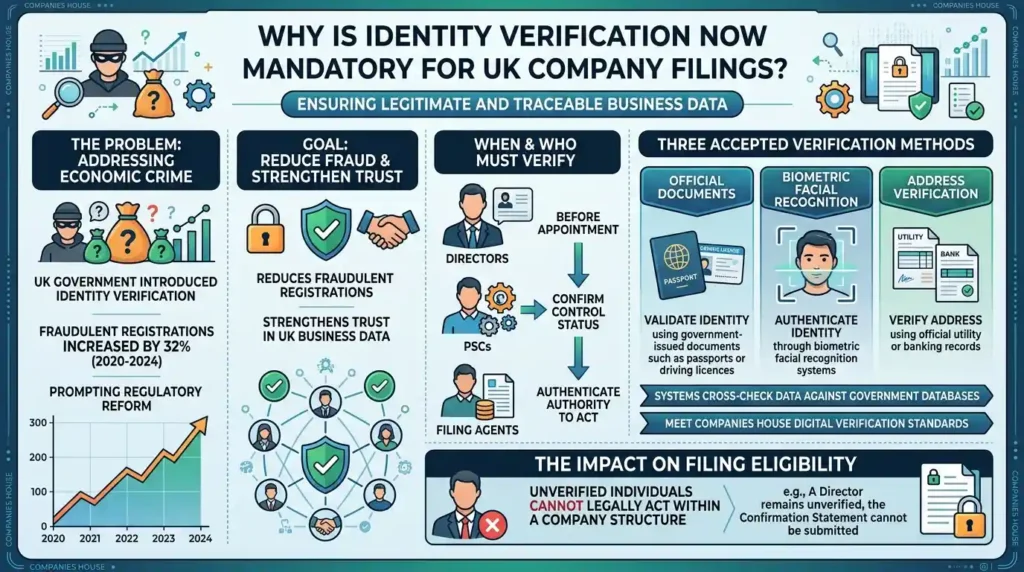
Identity verification ensures that all individuals linked to a company are legitimate and traceable. This reduces fraudulent registrations and strengthens trust in UK business data by requiring official authentication before any filing is accepted.
The UK government introduced identity verification to address economic crime risks. Fraudulent company registrations increased by 32% between 2020 and 2024, prompting regulatory reform.
Verification applies at multiple stages. Directors must verify identity before appointment. PSCs must confirm control status. Filing agents must also authenticate their authority to act on behalf of the company.
Three verification methods are accepted:
- Validate identity using government-issued documents such as passports or driving licences
- Authenticate identity through biometric facial recognition systems
- Verify address using official utility or banking records
Each method must meet Companies House digital verification standards. These systems cross-check data against government databases. Unverified individuals cannot legally act within a company structure. This restriction directly affects filing eligibility. If a director remains unverified, the confirmation statement cannot be submitted.
How do stricter deadlines affect compliance processes?
Stricter deadlines reduce flexibility and require businesses to maintain continuous compliance readiness. Companies must track filing dates precisely and prepare documentation early to avoid penalties or automatic enforcement actions.
The confirmation statement deadline remains 14 days after the review period ends. However, enforcement timelines have shortened. Companies House now initiates penalties within days of missed deadlines.
Late filings trigger automated consequences. These include financial penalties, compliance warnings, and potential strike-off notices. The system no longer allows extended grace periods for corrections.
Businesses must shift from reactive to proactive compliance. This involves maintaining updated records throughout the year rather than reviewing them annually.
Key compliance actions include:
- Track filing dates using digital compliance tools
- Update shareholder and PSC data immediately after changes
- Verify director identities before regulatory deadlines
This shift requires operational discipline. Companies that rely on last-minute filings face a higher risk under the 2026 rules.
What are the risks of non-compliance under the new regulations?
Non-compliance leads to financial penalties, filing rejections, and potential company dissolution. Companies that fail to meet verification or accuracy standards risk losing legal status and facing enforcement action from Companies House.
Penalties have increased in both frequency and severity. Late confirmation statements now incur immediate fines. Repeated non-compliance escalates enforcement actions. Companies House can reject filings that fail validation checks. This includes incomplete identity verification, inconsistent shareholder data, or outdated company information.
Persistent non-compliance leads to strike-off procedures. Once initiated, the company risks removal from the official register. This results in asset freezing and loss of legal trading status. Reputational damage also increases. Public records reflect compliance history. Investors, lenders, and partners review these records during due diligence.
Regulatory enforcement now operates through automated systems. These systems detect discrepancies instantly and apply penalties without manual review delays.
How can businesses adapt to the 2026 filing requirements?
Businesses must implement structured compliance processes, maintain accurate records year-round, and use digital tools to track and verify company data. Early preparation and consistent updates ensure smooth confirmation statement submissions.
Adapting to the new rules requires operational changes. Companies must integrate compliance into daily business processes rather than treating it as an annual task. Digital record management plays a central role. Businesses must store verified identity data, shareholder records, and company information in secure systems that align with Companies House requirements.
Automation improves accuracy. Compliance software can track deadlines, validate data, and flag inconsistencies before submission. Professional services also support compliance efficiency. Many businesses now choose to file a confirmation statement online with compliance support. Training internal teams improves compliance readiness. Staff responsible for filings must understand verification rules, data requirements, and submission processes.
Is professional filing support more valuable under the new rules?
Professional filing support reduces compliance risk, ensures accurate submissions, and helps businesses navigate complex verification requirements. As regulations become stricter, expert assistance improves efficiency and minimises costly errors.
The 2026 rules increase administrative complexity. Businesses must manage identity verification, data validation, and strict deadlines simultaneously. This creates a higher risk of errors. Professional services streamline this process. They verify data before submission, ensure compliance with Companies House standards, and manage deadlines effectively.
Outsourcing filing tasks also saves time. Internal teams can focus on operations while compliance specialists handle regulatory requirements. Businesses evaluating this approach often explore whether managed compliance services justify operational costs for startups. This analysis helps determine long-term value.
For companies with multiple directors or complex ownership structures, professional support significantly reduces compliance risk.
How does this affect small businesses and startups specifically?
Small businesses and startups face higher compliance pressure due to limited resources and less structured processes. The new rules require them to adopt disciplined record-keeping and verification practices early in their growth.
Startups often operate with lean teams. Compliance responsibilities typically fall on founders or small administrative staff. The 2026 rules increase workload in these areas. Identity verification introduces additional steps during company formation and updates. Founders must complete verification before acting as directors.
Data accuracy requirements also impact startups. Early-stage companies frequently change ownership structures, funding allocations, and operational activities. Each change must be recorded and verified promptly. Failure to comply affects growth. Investors review compliance records during funding rounds. Inaccurate filings or penalties create red flags. Many small businesses now prefer instant confirmation statement filing solutions for UK small businesses to maintain compliance without operational disruption.
Explore our file a confirmation statement guides,
Why Even Dormant UK Companies Must File a Confirmation
Is Your Company Information Up to Date on Companies House?
How does From My Company support compliance under the 2026 rules?
From My Company delivers structured filing support, ensuring accurate data submission, verified identity compliance, and timely confirmation statement processing aligned with Companies House requirements.
From My Company provides specialised support for UK businesses navigating updated compliance rules. Their process aligns with Companies House verification standards and filing protocols.
The service focuses on three key areas: data validation, identity verification coordination, and deadline management. Each step ensures that confirmation statements meet regulatory requirements. From My Company integrates digital tools to track compliance timelines and validate company data before submission. This reduces rejection rates and improves filing accuracy.
Businesses using the File a Confirmation Statement service benefit from structured workflows that align with 2026 regulations. This ensures that filings are complete, verified, and submitted within required deadlines. From My Company also supports ongoing compliance management. This helps businesses maintain accurate records throughout the year, reducing last-minute filing risks.
The 2026 filing rules redefine how UK companies approach annual compliance. Identity verification, stricter deadlines, and enhanced data accuracy requirements demand a proactive and structured approach. Businesses that maintain accurate records and verify information continuously reduce compliance risks.
From My Company provides a reliable solution through its File a Confirmation Statement service. By aligning with updated Companies House standards, it ensures accurate submissions and consistent compliance under evolving regulations.
Frequently Asked Questions
What is a confirmation statement for a UK company?
A confirmation statement is the yearly filing that confirms a UK company’s key details are correct, including directors, shareholders, PSCs, and registered office information. From My company uses its File a Confirmation Statement service to help businesses submit this filing accurately and on time.
When is a confirmation statement due in the UK?
A confirmation statement is due every 12 months, based on your company’s review period. Missing the deadline can lead to penalties or compliance action, so businesses often track the date in advance and file early.
What information do I need to file a confirmation statement?
You usually need your company number, registered office address, director details, shareholder information, and PSC records. For accurate filing, From My company’s File a Confirmation Statement service helps verify these details before submission.
Can I file a confirmation statement myself?
Yes, a company can file its own confirmation statement through the official filing process if the records are complete and accurate. Many businesses also use a filing service when they want extra support with compliance checks and deadline management.
What happens if I do not file a confirmation statement?
Failing to file a confirmation statement can result in penalties, filing restrictions, or even strike-off action. It also means your public company record may become inaccurate, which can create problems with banks, investors, and suppliers.