
New directors under the Companies Act 2006 act as company fiduciaries. They direct operations, ensure legal compliance, and promote success. They register with Companies House within 14 days, maintain accurate records, and avoid conflicts of interest.
What Duties Do New Directors Owe to the Company?
New directors owe seven core fiduciary duties under sections 170-177 of the Companies Act 2006. These duties demand utmost good faith, skill, care, and independent judgment.
Directors promote the company’s success as their primary duty. Section 172 requires directors to act in good faith. They consider stakeholders like employees, suppliers, and communities. Decisions balance long-term value with short-term gains.
Directors exercise independent judgment. They assess information critically. External advice shapes but does not dictate choices. Courts enforce this through breach claims. Directors apply reasonable care, skill, and diligence. General knowledge sets a baseline. Directors leverage specific expertise from their background. A finance expert applies advanced accounting standards.
Directors avoid conflicts of interest. They disclose related-party transactions. Board approval resolves potential issues. Breaches trigger personal liability. Directors reject personal benefits without approval. Gifts, payments, or contracts count. Shareholders authorise exceptions via ordinary resolution.
Directors limit the company’s powers only when authorised. They declare interests in transactions. Disclosure happens at board meetings or in writing. Directors use company property only for permitted purposes. Loans, credits, or guarantees follow strict rules. Violations lead to repayment orders. These duties apply from the appointment. New directors review them immediately.
How Does a New Director Register with Companies House?
New directors register via Form AP01 within 14 days of appointment. Companies House updates the public register. Late filings incur £100-£1,500 fines.
Submit Form AP01 online through Companies House WebFiling. Include full name, service address, residential address, date of birth, nationality, and occupation. Consent to act as a director accompanies the form.
Companies House processes filings within 24 hours for online submissions. Public records reflect changes instantly. Search the register to confirm status. Verification requires identity checks. Directors upload passport scans or driving licences. Address proof validates residency.
Private companies appoint directors via board resolution or shareholder vote. Public filings follow immediately. Non-UK residents use service addresses. They comply with the same timelines. Digital signatures streamline approvals. Failures to register expose directors to strike-off risks. Companies House issues warnings first.
What Compliance Obligations Bind New Directors?
New directors maintain statutory books, file annual accounts, and confirm compliance yearly. They adhere to sections 243, 394, and 836 of the Companies Act 2006.
Keep registers of directors, secretaries, members, and PSC. Update within 14 days of changes. Store at the registered office or SAIL address. File annual accounts within nine months for private companies. Auditors verify where required. Small companies submit abridged versions.
Deliver confirmation statements annually. Detail share capital, addresses, and officers. Pay £13 fee online. Comply with accounting records rules. Retain three years of transactions. Records include invoices, ledgers, and bank statements. Report significant control persons. PSC registers identify 25%+ stakeholders. Update within 14 days. New directors audit existing compliance. Gaps trigger immediate corrections.
How Do New Directors Handle Conflicts of Interest?
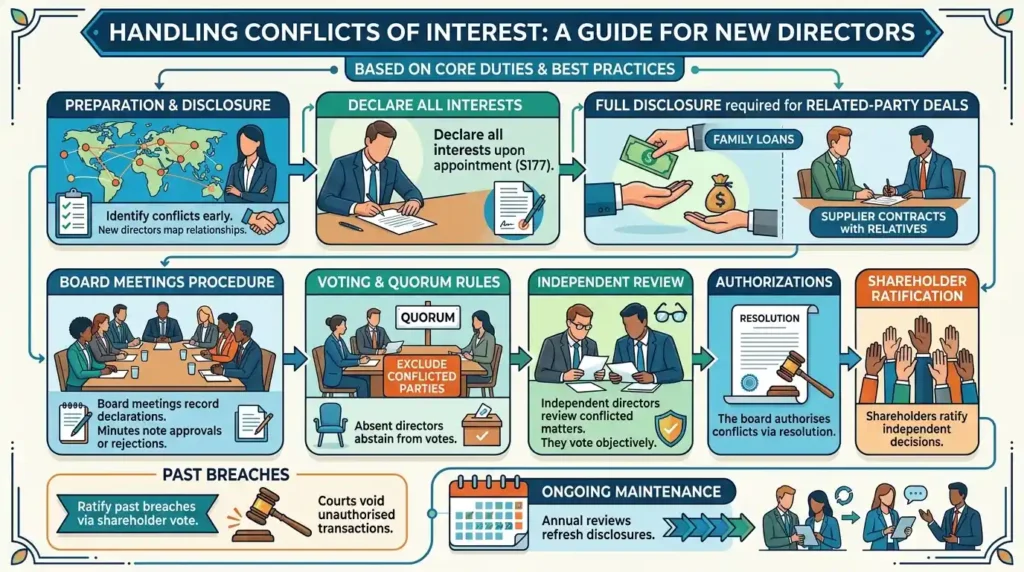
New directors declare all interests under section 177. The board authorises conflicts via resolution. Absent directors abstain from votes.
Identify conflicts early. Related-party deals require full disclosure. Examples include family loans or supplier contracts with relatives. Board meetings record declarations. Minutes note approvals or rejections. Shareholders ratify independent decisions.
Independent directors review conflicted matters. They vote objectively. Quorum rules exclude conflicted parties. Ratify past breaches via shareholder vote. Courts void unauthorised transactions. New directors map relationships. Annual reviews refresh disclosures.
What Reporting Duties Apply to New Directors?
New directors approve and file annual reports, returns, and changes. Deadlines range from 14 days to nine months post-year-end.
File accounts with Companies House. Micro-entities use the balance sheet only. Medium-sized companies detail the directors’ report. Sign confirmation statements. Directors confirm ongoing compliance. Submit by anniversary date.
Notify changes in 14 days. Director details, addresses, or share allotments require forms like TM01 or SH01. Report events like charges or winding-up. Form MR01 registers mortgages. New directors oversee audit committees if applicable. They select auditors annually.
What Personal Liabilities Face New Directors?
New directors face unlimited personal liability for breaches, wrongful trading, or fraudulent acts under sections 172-178 and the Insolvency Act 1986.
Breach of duty claims come from shareholders or regulators. Courts order compensation or disqualification for 2-15 years. Wrongful trading triggers contributions to assets. Directors continue insolvent operations knowingly.
Fraudulent trading imposes criminal penalties. Fines and imprisonment follow convictions. Tax defaults lead to joint liability. HMRC pursues directors for VAT or PAYE failures. Directors ensure against D&O claims. Policies cover legal defence. Mitigate risks through training. Document decisions rigorously.
What Ongoing Responsibilities Maintain Director Compliance?
New directors attend board meetings, review finances quarterly, and update skills annually. Compliance audits occur every six months.
Schedule quarterly reviews. Examine cash flow, KPIs, and risks. Train on updates. Companies Act amendments demand awareness. Delegate tasks. Appoint a company secretary for filings. Monitor PSC changes. Verify ultimate beneficial owners. Retain records for seven years. Digital tools archive securely.
Explore our Director Appointment guides,
The Legal Age Requirements and Restrictions for Appointing New UK Company Directors
How to Correctly Draft Board Minutes for a New Director Appointment Process
What Role Does Director Appointment Play in Compliance?
Director of Appointment Services verifies eligibility, files AP01, and updates registers. They ensure Companies Act compliance from day one.
Professionals handle identity validation. They use passport checks, biometric scans, and address proofs. Services file instantly. They avoid late penalties. From My Company streamlines the process. Their Director Appointment service registers new directors efficiently.
Compare options in our guide on Comparing Different Director Appointment Service Packages for Small and Medium-Sized Businesses. Buy Our Reliable Director Appointment Service to Keep Your Statutory Registers Current at From My Company for seamless compliance.
New directors integrate these services early. From My Company delivers verified appointments. They maintain registers accurately. Compliance follows statutory timelines.
Frequently Asked Questions
What is a director appointment and why is it important?
A director appointment is the formal process of adding a new director to a company’s board and registering them with Companies House. Proper director appointment ensures statutory compliance, keeps the company’s registers up to date, and supports smooth corporate governance under the Companies Act 2006.
How does From My Company handle director appointment for UK businesses?
From My Company manages the full director appointment process, from verifying eligibility to preparing and filing the correct Companies House forms. The service ensures accurate registration, timely submissions, and ongoing alignment with Companies Act requirements for small and medium‑sized businesses.
What documents are needed for a director appointment?
A director appointment typically requires a valid government‑issued ID, proof of address, and consent to act as director, along with any required board or shareholder resolutions. From My Company uses these documents to complete the Director Appointment service and notify Companies House within statutory deadlines.
Can a non‑UK resident be appointed as a director?
Yes, non‑UK residents can be appointed as company directors, provided they meet the same eligibility and disclosure rules as UK‑based directors. From My Company supports foreign director appointments by handling the necessary identity checks and Companies House filings under the Director Appointment service.
How long does a typical director appointment take to complete?
A standard director appointment is usually finalised within 1–3 working days once all documents and approvals are in place. From My Company streamlines this timeline through its Director Appointment service, ensuring prompt registration with Companies House and an updated statutory record.