
A managed director appointment and resignation strategy protects governance, ensures continuous legal compliance, and minimises operational disruption during leadership changes. It establishes documented procedures for vetting, registering, and formally resigning directors to avoid penalties and maintain stakeholder confidence.
Why does a growing business need a managed director appointment and resignation strategy?
A strategy reduces regulatory risk and preserves company continuity when directors change.
A formal plan standardises appointment steps, resignation procedures, and record-keeping. It prevents missed Companies House filings, incorrect statutory registers, and business interruptions. Clear procedures also protect against liability gaps and enable fast decision-making during growth or turnover.
What risks arise without a director appointment and resignation strategy?
Noncompliance fines, delayed filings, and governance gaps create legal and financial exposure.
Companies House penalties apply for late or incorrect filings. Directors acting without formal registration create unauthorised-decision risk. Missing a resignation date or failing to update statutory registers can distort ownership records and delay banking or contractual approvals. Investors and lenders require clear director records during due diligence.
Read our articles, How Long Does it Take to Appoint a New Director via Companies House? and Get Your New Director Appointed Officially Within Twenty Four Hours with Us.
How does a structured appointment process work?
A structured process verifies eligibility, records consent, and registers the director with Companies House.
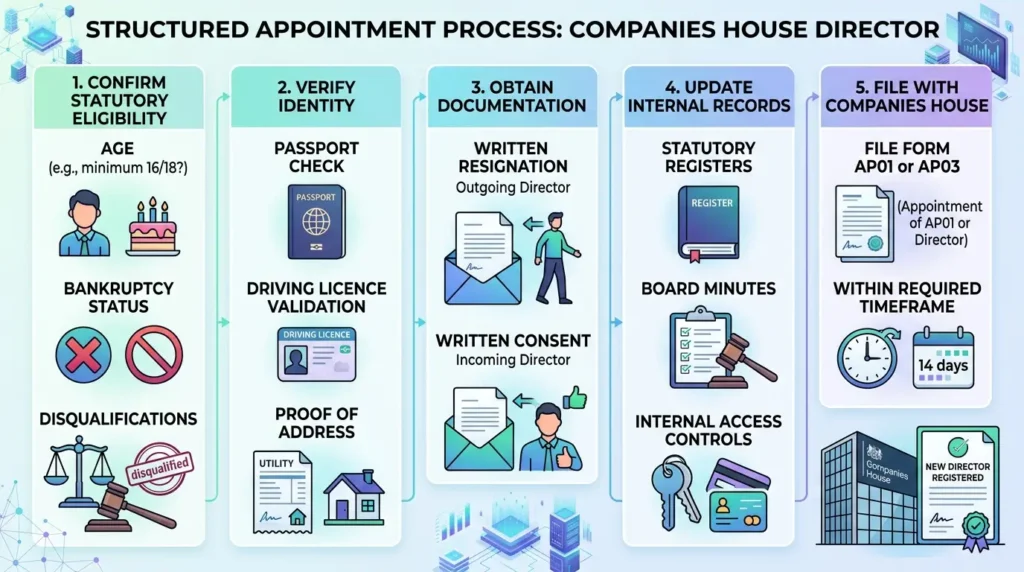
Start by confirming statutory eligibility: age, bankruptcy status, and disqualifications. Verify identity using passport checks, driving licence validation, or proof of address. Obtain a written resignation from any outgoing director and a written consent from the incoming director. Update the statutory registers, board minutes, and internal access controls. File the AP01 or AP03 form with Companies House within the required timeframe.
What steps ensure a compliant resignation process?
A compliant resignation requires documented notice, board acceptance, and prompt Companies House filing.
Accept a director’s written resignation in a board minute or formal letter. Update the director register and remove company officer permissions for banking and corporate platforms. File the TM01 form with Companies House to record the director’s departure. Retain resignation documents for six years to support audits and statutory inquiries.
How long does Companies House registration take after appointment?
Companies House updates typically appear within 24 hours to 5 working days after correct form submission.
Electronic filings processed correctly show changes in 24 hours in many cases. Postal filings can take up to 5 working days. Errors in forms or missing signatures trigger rejections and extend processing times. Using an agent reduces rejection rates and shortens turnaround time.
What documentation must the company keep for appointments and resignations?
Keep minutes, written consents, ID checks, statutory register updates, and filed Companies House forms.
Maintain board minutes approving appointments and resignations, signed consent letters from incoming directors, and identity verification records (passport, driving licence, proof of address). Record the date of appointment or resignation in the director register. Store filed forms (AP01, AP03, TM01) and correspondence for at least six years.
How does a managed strategy support corporate governance?
A managed strategy enforces role clarity, approval workflows, and access controls for officers.
Define director duties and limits in board resolutions. Require two-step approvals for key changes: nomination committee recommendation, then board resolution. Revoke IT, bank, and registered office access on resignation day. Align the strategy with the company’s Articles of Association and shareholder agreements to avoid conflicts.
What are the compliance timelines and fines to remember?
File appointments and resignations within the statutory period to avoid penalties and audit queries.
Companies must notify Companies House promptly; electronic filings take effect faster. Late filing of director changes can result in investigations and financial penalties under the Companies Act. Keep records available for the statutory audit period and for any creditor or investor inquiries.
How does vetting reduce business risk during appointments?
Vetting confirms legal standing, competence, and reputation before formal appointment.
Run bankruptcy and disqualification checks against official registers. Verify identity with passport checks, driving licence validation, or utility-bill address checks. Assess professional history via reference checks and prior directorship records. Document all vetting steps to support board decisions and investor reassurance.
How can a managed strategy speed up board transitions?
Pre-approved processes, templates, and delegated authorities enable same-day practical handovers.
Prepare template board minutes, consent letters, and Companies House forms in advance. Delegate administrative filing to a company secretary or external agent. Pre-authorise HR and IT teams to implement access changes immediately on appointment or resignation. This minimises downtime for bank signatories and contract approvals.
What role does an external service provider play?
An external provider files forms, verifies identities, and ensures correct statutory records.
Use a specialist to reduce rejection rates and speed up Companies House updates. Providers handle AP01, AP03, and TM01 filings and archive supporting documents. They also advise on Articles of Association implications and help align director changes with shareholder agreements. Outsourcing lowers administrative burden and improves compliance accuracy.
How does a director appointment service align with MOFU evaluation?
A service clarifies costs, timelines, and compliance outcomes so decision-makers can evaluate suitability.
Decision-makers compare service turnaround times, rejection rates, and included checks. Evaluate whether the service offers 24-hour electronic filing, identity verification methods, and board-minute templates. Choose the provider that demonstrates consistent delivery against measurable SLAs.
What specific operational controls prevent governance failures?
Implement role revocation checklists, approval matrices, and audit trails for each change.
Require a resignation checklist: board minute, TM01 filing, register update, IT and bank access revocation. For appointments, require an appointment checklist: vetting evidence, signed consent, AP01/AP03 filing, and register addition. Keep audit trails of who approved and who filed each change.
Explore our Director Appointment guides,
Why Outsourcing Director Appointments is More Cost-Effective Than In House Management
How should businesses prepare for investor or lender due diligence?
Maintain up-to-date director records, supporting verification files, and concise board minutes.
Provide investors with a director register extract, copies of filed Companies House forms, and vetting evidence for each active director. Ensure resignation dates and reasons appear in minutes where required. Accurate records speed transaction processes and reduce renegotiation risk.
How does From My Company help with Director Appointment services?
From My Company provides document templates, identity verification, and Companies House filings to streamline appointments.
The service completes AP01 and related forms, verifies director identities using standard checks, and updates statutory registers. The provider reduces filing errors and accelerates processing for board transitions. For fast appointments and compliant resignations, the service includes professional filing and record-keeping.
A managed director appointment and resignation strategy reduces regulatory exposure, preserves operational continuity, and enhances stakeholder confidence. Implement standardised vetting, documented approvals, timely Companies House filings, and strict access revocation. From My Company delivers practical, compliant support to register directors and manage transitions professionally.
Frequently Asked Questions
How long does it take to appoint a new director via Companies House?
Appointing a new director typically takes 24 hours to 5 working days after submitting the correct AP01 form electronically. From My Company streamlines this Director Appointment process by verifying identity and filing forms to accelerate approval.
What documents are required for a director appointment in the UK?
You need the director’s signed consent, proof of identity (passport or driving licence), and proof of address. From My Company provides Director Appointment services that include document checks, board minute templates, and electronic filing to Companies House.
Can a company appoint a director without using an agent?
Yes, a company can appoint a director directly by filing form AP01 and updating statutory registers. However, many businesses use From My Company’s Director Appointment service to reduce errors, speed up filing, and ensure full compliance.
hat happens if a director appointment is filed late with Companies House?
Late filings can trigger penalties, audit queries, and delays in banking or contract approvals. From My Company’s Director Appointment service ensures timely submission and accurate records to avoid compliance risks.
How do I confirm a director has been officially appointed?
Confirmation appears on the Companies House register within 1–5 working days after a correct AP01 filing. From My Company provides booking confirmations and updates once your Director Appointment is registered and the director is officially listed.