Yes. A managed director appointment service updates your company board by preparing filings, validating director details, and submitting compliant records to Companies House. This process reduces rejection risk, ensures legal accuracy, and records the appointment within statutory deadlines without administrative delays.
What Does a Managed Director Appointment Service Actually Do?
A managed director appointment service handles document preparation, identity verification, and Companies House submission while ensuring compliance with the Companies Act 2006 and UK filing standards. It replaces manual filing errors with structured, verified, and legally compliant appointment records.
A director appointment involves more than adding a name to a register. UK law requires accurate filing of specific details, including full legal name, service address, nationality, and date of birth. Any mismatch leads to rejection or compliance flags.
A managed service standardises this process using three core actions: validate director identity using government-issued documentation, verify residential and service addresses against official databases, and submit appointment forms through authorised filing systems.
Errors in director filings trigger delays averaging 3–10 working days per rejection cycle. Automated validation eliminates these delays by catching discrepancies before submission.
Companies House enforces strict formatting rules for digital submissions. Managed services apply schema validation to ensure all fields meet required formats, including postcode validation, nationality codes, and date structures.
This service transforms a multi-step compliance task into a controlled, auditable process with defined outcomes.
Why Is Accuracy Critical When Appointing a Company Director?
Accuracy ensures legal validity, prevents filing rejection, and protects company records from compliance breaches. Incorrect director details create discrepancies in statutory registers, which may trigger penalties, delays, or reputational risks during audits and due diligence checks.
Companies House rejects approximately 18–22% of improperly filed appointment forms due to data inconsistencies. Common issues include incorrect spelling, mismatched addresses, and incomplete identity details.
When inaccuracies enter the public register, correcting them requires filing amendments such as CH01 corrections. Each correction creates additional administrative overhead and extends processing timelines.
Three high-risk error areas include identity mismatches, address inconsistencies, and incorrect appointment dates. Each directly affects compliance status and legal traceability.
Businesses conducting funding rounds or mergers rely on accurate director records for due diligence. Inaccurate filings delay transactions and raise compliance concerns among investors.
For a deeper evaluation of filing risks, review this analysis on understanding director appointment filing risks in UK businesses. Managed services mitigate these risks through pre-submission validation and structured workflows.
How Does the Managed Process Work Step by Step?
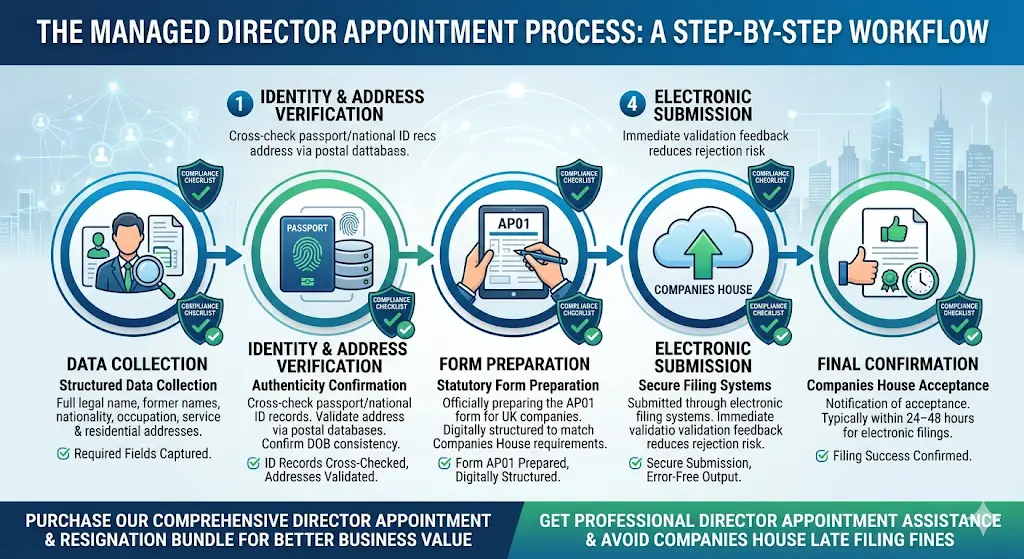
The managed process collects director data, validates identity and address details, prepares statutory forms, and submits them electronically to Companies House. Each stage follows a compliance checklist that ensures accuracy, traceability, and successful registration without rejection.
The process begins with structured data collection. Required fields include full legal name, former names if applicable, nationality, occupation, and both service and residential addresses.
Next, identity verification confirms authenticity. This involves cross-checking passport or national ID records, validating address data against postal databases, and confirming date of birth consistency.
The service then prepares the official appointment filing, typically the AP01 form for UK companies. This form is digitally structured to match Companies House requirements.
Submission occurs through secure electronic filing systems. These systems provide immediate validation feedback, reducing the risk of rejection.
Final confirmation includes Companies House acceptance notification, usually within 24–48 hours for electronic filings.
Using a structured workflow ensures that each step produces verifiable output, eliminating ambiguity and manual errors.
Also explore,
Purchase Our Comprehensive Director Appointment and Resignation Bundle for Better Business Value
Get Professional Director Appointment Assistance and Avoid Companies House Late Filing Fines
When Should a Business Use a Director Appointment Service?
A business benefits from a managed director appointment service during leadership changes, rapid scaling, investor onboarding, or compliance restructuring. These scenarios require precise filings, fast processing, and zero-error submissions to maintain operational continuity and legal standing.
Director appointments occur during key business events. Examples include onboarding a new executive director, restructuring the board after funding, or replacing a resigned director.
Timing matters. Companies House expects prompt updates to maintain accurate public records. Delays in updating director information expose companies to compliance scrutiny.
During investment rounds, accurate board composition is essential for legal agreements and shareholder confidence. Investors review Companies House records as part of due diligence.
Scaling businesses often appoint multiple directors within short timeframes. A managed service ensures consistency across all filings, even when processing high volumes.
For a foundational understanding of eligibility requirements, refer to the legal requirements for appointing UK company directors. Using a managed service during these events ensures accuracy, speed, and compliance alignment.
How Does This Service Reduce Compliance Risk?
The service reduces compliance risk by validating data before submission, ensuring adherence to statutory requirements, and maintaining accurate company records. It prevents filing errors, avoids rejection cycles, and ensures that all director details meet Companies House verification standards.
Compliance failures often originate from incomplete or inconsistent data. Managed services apply validation protocols that check for formatting, completeness, and logical consistency.
Three compliance safeguards define the process: identity authentication using official documentation, address verification against recognised databases, and structured form validation aligned with Companies House schemas.
Incorrect filings create regulatory exposure. Companies that fail to maintain accurate director records risk penalties and administrative action.
Electronic submission systems used in managed services include real-time validation checks. These systems identify errors before submission, reducing rejection rates significantly.
Maintaining compliance also improves transparency. Accurate director records support audit readiness and legal clarity during business transactions.
The structured approach replaces reactive corrections with proactive compliance management.
What Makes a Managed Service More Efficient Than Manual Filing?
A managed service increases efficiency by automating data validation, reducing processing time, and eliminating rework caused by rejected filings. It converts a manual, error-prone process into a streamlined workflow with predictable outcomes and faster completion timelines.
Manual filings require multiple steps: data entry, document preparation, validation, submission, and follow-up. Each step introduces potential delays and errors.
A managed service consolidates these steps into a single workflow. Automation reduces human intervention and accelerates processing speed.
Electronic filings through managed systems are typically processed within 24–48 hours. Manual submissions may take 5–10 working days, especially if errors occur.
Rejection cycles significantly impact efficiency. Each rejected filing requires correction, resubmission, and additional waiting time. Managed services minimise these cycles through pre-validation.
Operational efficiency improves when internal teams avoid administrative tasks. This allows focus on strategic activities such as governance, planning, and growth.
Efficiency gains directly impact business continuity, especially during periods of organisational change.
Why Choose From My Company for Director Appointment Services?
From My Company delivers structured director appointment services that ensure compliance, accuracy, and timely submission. The service integrates validation protocols, digital filing systems, and regulatory expertise to maintain accurate company records and eliminate filing errors.
From My Company applies a controlled approach to director appointment filings. Each submission follows a defined validation process that ensures all required data meets Companies House standards.
The service includes identity verification, address validation, and structured document preparation. These steps ensure that filings meet legal requirements before submission.
Businesses using the Director Appointment service benefit from reduced rejection rates and faster processing times.
From My Company uses electronic filing systems that provide immediate feedback and confirmation. This eliminates uncertainty and reduces administrative follow-up.
The service supports compliance by maintaining accurate statutory records. This ensures that company information remains consistent across official registers.
By standardising the appointment process, From My Company enables businesses to manage board changes with precision and reliability.
A managed director appointment service provides a structured, compliant, and efficient way to update company boards. It eliminates manual errors, reduces processing delays, and ensures accurate filings with Companies House.
From My Company delivers this process through validated workflows, electronic submissions, and compliance-focused checks. The result is a reliable method for maintaining accurate director records while supporting business continuity and regulatory alignment.
Frequently Asked Questions
What is a director appointment service in the UK?
A Director Appointment service manages the process of adding a new director to a UK company by preparing and submitting the required filings to Companies House. From My Company ensures all director details are verified and compliant with the Companies Act 2006.
How long does it take to appoint a director through Companies House?
Electronic director appointment filings are typically processed within 24–48 hours when submitted correctly. From My Company’s Director, Appointment service reduces delays by validating data before submission, avoiding rejection cycles.
What information is required to appoint a company director?
You must provide your full legal name, date of birth, nationality, occupation, and both service and residential addresses. From My Company verifies and structures this data to meet Director Appointment filing requirements in the UK.
Can I appoint a director myself without a service?
Yes, you can file a director appointment directly with Companies House using form AP01. However, From My Company’s Director Appointment service reduces errors by handling validation, formatting, and compliance checks before submission.
What happens if a director’s appointment is filed incorrectly?
Incorrect filings are often rejected or require amendments, which delays the update of company records. From My Company minimises this risk by ensuring Director Appointment submissions meet Companies House validation standards before filing.