
A qualified agent ensures your confirmation statement is filed accurately, on time, and in full compliance with Companies House requirements. They manage shareholder data, SIC codes, and PSC records, reducing legal risk while maintaining your company’s active status and avoiding financial penalties or strike-off action.
What does an agent do when managing your confirmation statement?
An agent prepares, verifies, and submits your confirmation statement using current company data. They audit shareholder registers, validate Persons with Significant Control (PSC) details, and ensure SIC codes and registered office information match Companies House records before filing within statutory deadlines.
An agent handles the full lifecycle of the filing process. This begins with extracting existing company data from official records and cross-checking it against internal registers. Three core data areas are reviewed: shareholder structure, PSC records, and business activity classification.
Accuracy matters because Companies House records are public and legally binding. If a shareholder allocation is wrong or a PSC is missing, the company breaches compliance rules under the Companies Act 2006. Agents use structured validation workflows to prevent this.
Submission timing is equally critical. The confirmation statement must be filed at least once every 12 months. Agents track deadlines and initiate filing well before the due date, preventing late penalties or compliance flags.
Why is choosing the right agent critical for compliance?
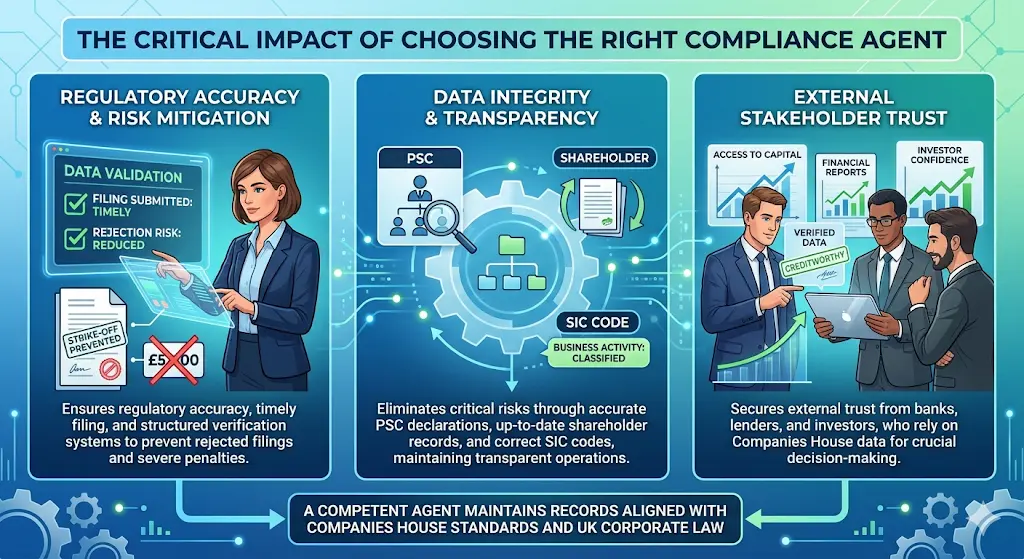
Choosing the right agent ensures regulatory accuracy, timely filing, and proper data validation. A competent agent reduces the risk of rejected filings, penalties up to £5,000, and company strike-off by maintaining compliant records aligned with Companies House standards and UK corporate law.
Companies House enforces strict validation checks. Errors in filings trigger rejections, which delay compliance and expose the company to penalties. A qualified agent reduces this risk by using structured verification systems.
Three compliance risks stand out:
- Incorrect PSC declarations, which violate transparency laws
- Outdated shareholder records, which misrepresent ownership
- Wrong SIC codes, which misclassify business activity
Each error type affects how regulators and financial institutions assess your company. Banks, lenders, and investors rely on Companies House data when making decisions.
An experienced agent understands these dependencies. They ensure that every submission aligns with legal frameworks and external verification standards.
What criteria should you use to evaluate an agent?
Evaluate an agent based on regulatory expertise, filing accuracy rates, turnaround time, and data verification processes. Look for agents who use structured compliance workflows, maintain error rates below 2%, and provide clear audit trails for every confirmation statement submission.
Start with regulatory knowledge. An agent must understand Companies House filing rules, PSC regulations, and shareholder reporting standards. Without this, even small errors can lead to rejection.
Next, assess operational accuracy. Reliable agents maintain low rejection rates through layered verification. For example, they validate director details against official ID records and cross-check shareholder data with internal registers.
Turnaround time also matters. Efficient agents complete filings within 24 to 72 hours after data confirmation. Delays increase compliance risk, especially near deadlines.
Finally, transparency is essential. A good agent provides a clear audit trail. This includes submission timestamps, confirmation receipts, and documented changes to company data.
How does an agent reduce administrative burden for directors?
An agent removes manual filing tasks, tracks deadlines, and manages regulatory updates. This reduces administrative workload by up to 80%, allowing directors to focus on operations while ensuring that all Companies House obligations are met without missed deadlines or compliance errors.
Directors often manage multiple responsibilities. Filing a confirmation statement requires time, accuracy, and familiarity with compliance rules. Delegating this task eliminates repetitive administrative work.
Agents automate key processes. These include deadline tracking, data validation, and submission scheduling. When deadlines approach, the agent initiates the process without requiring manual intervention.
This also improves consistency. Manual filings often vary in accuracy due to time pressure or incomplete records. Agents use standardised workflows that ensure each submission meets the same quality threshold.
For directors managing multiple companies, this efficiency becomes essential. It prevents overlapping deadlines and ensures each entity remains compliant.
If you want a deeper understanding of filing risks, this guide explains the consequences of missed submissions: What Happens if You Forget to File Your Confirmation Statement?
What risks arise from using an unqualified or low-cost agent?
Using an unqualified agent increases the risk of incorrect filings, missed deadlines, and regulatory penalties. Poor data validation leads to rejected submissions, while a lack of compliance knowledge exposes companies to fines, reputational damage, and potential removal from the Companies House register.
Low-cost services often rely on minimal verification. They submit data as provided without validating its accuracy. This creates a high risk of errors in shareholder distribution or PSC records.
Rejected filings create a chain reaction. The company must correct errors, resubmit documents, and manage delays. During this period, the company may appear non-compliant in public records.
Three common failures occur with unqualified agents:
- Skipping PSC verification, leading to incomplete disclosures
- Misclassifying SIC codes affects regulatory categorisation
- Missing deadlines, triggering late filing penalties
Each failure affects the compliance status. Over time, repeated issues increase the likelihood of enforcement action.
Choosing based on price alone ignores these risks. Compliance quality directly impacts the company’s legal standing and operational continuity.
Also explore,
How to Ensure Your Lawful Purpose Statement is Correctly Filed
The Benefits of a Managed Filing Service for UK Small Businesses
How does a professional service streamline the filing process?
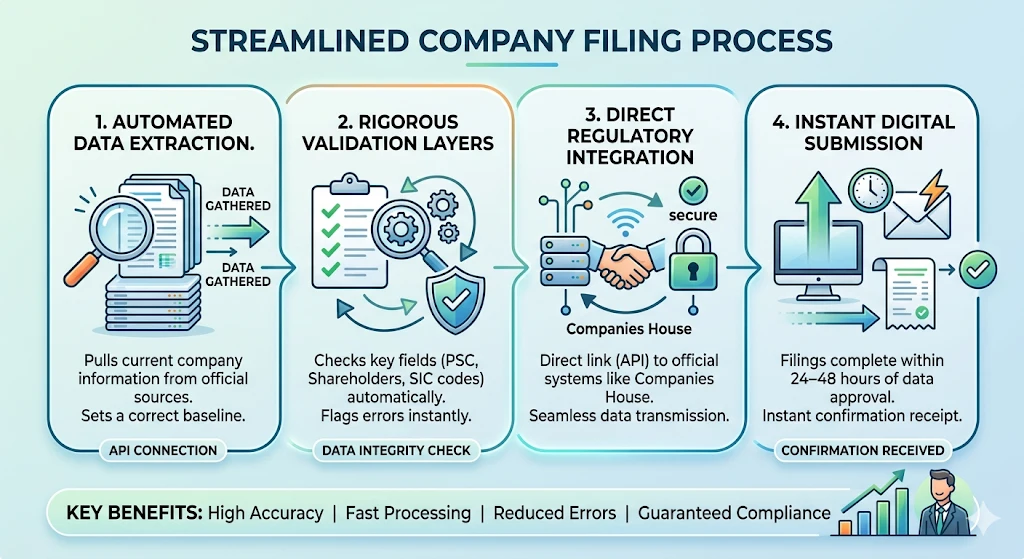
A professional service uses structured workflows, automated checks, and direct Companies House integration to complete filings quickly and accurately. This ensures real-time validation, reduces processing errors, and enables confirmation statements to be submitted within 24–48 hours of data approval.
Professional services rely on systemised processes. These include automated data extraction, validation layers, and direct API integration with Companies House systems.
Three workflow stages define the process:
- Extract company data from official registers
- Validate key fields, including PSC, shareholders, and SIC codes
- Submit digitally with an instant confirmation receipt
This reduces human error and speeds up processing time. Digital submissions are validated in real time, which prevents common formatting or data-entry mistakes.
For companies seeking a reliable solution, using a structured service like File a Confirmation Statement ensures that each step follows compliance standards and submission protocols.
Decision-stage buyers often prioritise speed and security. This overview explains how a complete solution works: Done-For-You Confirmation Statement Filing – Fast & Secure.
When is it best to switch to a managed filing service?
Switch to a managed service when internal filing errors occur, deadlines are missed, or company structures become complex. Businesses with multiple shareholders, frequent ownership changes, or compliance issues benefit most from professional handling and structured filing systems.
Complexity increases compliance risk. Companies with layered ownership structures or frequent share transfers require precise record management. Manual tracking becomes unreliable in these cases.
Missed deadlines are another trigger. If a company has previously filed late or received warnings, switching to a managed service restores compliance stability.
Growth also drives the need for professional support. As companies expand, administrative tasks multiply. Delegating compliance functions ensures that filings remain accurate while operations scale.
A managed service introduces consistency. Each filing follows a defined process, reducing variability and improving reliability over time.
Selecting the right agent determines whether your company maintains accurate records and meets Companies House requirements without disruption. A structured, professional approach ensures validation, timely submission, and compliance with UK regulations.
From My Company delivers this through verified workflows, low error rates, and secure digital filing systems. Their File a Confirmation Statement service ensures companies remain compliant, avoid penalties, and maintain accurate public records with minimal administrative effort.
Frequently Asked Questions
What is a confirmation statement, and why is it required in the UK?
A confirmation statement is a mandatory annual filing that verifies company details held by Companies House, including directors, shareholders, and SIC codes. Using a service like File a Confirmation Statement ensures records remain accurate and legally compliant under UK corporate regulations.
When do I need to file a confirmation statement for my company?
A confirmation statement must be filed at least once every 12 months, based on your company’s incorporation or last filing date. From My Company helps track this deadline and ensures the File a Confirmation Statement process is completed on time to avoid penalties.
What happens if I file a confirmation statement late?
Late filing can result in financial penalties, legal action against directors, or company strike-off from the register. Using a structured service like File a Confirmation Statement reduces the risk of missed deadlines and ensures timely submission.
What information is required to file a confirmation statement?
You must confirm or update details such as registered office address, directors, shareholders, Persons with Significant Control (PSC), and SIC codes. From My Company verifies this data before submitting the File a Confirmation Statement to ensure accuracy and compliance.
Can I file a confirmation statement myself or do I need an agent?
You can file it yourself through Companies House, but errors in PSC or shareholder data often lead to rejection. Many businesses use From My Company to File a Confirmation Statement accurately, as it includes validation checks and compliance review.