
An overdue confirmation statement means a UK company has missed its statutory deadline to confirm its registered information with Companies House. Late filing can expose the company and its directors to legal consequences, financial penalties and potential strike-off action. The quickest way to address a missed deadline is to check the company’s filing status, review its records and submit the outstanding confirmation statement as soon as possible.
Every UK company, including dormant and non-trading companies, must file a confirmation statement at least once every 12 months. Companies House allows a filing window of 14 days after the end of the review period. Missing this deadline does not remove the obligation to file, even when the company’s details have not changed.
This guide explains what happens when a confirmation statement is late, whether a confirmation statement overdue fine applies, how to complete a late filing and how to prevent future compliance problems.
What Is an Overdue Confirmation Statement?
An overdue confirmation statement is a Companies House filing that has not been submitted by the statutory deadline. The statement confirms that the information held on the public register is accurate and that the company has met the relevant reporting requirements.
The confirmation statement is filed using form CS01. It is different from annual accounts, which report financial information about the company. Both filings have separate requirements, and completing one does not replace the other.
A company must submit its confirmation statement even if there have been no changes to its registered information. The filing helps maintain an accurate public record of company details, including relevant shareholder information, share capital and people with significant control.
Confirmation Statement Overdue: What Does It Mean for Your Company?
When a confirmation statement is overdue, the company has missed a legal filing deadline. Directors should check the company’s Companies House record, establish which statement is outstanding and arrange the filing promptly.
An overdue status can raise questions during commercial due diligence. Banks, suppliers, lenders and prospective investors may review public company records when assessing a business. Although the consequences depend on the circumstances, an unresolved filing obligation creates an avoidable compliance risk.
What Happens If You File a Confirmation Statement Late?
A late confirmation statement does not automatically mean that the company will be dissolved immediately. However, the company remains responsible for making the required filing, and Companies House can take enforcement action if the failure continues.
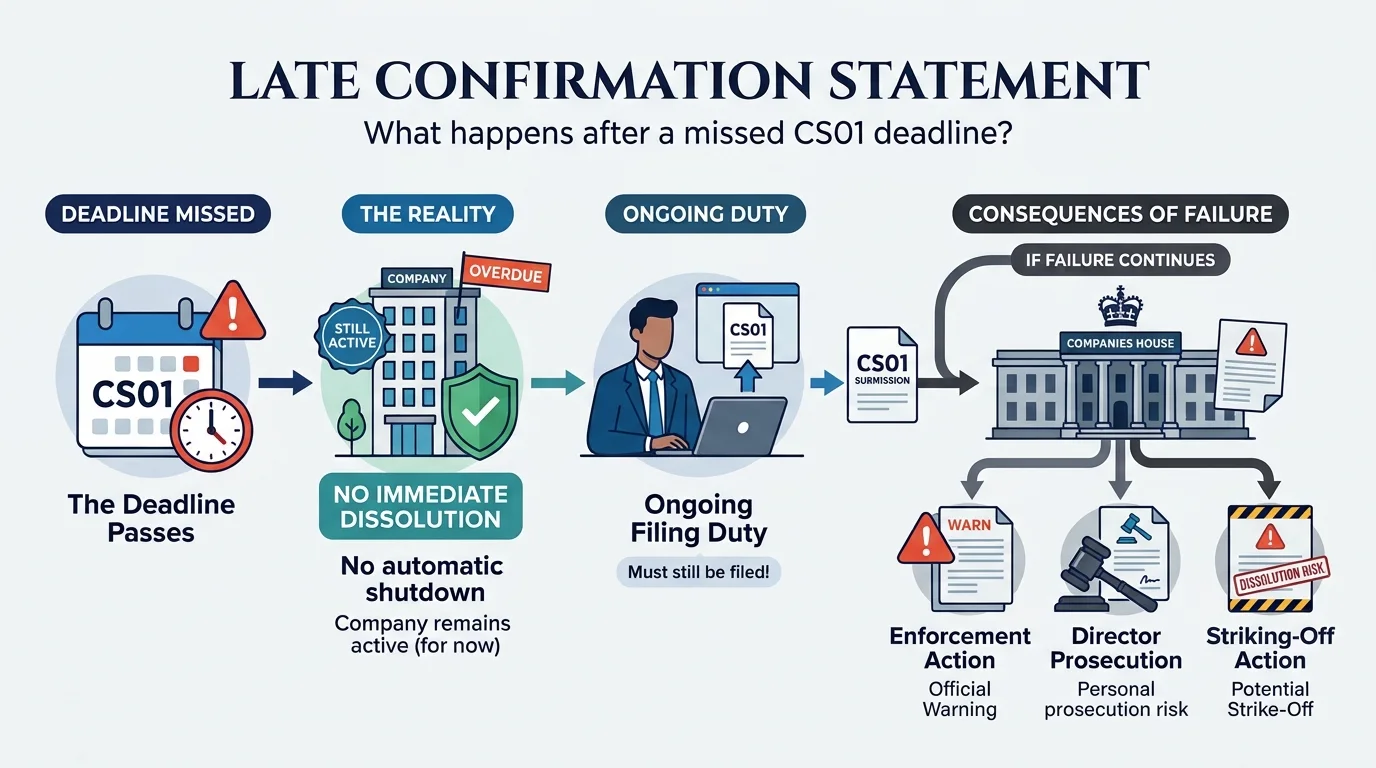
The main risks include:
Financial penalties: Companies House states that a company can be fined up to £5,000 for failing to file a confirmation statement.
Criminal liability: Failure to deliver the statement can constitute an offence by the company and relevant officers in default.
Strike-off proceedings: Companies House may take steps to remove a non-compliant company from the register.
Commercial disruption: An overdue public filing can raise concerns during banking applications, lending assessments and supplier checks.
Additional administrative costs: Directors may need professional support to resolve outstanding filings and restore a company if it has already been struck off.
The consequences depend on the circumstances and the action taken by Companies House. Do not assume that a missed confirmation statement carries no financial consequences simply because it is different from a late annual accounts filing.
Is There a Confirmation Statement Overdue Fine?
Yes. Companies House guidance states that a company can be fined up to £5,000 for failing to file its confirmation statement. The legal framework also provides for offences involving the company and relevant officers in default.
It is important to distinguish this from the late filing penalty regime for annual accounts. The applicable rules and consequences are different, so businesses should not rely on annual accounts penalty tables to determine the consequences of a late confirmation statement.
| Issue | What businesses need to know |
|---|---|
| Missed deadline | The company must still submit the outstanding statement |
| Financial penalty | Companies House states that a fine of up to £5,000 may apply |
| Director responsibility | Relevant officers in default can face legal consequences |
| Strike-off risk | Continued non-compliance can lead to removal from the register |
| Filing fee | The normal confirmation statement filing fee may still be payable |
The current Companies House guidance lists a £50 fee for online filing and £110 for filing a paper CS01. Check the official guidance before submitting because fees and filing requirements can change.
For further details about the current filing charge, read our guide to the new £50 Companies House filing fee.
Can Companies House Strike Off a Company for a Late Confirmation Statement?
Yes. Companies House may initiate strike-off action when a company fails to meet its statutory filing obligations. The process is not necessarily immediate, but directors should not wait for a formal warning before addressing an overdue statement.
If a company is struck off and dissolved, it ceases to exist as a registered legal entity. This can affect its ability to trade, maintain contracts and access company assets. Assets remaining at dissolution may pass to the Crown, subject to the applicable legal rules.
Restoring a dissolved company can involve additional applications, fees and professional assistance. It is therefore preferable to resolve an overdue confirmation statement before the situation escalates.
If your company has received a Companies House notice, check the instructions and deadlines stated in the notice. If dissolution has already occurred, obtain appropriate advice about the available restoration procedure rather than assuming that filing a late statement alone will restore the company.
To understand how to evaluate such services, review this guide on
choosing an agent to manage your annual Companies House duty.
done-for-you confirmation statement filing – fast & secure
How to File a Late Confirmation Statement
The most practical way to resolve a late filing is to establish the outstanding requirements and submit the correct confirmation statement through Companies House. A professional filing service can also assist with reviewing company information and managing the submission.
Step 1: Check Your Companies House Record
Find your company on the Companies House register and review its filing history. Identify the confirmation statement deadline, whether the statement is overdue and whether any other filings are outstanding.
Checking the record first helps prevent confusion between a missed confirmation statement and a separate annual accounts deadline.
Step 2: Review the Company Information
Check the details that must be confirmed, including the relevant share information, shareholder details and people with significant control. Make sure required changes have been reported through the appropriate process.
A confirmation statement is not a substitute for every notification a company must make. Some changes must be reported separately rather than being left until the next annual confirmation statement.
Step 3: Complete the CS01 Filing
Use the official Companies House service or an appropriate filing agent to submit the confirmation statement. You will generally need the company’s authentication details to access its online filing service.
Review all information carefully before submission. Incorrect or incomplete information can create further administrative work and leave outstanding compliance issues unresolved.
Step 4: Pay the Applicable Filing Fee
Check the current filing fee and payment requirements before completing the submission. The normal confirmation statement fee may apply even when the filing is late.
Step 5: Confirm Submission and Keep a Record
Retain the submission confirmation and check the public record after processing. If Companies House has already started strike-off proceedings or issued a notice, follow the instructions provided and establish whether any further action is necessary.
For direct assistance, use our File a Confirmation Statement service to explore support with preparing and submitting the required filing.
Also explore,
The Deadlines for Filing Your Annual Confirmation Statement
How Often Does a UK Company Need to File a Statement?
When Is a Confirmation Statement Due?
A company must file at least one confirmation statement every 12 months. The review period generally runs from the company’s incorporation date for the first statement or from the confirmation statement date recorded for the previous filing.
The company then has 14 days after the end of the review period to submit the statement. The exact deadline can be checked through the company’s Companies House record.
For example, if the review period ends on 10 March, the filing deadline is generally 24 March. The company should verify the actual deadline shown on its record and submit the statement within the permitted period.
Understanding the filing cycle helps directors avoid a late confirmation statement and maintain a reliable compliance schedule. For more detail, read how often a UK company needs to file a confirmation statement.
How to Avoid a Late Filing of a Confirmation Statement
Preventing a confirmation statement late filing is easier when responsibility for company compliance is clearly assigned and deadlines are monitored throughout the year.
Maintain a Compliance Calendar
Record the review period end date and filing deadline in a shared calendar. Set reminders well before the due date so there is time to review the company record and resolve any missing information.
Check Company Information Regularly
Do not wait until the annual filing deadline to review company details. Monitor changes involving shareholders, share capital, people with significant control and other relevant company information. Submit separate notifications where required.
Use Companies House Email Reminders
Companies House provides an option to sign up for filing reminders. These notifications can help directors identify approaching deadlines, but the company remains responsible for filing on time.
Assign Clear Responsibility
Make sure a director, administrator or appointed filing agent knows who is responsible for preparing, checking and submitting the confirmation statement. Keep evidence of submissions and ensure that access credentials are handled securely.
Consider a Professional Filing Agent
A filing agent can assist with deadline monitoring, checking company information and submitting confirmation statements. Before appointing one, establish the service scope, fee structure and responsibility for responding to Companies House queries.
Is Using a Filing Agent Better for a Late Confirmation Statement?
A filing agent can be useful when directors have limited time, the company record needs reviewing or several compliance obligations are outstanding. However, using an agent does not remove the company’s legal responsibilities or guarantee that Companies House will accept every submission without further action.
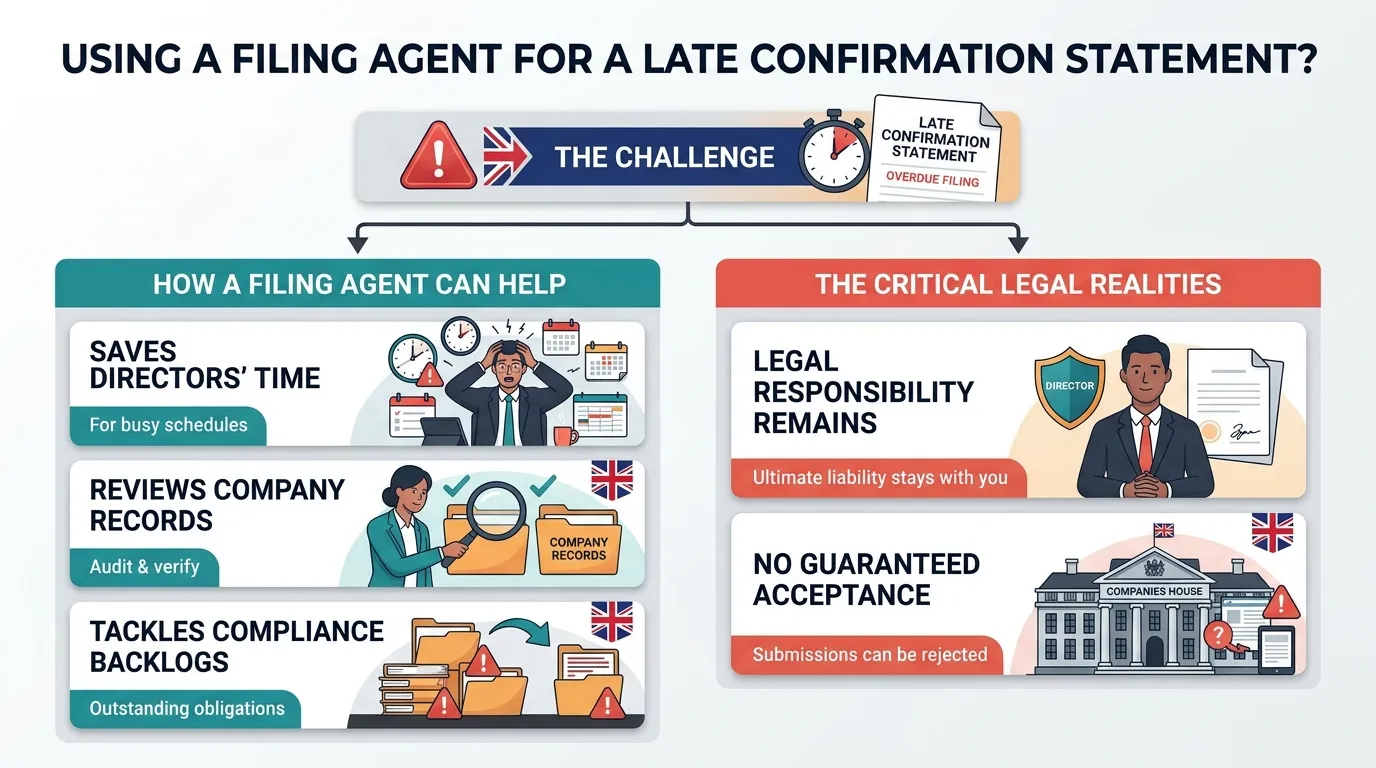
Before selecting a service, compare the following:
The filing work included in the quoted fee
Whether company details are checked before submission
How deadlines and outstanding filings are monitored
Whether the provider explains additional charges clearly
How the provider communicates filing confirmations and follow-up requirements
A company with a straightforward filing may be able to submit the statement directly. Businesses with complex share structures, unresolved record discrepancies or existing strike-off notices may benefit from additional professional guidance.
Form My Company provides a confirmation statement filing service for businesses seeking help with the process.
How to Manage Confirmation Statement Compliance Going Forward
A reliable compliance process should cover more than one annual filing. Directors should know which information must be confirmed each year, which changes require separate notifications and who is responsible for submitting them.
A practical system includes a central record of filing deadlines, regular checks of the Companies House register, reminders before each due date and secure storage of submission confirmations.
Businesses should also distinguish confirmation statements from annual accounts and other statutory obligations. Keeping these processes separate reduces the risk of overlooking one filing because another has already been completed.
A managed filing arrangement can help companies organise recurring submissions and reduce administrative pressure. However, directors should still review important notices and ensure that the information supplied to Companies House is accurate.
Frequently Asked Questions
What happens if my confirmation statement is overdue?
If your confirmation statement is overdue, you should check your Companies House filing history and submit the outstanding statement as soon as possible. Companies House can impose a fine of up to £5,000 and may pursue strike-off action if the company fails to comply. The precise consequences depend on the circumstances.
Is there a late filing confirmation statement penalty?
Yes. Companies House states that failure to file a confirmation statement can result in a fine of up to £5,000. The legal framework also provides for offences involving the company and relevant officers in default. This is different from the standard late filing penalty system for annual accounts.
What is the deadline for a confirmation statement late filing?
A company must file its confirmation statement within 14 days after the end of its review period. The review period generally covers 12 months. Check the company’s Companies House record to confirm the specific deadline.
How do I fix a late confirmation statement?
Check your filing history, review the relevant company information, prepare the CS01 confirmation statement and submit it through Companies House or an appropriate filing agent. If strike-off proceedings have started, follow the notice instructions and establish whether additional action is needed.
Can a company be struck off for a confirmation statement overdue filing?
Yes. Companies House may take strike-off action if a company fails to meet its filing obligations. Directors should resolve an overdue statement promptly and respond to any formal notices to reduce the risk of dissolution.
Does a dormant company need to file a confirmation statement?
Yes. Companies House requires every company, including dormant and non-trading companies, to file a confirmation statement at least once every year. Dormant status does not remove this obligation.
Can I file a confirmation statement myself?
Yes. You can file directly through the Companies House online service or use a filing agent. Check the company’s details carefully before submitting and retain confirmation of the filing.
How much does it cost to file a confirmation statement?
The current GOV.UK guidance lists a £50 online filing fee and a £110 paper filing fee. Additional professional service charges may apply if you use an agent. Check the latest official fees before submitting your statement.
Resolve Your Overdue Confirmation Statement With Form My Company
An overdue confirmation statement should be addressed promptly to reduce the risk of financial penalties, legal consequences and strike-off proceedings. Checking your filing history, confirming the accuracy of company information and submitting the outstanding statement are the essential first steps.
Form My Company helps businesses manage their Companies House filing requirements through its confirmation statement filing service. Review the File a Confirmation Statement service to explore the available support and take the next step towards keeping your company records up to date.