
A polished logo alone won’t make your freelance business look professional. To understand how to appear more professional as a freelancer, create a consistent identity across your online profiles, keep your photo current, and make your work and project terms easy to understand. Your website and portfolio should quickly show what you do, how you work and how clients can reach you.
It’s easy to focus on visual details, but professionalism also comes through in clear communication and reliable expectations. A recognisable, honest presentation helps potential clients understand who they’re working with and what to expect.
This article explains how to bring your personal brand together, set out deadlines, revisions and payment terms, and present a website and portfolio that build confidence. You’ll also learn what to include in a project proposal, so each step from first impression to agreed work feels clear and considered.
Key Takeaways
- Present a consistent personal brand across your profiles, email signature and portfolio so clients can recognise who they’re dealing with.
- Set out deadlines, payment arrangements and revision limits clearly before work begins to keep expectations aligned.
- Make your website easy to navigate, personal and focused on selected work that shows how you approach projects.
- Use a written proposal to define the scope, deliverables, quotation and terms for each project.
- Keep your professional photo current and use it consistently so your online presence feels recognisable and genuine.
1. Building a consistent personal brand
Start by deciding what you want potential clients to remember about your work. Choose a clear description of your service, the clients you help and the problems you solve. For example, “copywriter for independent food businesses” tells readers more than “creative professional”. Use the same description across your portfolio, social media profiles and email signature. Consistency helps clients connect each introduction to the same person and service.
Your brand is more than a business name and logo. It also comes through in the opinions you share, the way you explain your process and how you respond to clients. Write in a recognisable voice, whether concise, warm or highly technical. Be honest about working alone rather than presenting yourself as an agency or team. A personal approach makes it clear who clients will work with.
A logo can help people recognise your business, but it needs to work alongside your name and service description. Keep its colours and style consistent across your website, social media and business documents. Make your business card easy to read, with your name, profession, field, contact details and website. A QR code can lead directly to your portfolio or LinkedIn profile, giving a potential client a simple next step.
Use social media to show the thinking behind your work, not just finished results. Share a portfolio piece with a short explanation of the challenge, your approach and the outcome. Behind-the-scenes posts can show how you work, while a brief video can help potential clients understand your personality. Choose platforms that suit your field, then post in a consistent style rather than trying to appear everywhere.
Build credibility with testimonials, case studies and references. Ask past clients for a short testimonial, then feature it alongside relevant work in your portfolio or marketing materials. A case study can explain the client’s need, your contribution and the result. Get permission before sharing project details. References can give prospective clients another way to understand your working relationship. Keep each example accurate and specific.
Strong client relationships also support referrals. Agree how you’ll communicate, keep clients updated and follow through on the work you’ve promised. When a project ends well, thank the client and make it easy for them to share your details with someone who needs similar help. A clear niche helps referrals travel: clients can describe your service more easily when they know exactly whom you help.
Keep your business presentation aligned with your administrative responsibilities, too. In the UK, a self-employed person earning more than £1,000 must file a tax return before 31 January for the previous year of work, according to HM Revenue & Customs. HM Revenue & Customs states that the UK VAT registration turnover threshold is £90,000 per year, as of April 2024. Clear records and a consistent business identity make it easier to manage professional communication alongside these obligations.
2. Agreeing deadlines, revisions and payment terms
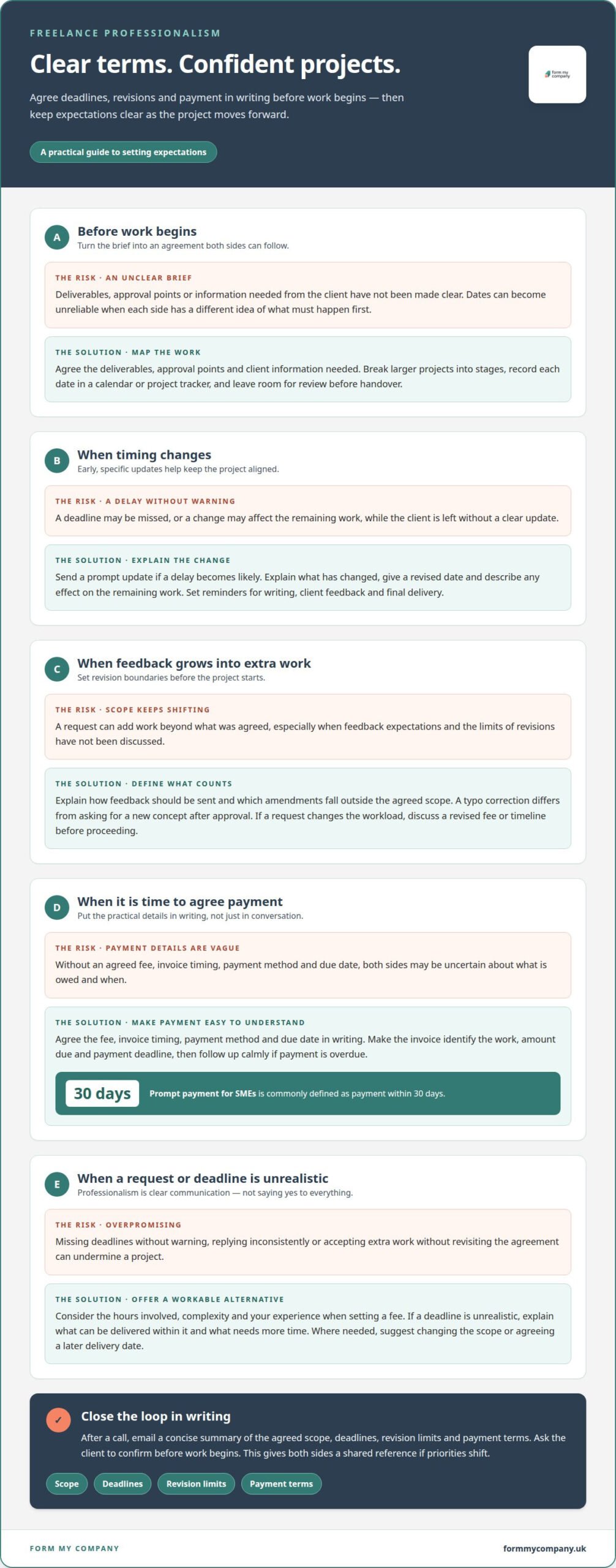
Before accepting work, turn the client’s brief into a practical schedule. Identify the deliverables, approval points and information you need from them. If a website needs copy for several pages, agree when each draft and review will happen. A deadline is more reliable when both sides understand what must be ready first.
Break larger projects into stages and record each date in a calendar or project tracker. Set reminders for writing, client feedback and final delivery, then leave room for review before handover. Send a prompt update if a delay becomes likely. Explain what has changed, give a revised date and describe any effect on the remaining work.
Set revision boundaries before the project starts. Explain what counts as a requested change, how feedback should be sent and which amendments fall outside the agreed scope. For example, correcting a typo differs from asking for a new concept after approval. If a request changes the workload, discuss a revised fee or timeline before proceeding.
Your UK tax and business registration responsibilities depend on your business structure and circumstances. Decide whether you’ll operate as a sole trader or through a company, keep suitable records and understand the filing duties that apply to you.
Agree payment terms in writing, including the fee, invoice timing, payment method and due date. Prompt payment for SMEs is commonly defined as payment within 30 days. Send an invoice that clearly identifies the work, amount due and payment deadline, then follow up calmly if payment is overdue.
Common professionalism mistakes include missing deadlines without warning, replying inconsistently and accepting extra work without revisiting the agreement. Avoid them with a simple routine: acknowledge messages, confirm decisions in writing and flag problems early. If you can’t meet a request, offer a workable alternative, such as changing the scope or agreeing a later delivery date.
Negotiating doesn’t mean agreeing to every request. Consider the hours involved, the complexity of the work and your experience when setting a fee. If the proposed deadline is unrealistic, explain what can be delivered within it and what needs more time. A clear alternative keeps the discussion constructive and protects the standard of your work.
After a call, email a concise summary of the agreed scope, deadlines, revision limits and payment terms. Ask the client to confirm before work begins. This written record gives both sides a shared reference if priorities shift, helping you manage the project professionally and build a sustainable freelance career.
3. Creating a professional website and portfolio
A professional freelance website should explain your service, show selected work and make contacting you straightforward. Include a clear homepage, an about page, portfolio examples and visible contact options, such as an email address or enquiry form. A clear, well-organised site is one practical way to appear more professional as a freelancer because it gives potential clients useful information in one place.
Write the homepage for a potential client, not just for people in your industry. State what you do, who you help and what problem you solve. For example, a freelance illustrator might explain that they create editorial artwork for publishers and magazines. A visitor should understand the offer without searching through several pages or decoding specialist language.
Use first-person writing to make the site feel personal and direct. An about page can briefly cover your experience, working approach and the type of projects you take on. Add a current professional photo so visitors can connect your name with a person. Keep the language natural, then edit out jargon that a client might not recognise or understand.
Organise the portfolio around the work you want to attract. Choose examples that show range where it matters, but avoid adding every project you’ve completed. For each piece, explain the brief, your role and the decisions you made. A short case study can show how you approached a challenge and what the finished work achieved for the client.
Get a client’s permission before adding completed work to an online portfolio. If a project can’t be shown publicly, describe your contribution without revealing confidential details, or select another example. Label each portfolio piece clearly, so a visitor can quickly identify the service, format or sector it demonstrates. Keep project descriptions accurate and focused on your own contribution.
Make navigation simple and test the main journey yourself. From the homepage, a visitor should be able to reach your work, learn about you and find a way to enquire. Check that menus, buttons and forms work on mobile as well as desktop. Keep pages up to date when your services, contact details or portfolio change.
Use a useful call to action on relevant pages. “Tell me about your project” invites a conversation, while a working enquiry form can request the brief, deadline and preferred contact method. Avoid asking for details you don’t need at this stage. Make the next step clear, and ensure the form’s confirmation message tells visitors their enquiry has been received.
If you’re deciding how to appear more professional as a freelancer, make the site feel like a clear introduction to working with you. Freelance app developer Jason Kneen said his more personal website generated about 10 enquiries a week. Treat that as his experience, not a promised outcome. Review your own enquiries and improve pages that need clearer examples, stronger explanations or an easier route to connect.
4. Including project scope and terms in proposals
A proposal turns a client conversation into a clear plan for the project. Include a short overview, the work you’ll complete, the deliverables, your quotation and the terms. For a marketing project, describe the intended outcome, such as a campaign plan or a set of approved email drafts. This gives the client a concrete basis for deciding whether the proposal meets their needs.
Define the scope in practical language. Name the tasks you’ll handle, the information the client must provide and anything excluded. If you’re designing a brochure, specify whether the work includes copywriting, image sourcing or print-ready files. Separate optional extras from the agreed work, so neither side assumes they’re included.
Describe each deliverable in a way that makes completion easy to recognise. “Social media support” is broad; “a content calendar with draft posts for the agreed channels” is clearer. State the file formats or handover materials where they matter. If a client expects editable files, name them rather than relying on an informal assumption.
Set out the quotation alongside the scope it covers. Explain whether it covers the full project or particular stages, and identify any agreed expenses separately. Avoid vague wording such as “additional work may cost more”. Instead, explain that a request outside the scope needs a written change to the work and quotation before you begin it.
Include working arrangements that affect delivery. For example, note who supplies the brief, who approves drafts and how feedback will be shared. If a project depends on the client providing product details or access to a platform, identify that dependency. This helps both sides see what could hold up progress and what action is needed.
Use the proposal to record relevant terms, including payment arrangements, cancellation expectations and how changes are handled. Write in plain English, then invite the client to raise unclear points before accepting. Avoid copying clauses you don’t understand. The document should describe the actual working relationship, not create confusion through impressive-sounding language.
Agree ownership and portfolio use in writing before work starts. State who will own copyright in the finished work and whether you may show it in your online portfolio. A client may need confidential work kept private, while you may want permission to share a completed project later. Recording the decision avoids relying on assumptions after delivery.
When both sides are ready, ask the client to sign the written agreement and keep a copy with the project records. Follow up any verbal changes with an updated proposal or written confirmation. This creates a reliable reference if the brief shifts midway through delivery. It also gives you a clear, professional document to share after networking conversations or enquiries from your marketing activity.
5. Keeping your online appearance recognisable
A recognisable online presence helps potential clients connect your name, face and work across different platforms. Keep the same professional name, profile image and concise service description on your website, LinkedIn and Instagram. If your Instagram handle differs from your business name, make your profile name clear enough for clients to identify you.
Use a current photo that reflects how you look now. A client who has seen your website profile should recognise you at a video meeting or industry event. Choose a well-lit, uncluttered image, then use that same image across professional profiles. Replace it when your appearance changes significantly, rather than letting an outdated photograph create uncertainty.
Small inconsistencies can make separate accounts look as though they belong to different people. Check spelling, capitalisation and punctuation in your name, bio and service description. For example, don’t describe yourself as a freelance editor on LinkedIn and a full-service agency on Instagram if you work independently. Match the details while adjusting the wording to suit each platform.
Review each profile from a potential client’s perspective. On LinkedIn, check your headline and featured work; on Instagram, make sure your bio identifies your service and points towards a relevant portfolio. Remove broken links and update contact details when they change. A client should be able to move from a post to your work without guessing which account is yours.
Your online identity also includes older posts and public comments. Search your name and business name, then review the results clients are likely to see. Archive outdated service announcements, correct old contact details and remove portfolio links to work you no longer represent. Keep useful past projects where they still reflect the standard and direction of your career.
Recognisability doesn’t mean posting identical content everywhere. Adapt the format to each platform, but keep your central message and professional tone consistent. A detailed case study may suit your website, while Instagram may work better for a visual excerpt with a short explanation. Use the same project title or credit so a client can connect both versions.
Separate personal and professional accounts if their audiences or content differ. Before sharing a client project, follow the permission and copyright terms in your contract. A quick profile review whenever your services, photo or contact details change helps keep your public identity accurate. If you’re preparing to formalise your freelance business, explore company formation options as a next step.
Keep branding consistent across platforms, including your email signature and online profiles. A focused niche can help the right potential clients recognise that your service is for them.
The UAL guide recommends keeping your website clear, easy to navigate and up to date. Agree in writing whether you can show finished work in an online portfolio and who owns its copyright.
Form My Company
Form My Company helps new businesses take shape through UK company formation packages. If your freelance work is becoming an established business, its Digital Package, Digital & Print Package and Entrepreneurs Choice Package offer options for setting up a company. For a business structure with partners, Limited Liability Partnership (LLP) Formation may be relevant.
A consistent online brand works best when it reflects the business behind it. Choosing a structure and completing the formation process can help you move from solo freelance work towards a formally established company. The right next step depends on how you plan to work and who will be involved.
If you’re considering setting up a company alongside your freelance career, contact Form My Company to discuss your next step.
Make your next step reflect the business you’re building
Professionalism online isn’t a finish line. As your work develops, your services, audience and ambitions may change, so make time to review whether your public presence still reflects the business you want to grow. A useful question is whether a new client can recognise what you offer and understand how to take the next step.
Knowing how to appear more professional as a freelancer also means making deliberate decisions behind the scenes. If you’re considering moving from independent work towards a registered company, choose a structure that fits how you plan to operate. Form My Company can help with company formation, giving you a practical route to explore that next stage.
Take the next step at your own pace. If company formation is part of your plans, contact Form My Company to discuss your options. Keep building a freelance business that feels clear, credible and true to you.
Frequently Asked Questions
How can freelancers create a professional portfolio and personal brand?
Choose portfolio examples that match the work you want to win, then make your contribution easy to understand. If a project involved collaborators, state which parts you handled rather than implying you completed everything yourself. Keep a short description of your services consistent across platforms, while adapting the format to each audience. This helps potential clients recognise your expertise and assess whether your experience suits their project.
How should freelancers write a polished proposal and client contract?
Make each document easy to scan, with clear headings, concise wording and the client’s correct details. A proposal should let someone compare the offer with their brief; the contract should capture the terms both sides have agreed. Before sending, check that the project name, deliverables and quotation match across both documents. Save the accepted version with the project records, so you can refer to the same agreed terms later.
How should freelancers set rates and present pricing professionally in the UK?
Set rates by considering the hours involved, your experience, the complexity of the work and relevant industry rates. Then present the fee in pounds and explain its basis, such as a project quotation or an hourly rate. For a fixed project fee, describe the work it covers and distinguish optional extras. This gives a prospective client enough context to assess the price without relying on an unexplained figure.