
Form My Company ensures on-time VAT compliance by verifying business documentation before submission, registering entities directly with HMRC, and configuring Making Tax Digital software prior to trading. These structured steps prevent late registration surcharges, eliminate application rejections, and establish accurate quarterly filing deadlines immediately.
UK businesses face strict statutory timelines once taxable turnover crosses the £90,000 threshold. Missing this statutory deadline triggers automatic financial penalties from HM Revenue and Customs (HMRC). Accurate submission requires validated company records, correct Standard Industrial Classification (SIC) codes, and verified director identities.
Form My Company removes administrative bottlenecks by managing the entire registration workflow before operational risks emerge. The compliance team audits incorporation records, confirms effective dates of registration, and aligns accounting software with HMRC digital portals. Businesses gain immediate legal clarity and avoid costly retrospective tax assessments.
What Are the Financial Penalties for Late UK VAT Registration?
HMRC imposes late registration penalties ranging from 5% to 15% of the net VAT owed, depending on the delay duration. Delays under nine months incur a 5% surcharge, delays between nine and eighteen months incur 10%, and delays exceeding eighteen months trigger 15%.
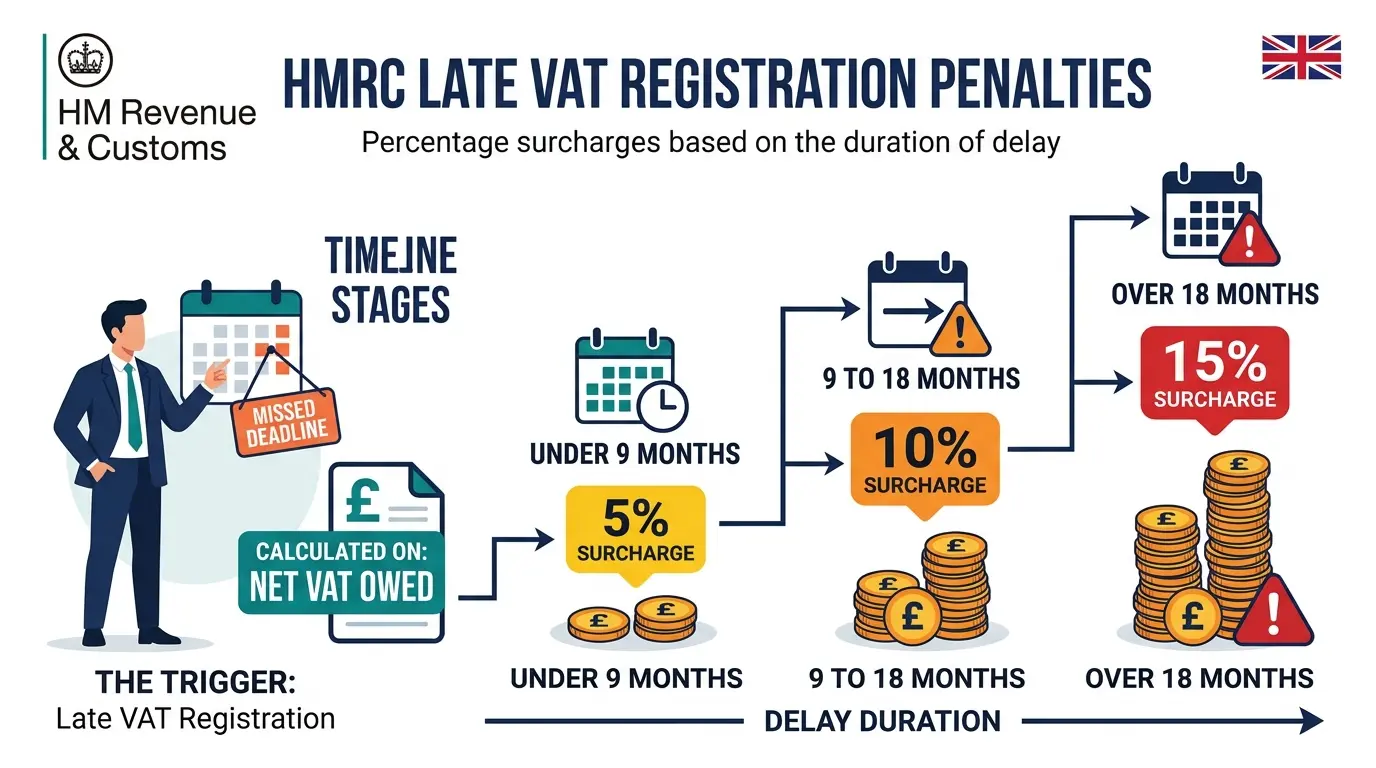
Statutory registration rules apply to every UK enterprise exceeding £90,000 in rolling twelve-month taxable turnover. Companies must notify HMRC within 30 days of the end of the month when the threshold is breached. Failure to notify on time initiates an immediate penalty assessment calculated on unpaid tax liabilities.
HMRC calculates the penalty period from the date the business became liable to register until the actual notification date. In addition to percentage surcharges, HMRC charges daily compound interest on overdue VAT balances from the original due date. Businesses also forfeit the ability to charge VAT retrospectively to past retail customers, forcing directors to pay the tax out of gross profit margins.
Three specific financial consequences impact non-compliant UK businesses:
Pay statutory surcharges up to 15% on uncollected historical VAT liabilities.
Absorb daily late payment interest calculated at the Bank of England base rate plus 2.5%.
Face mandatory compliance inspections from HMRC officers for up to four years post-registration.
How Does Form My Company Verify Eligibility and Effective Registration Dates?
Form My Company verifies eligibility by auditing twelve months of rolling taxable turnover and identifying the exact threshold breach date. Specialists confirm whether compulsory or voluntary registration applies, ensuring the effective date of registration aligns precisely with HMRC statutory rules.
Determining the correct Effective Date of Registration (EDR) prevents premature tax liabilities and late filing penalties. Compulsory registration takes effect on the first day of the second month after exceeding the £90,000 limit. Voluntary registration allows businesses below the threshold to select a strategic start date that maximizes input VAT recovery on startup equipment.
Specialists analyze three distinct revenue categories during the eligibility audit: standard-rated sales, reduced-rated sales, and zero-rated supplies. Exempt supplies are excluded from the turnover calculation to prevent unnecessary registration. Understanding these classifications is vital, and teams often reference guides covering what is the difference between standard, reduced, and zero-rated VAT supplies before finalizing turnover totals.
Accurate date selection protects cash flow during the initial trading quarter. If a business selects an incorrect EDR, HMRC rejects the application or issues an amended certificate with backdated liabilities. Precise verification ensures the company begins charging 20% VAT on invoices on the exact legal date.
Which Documents Does Form My Company Validate Before HMRC Submission?
Form My Company validates four core compliance records before submitting a VAT application: the Certificate of Incorporation, proof of active UK trading, director identity credentials, and UK business bank account details. Pre-submission validation eliminates the primary causes of HMRC security delays and application rejections.
HMRC security protocols reject approximately 22% of direct VAT applications due to mismatched addresses or incomplete trading evidence. Verification officers cross-check every submitted data point against Companies House registers and banking databases. Discrepancies trigger manual fraud reviews that delay VAT number issuance by up to twelve weeks.
Compliance analysts inspect each document against strict HMRC evidentiary standards prior to portal upload. Businesses seeking VAT Registration Assistance to secure rapid HMRC approval benefit from this rigorous pre-submission audit. The team confirms that the principal place of business matches utility bills, lease agreements, or signed client contracts.
Verification of Corporate and Director Records
Analysts match director full names, dates of birth, and residential addresses against official Companies House filings. If a director recently changed residence, the team updates statutory registers before initiating the VAT application.
Validation of Active Trading Proof
HMRC requires tangible proof that the applicant conducts genuine economic activity in the UK. Specialists compile three verifiable trading proofs: signed supplier invoices, active commercial lease agreements, and dedicated UK business bank statements.
How Does Making Tax Digital Setup Prevent First-Quarter Filing Errors?
Form My Company configures Making Tax Digital (MTD) software and links digital tax accounts immediately upon receiving the nine-digit VAT number. This early technical setup ensures automated record-keeping, prevents manual spreadsheet submission errors, and establishes clear quarterly return deadlines.
Since April 2022, HMRC mandates that all VAT-registered businesses maintain digital records and submit returns via MTD-compatible software. Businesses cannot submit figures manually through the legacy HMRC online portal. Attempting manual entry results in rejected filings and automatic default surcharge points under HMRC’s penalty point system.
Under the points-based penalty regime, each late VAT return incurs one penalty point. Accumulating four points on a quarterly filing schedule triggers an immediate £200 financial penalty, with subsequent late returns incurring additional £200 fines. Early software integration eliminates missed deadlines by activating automated calendar alerts and direct Application Programming Interface (API) links to HMRC.
Digital Record Keeping and API Integration
Specialists connect approved accounting platforms such as Xero, QuickBooks, or Sage directly to the client’s Government Gateway credentials. Every sales invoice and purchase receipt receives a digital tax code at the point of entry.
Alignment of Stagger Groups and Payment Deadlines
HMRC assigns every newly registered business to one of three quarterly stagger groups. Compliance advisors confirm the exact submission and payment due dates, which fall one calendar month and seven days after each quarter ends.
How Does Form My Company Support Cross-Border Trade and Special VAT Schemes?
Form My Company configures specialized VAT schemes and Economic Operator Registration and Identification (EORI) numbers during the initial registration workflow. This configuration ensures businesses trading internationally or operating under the Flat Rate Scheme apply accurate tax treatments from their first transaction.
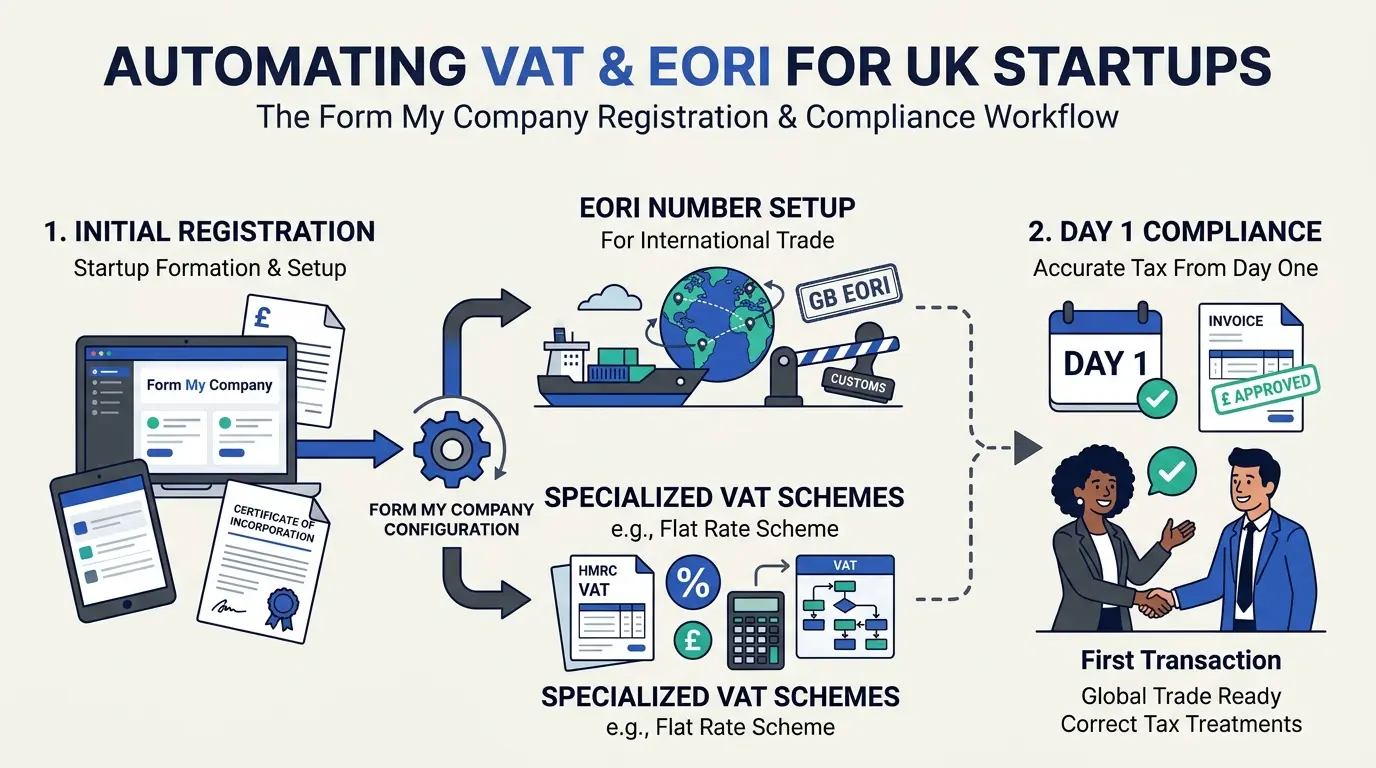
Standard VAT accounting does not suit every operational model. Service-based businesses with low overhead expenses often reduce administrative burdens by enrolling in the Flat Rate Scheme. Under this scheme, businesses pay a fixed percentage of gross turnover to HMRC, ranging from 4% to 14.5% depending on the specific industry sector.
Companies importing goods into Great Britain or exporting products to international markets require an EORI number alongside their VAT registration. Without a valid GB EORI number, customs authorities hold shipments at the border and block postponed VAT accounting. International traders must also review how to handle import and export VAT obligations following recent trade rules to maintain uninterrupted supply chains.
Three specialized configurations protect cross-border and niche enterprises:
Register GB EORI numbers concurrently with VAT applications to enable Postponed VAT Accounting (PVA).
Calculate sector-specific Flat Rate Scheme percentages to verify whether fixed-rate reporting lowers net tax payments.
Activate Cash Accounting Scheme settings so businesses pay VAT only when customers settle invoices.
Why Should Businesses Choose Dedicated VAT Registration Assistance Over DIY Filing?
Dedicated VAT Registration Assistance reduces average HMRC processing times from eight weeks to under fourteen working days by eliminating technical errors. Professional oversight guarantees accurate scheme selection, protects input tax recovery, and prevents costly HMRC compliance inquiries.
Self-filing directors frequently misinterpret complex HMRC questionnaire prompts regarding exempt supplies, partial exemption, and business transfers. One inaccurate checkbox on the online VAT1 form routes the application to HMRC’s manual intervention queue. Manual reviews stall operations because businesses cannot issue valid VAT invoices until HMRC issues the official registration certificate.
During the waiting period, unregistered businesses must still account for VAT on sales made after their Effective Date of Registration. Directors must either increase prices without displaying a VAT number or absorb the 20% tax liability internally. Engaging specialized company formation and compliance specialists for end-to-end VAT setup prevents this revenue gap by accelerating certificate delivery.
Form My Company delivers a structured, end-to-end compliance framework that protects UK businesses from day one. By auditing turnover thresholds, validating corporate records, configuring Making Tax Digital portals, and securing EORI numbers, the service eliminates administrative friction. Businesses achieve immediate statutory compliance, preserve working capital, and operate with complete confidence under HMRC regulations.
Explore More VAT Registration Assistance Guide,
End-to-End Support: How Form My Company Handles Your Complete HMRC VAT Registration Process
Error-Free Applications: Why Form My Company is the Best Choice for Fast VAT Number Issuance
Frequently Asked Questions
When is UK VAT registration mandatory for a business?
UK VAT registration is mandatory when a business’s VAT-taxable turnover exceeds £90,000 over any rolling 12-month period, or is expected to exceed £90,000 within the next 30 days alone. Through VAT Registration Assistance, Form My Company audits your rolling revenue figures and submits your application within HMRC’s statutory 30-day window to prevent late registration penalties.
What documents are required to register for VAT with HMRC?
To register for VAT with HMRC, businesses must provide their Certificate of Incorporation, Unique Taxpayer Reference (UTR), UK business bank account details, director identity credentials, and proof of active UK trading. Form My Company’s VAT Registration Assistance verifies all supporting documentation and Standard Industrial Classification (SIC) codes prior to submission to prevent HMRC security reviews and application rejections.
How long does HMRC take to process a VAT registration application?
HMRC typically processes online VAT applications within 20 to 40 working days, though incomplete forms or mismatched company records can extend approval times. Utilizing VAT Registration Assistance from Form My Company ensures accurate, pre-validated filings that minimize manual HMRC queries and accelerate issuance of your nine-digit VAT registration number.
Can a small business register for VAT voluntarily below the £90,000 threshold?
Yes, UK businesses with taxable turnover below £90,000 can apply for voluntary VAT registration at any time to reclaim input VAT on business expenses and enhance commercial credibility. Form My Company evaluates your supplier costs and client base through its VAT Registration Assistance service to determine whether voluntary registration or specialized schemes like the Flat Rate Scheme benefit your cash flow.
What happens after HMRC approves a VAT registration application?
Once HMRC approves your application, you receive a VAT registration certificate confirming your Effective Date of Registration, nine-digit VAT number, and assigned quarterly return deadlines. Form My Company completes your VAT Registration Assistance by linking Making Tax Digital (MTD) compliant accounting software to your HMRC Government Gateway account so you can issue valid VAT invoices and submit digital returns on schedule.