
UK businesses manage import and export VAT obligations by obtaining an EORI number, applying Postponed VAT Accounting for imports, and retaining official proof of removal for zero-rated exports. Accurate customs declarations and timely digital VAT submissions prevent border delays and HMRC compliance penalties.
Cross-border trade rules require UK companies to treat movements of goods between Great Britain and international markets as formal imports and exports. Following the end of the EU transition period and the implementation of the Windsor Framework, customs borders operate across all non-UK territories. Businesses must register for Value Added Tax once taxable turnover exceeds the £90,000 threshold within a rolling 12-month period. Companies below this threshold often register voluntarily to reclaim import VAT paid on incoming commercial stock.
Securing an Economic Operators Registration and Identification (EORI) number starting with the prefix GB is mandatory before moving goods across borders. HMRC uses this 12-digit identifier to track shipments, process customs declarations, and link tax payments to specific corporate entities. When businesses ship goods to or from Northern Ireland, they also require an XI EORI number to comply with dual-access trade protocols. Obtaining professional VAT Registration Assistance ensures your corporate entity secures valid tax and customs credentials before executing international transactions.
How Does Postponed VAT Accounting Simplify Import Cash Flow?
Postponed VAT Accounting allows UK VAT-registered importers to declare and recover import VAT on the same quarterly VAT return rather than paying upfront at the border. This mechanism eliminates cash flow bottlenecks and accelerates customs clearance for incoming international shipments.
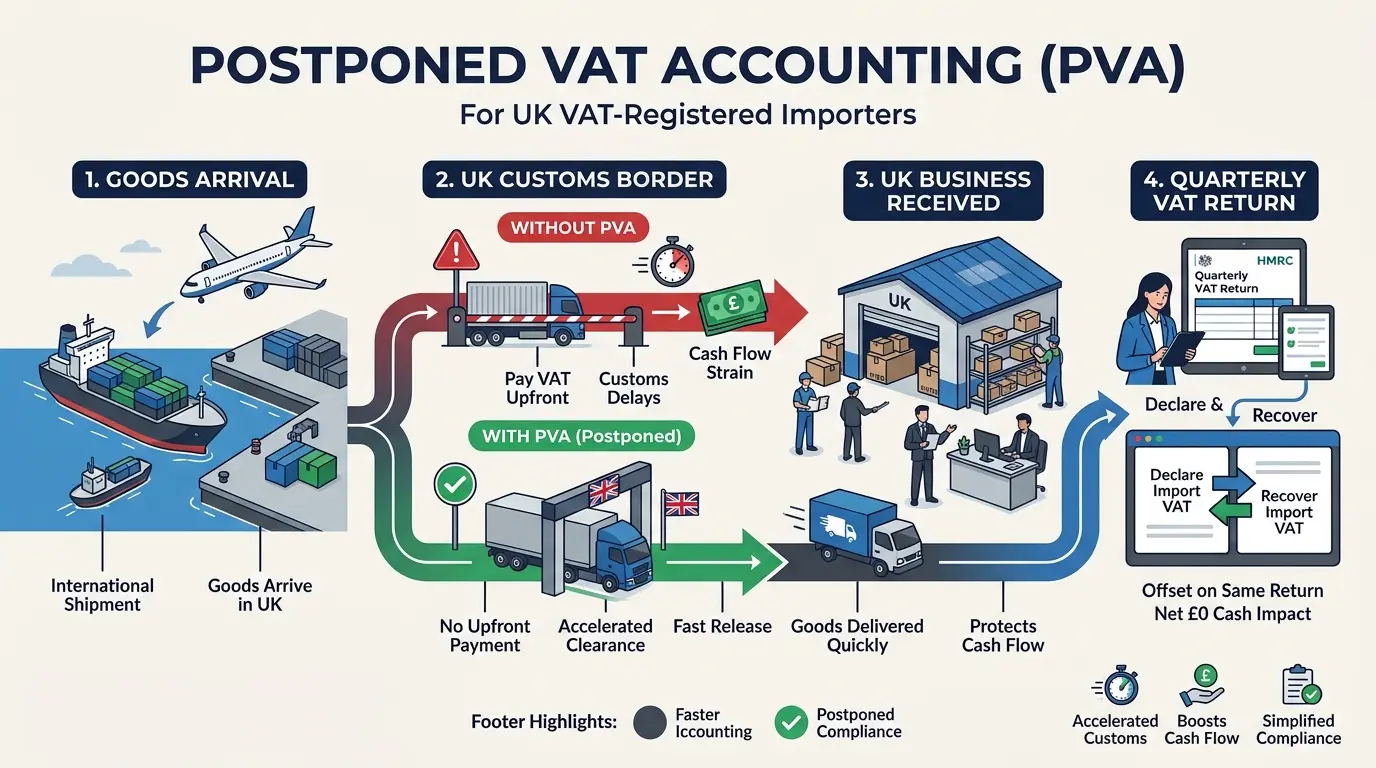
Prior to the introduction of Postponed VAT Accounting (PVA), importers paid 20% standard import VAT at the port of entry before HMRC released goods. Businesses then waited up to three months to reclaim that cash on their subsequent VAT return. Under current UK trade regulations, any VAT-registered business importing goods into Great Britain from anywhere in the world uses PVA automatically. Importers instruct their customs agent or freight forwarder to select the postponed accounting option on the Customs Declaration Service (CDS) entry.
Because import VAT is accounted for digitally on the return, companies retain working capital inside their operational accounts. Each month, HMRC generates an online Postponed Import VAT Statement through the CDS dashboard, detailing the exact tax owed for the previous calendar month. Finance teams download these statements before the tenth working day of the month to reconcile figures accurately. Entering the postponed import VAT amount in Box 1 and Box 4 of the VAT return simultaneously accounts for the liability and reclaims the input tax, provided the goods support taxable business activities.
When Must Importers Use Postponed VAT Accounting?
Importers must use Postponed VAT Accounting whenever they import goods into Great Britain that are subject to Non-Controlled Goods simplified declarations. HMRC also mandates PVA when businesses remove excise goods from a customs warehouse or release goods from a freeport zone. If an importer fails to instruct their freight forwarder correctly, the courier pays the VAT upfront and charges an administrative disbursement fee of £12 to £35 per consignment.
What Documentation Is Required to Zero-Rate Exports Legally?
Businesses zero-rate exports by obtaining official evidence of removal from the UK within three months of the supply date. Acceptable proof includes authenticated customs export declarations, bills of lading, airway bills, and signed international consignment notes linking the goods to the overseas buyer.
Zero-rating an export means charging 0% VAT to the overseas customer while retaining the right to reclaim input VAT incurred on manufacturing or purchasing those goods. Understanding What Is the Difference Between Standard, Reduced, and Zero-Rated VAT Supplies? establishes the foundational tax classification required before issuing international invoices. Under UK VAT Notice 703, HMRC treats every sale as a standard-rated domestic supply unless the exporter holds valid commercial and official evidence proving the goods left the United Kingdom.
Official evidence is generated electronically through the Customs Declaration Service when the export entry receives a “Departed” status message. Commercial transport evidence supplements this record by showing the physical movement of the cargo from a UK port or airport to a foreign destination. Three mandatory commercial documents validate this movement: master airway bills for air freight, shipped-on-board bills of lading for sea cargo, and CMR international consignment notes for road haulage. If an exporter misses the strict three-month deadline for gathering this proof, the business must account for 20% output VAT on its next return.
How Do Direct and Indirect Exports Differ Under UK Law?
Direct exports occur when the UK supplier arranges the transport of goods outside the UK directly to the overseas customer. Indirect exports happen when the overseas buyer collects the goods from the UK supplier’s premises using their own freight agent. Because indirect exports carry higher fraud risks, HMRC prohibits zero-rating if the overseas buyer is established in the UK or operates a UK VAT registration.
How Do Rules of Origin and Valuation Affect Import VAT Calculations?
Rules of origin determine whether imported goods qualify for zero tariffs under free trade agreements, while customs valuation establishes the taxable base for import VAT. Importers calculate import VAT on the total landed cost, including product value, shipping, insurance, and applicable customs duties.
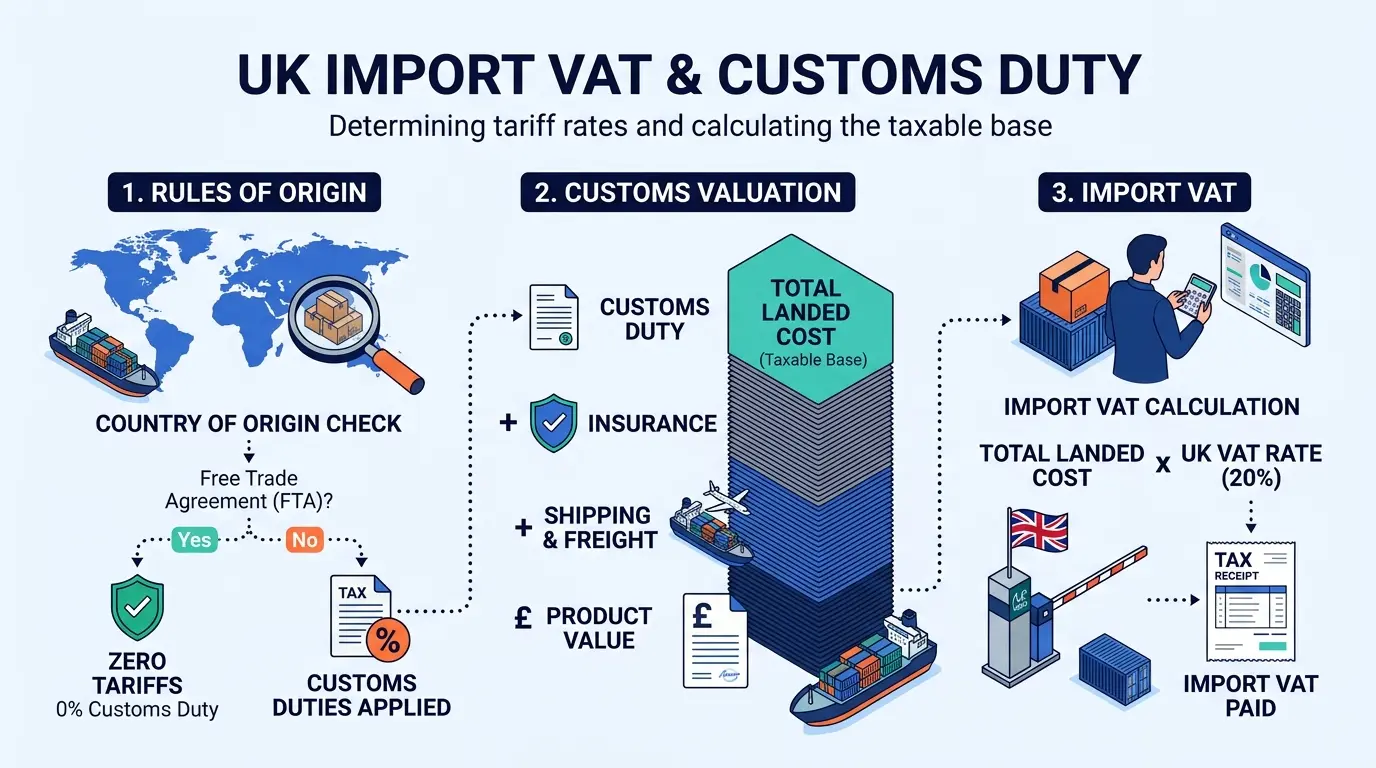
Trade agreements such as the UK-EU Trade and Cooperation Agreement eliminate customs tariffs only when goods meet specific product-specific rules of origin. Importers must hold a valid Statement on Origin issued by the exporter or rely on Importer’s Knowledge backed by technical manufacturing records. When goods fail to meet origin thresholds—such as Asian textiles re-exported from Europe without sufficient processing—HMRC applies standard Most Favoured Nation (MFN) tariffs.
Import VAT is calculated after customs duties are added to the shipment’s Cost, Insurance, and Freight (CIF) value. Four specific cost components form the statutory import VAT base: the commercial invoice price, international transport costs to the UK border, marine or cargo insurance premiums, and any payable customs or excise duties. Businesses frequently miscalculate import VAT by excluding incidental expenses like packaging fees or royalties paid to overseas licensors. Enrolling in comprehensive VAT Registration Assistance helps importers configure accurate ERP tax codes that capture full landed costs automatically.
What Record-Keeping Standards Does Making Tax Digital Mandate for Trade?
Making Tax Digital requires VAT-registered traders to maintain digital records of all import and export transactions and submit returns using compatible API software. Businesses must preserve digital links between customs declarations, commercial invoices, and VAT ledgers for at least six years.
HMRC enforces Making Tax Digital (MTD) across all VAT-registered entities regardless of turnover size. Manual re-keying of export sales data or copy-pasting import VAT figures between spreadsheets violates MTD digital link regulations. When software platforms exchange trade data, automated formulas, API integrations, or XML exports must transfer the figures without human intervention.
Businesses maintain a compliant digital audit trail by storing four core categories of trade data inside their accounting system:
Store customs declaration Movement Reference Numbers (MRNs) alongside supplier purchase invoices
Archive monthly Postponed Import VAT Statements downloaded from the HMRC Customs Declaration Service
Link commercial export invoices directly to digital transport bills and customs departure confirmations
Record commodity codes (HS codes) and country-of-origin designations for every cross-border stock keeping unit
If HMRC conducts a compliance inspection, auditors review these digital links to verify that zero-rated exports match physical shipping records. Discrepancies trigger immediate tax assessments alongside statutory interest charges calculated at the Bank of England base rate plus 2.5%.
How Do Businesses Avoid Penalties on Cross-Border VAT Returns?
Businesses prevent HMRC penalties by reconciling monthly Customs Declaration Service statements against accounting ledgers and submitting quarterly VAT returns before statutory deadlines. Implementing automated compliance checks eliminates late-filing points, inaccurate zero-rating claims, and underdeclared import liabilities.
HMRC operates a points-based penalty regime for late VAT submissions and a separate interest-plus-penalty structure for late tax payments. Accumulating four penalty points on a quarterly filing schedule triggers an automatic £200 financial penalty, with every subsequent late return incurring an additional £200 charge. Furthermore, careless inaccuracies in declaring import VAT or claiming zero-rated exports without valid proof result in behavior-based penalties ranging from 15% to 30% of the potential lost revenue.
Consistent monthly reconciliation between freight forwarder invoices and HMRC CDS statements prevents duplicate VAT claims. Many businesses accidentally reclaim import VAT twice when they use Postponed VAT Accounting while simultaneously processing a courier’s VAT invoice as a standard expense. Establishing clear internal controls ensures finance teams verify the declaration method on every customs entry before posting transactions. For companies seeking structured oversight, exploring Avoid Costly Penalties: How Form My Company Ensures On-Time VAT Compliance from Day One outlines proven workflows for safeguarding corporate tax standing.
Navigating updated UK trade regulations requires precise alignment between customs declarations, digital accounting systems, and HMRC reporting deadlines. By securing valid EORI credentials, utilizing Postponed VAT Accounting, and archiving strict proof of export within three months, trading companies protect cash flow and maintain full regulatory compliance. Form My Company delivers end-to-end VAT Registration Assistance and compliance structuring, enabling UK businesses to execute international trade operations accurately from their first cross-border shipment.
Explore More VAT Registration Assistance Guide,
How to Audit Your Invoices to Ensure Correct VAT Sourcing and Calculations
How to Prepare Your First VAT Return for HMRC Without Making Common Errors
Frequently Asked Questions
When is a UK business legally required to register for VAT?
A UK business must register for VAT when its taxable turnover exceeds £90,000 over any rolling 12-month period, or if it expects to surpass this threshold within a single 30-day period. Non-established taxable persons without a UK physical presence must register immediately before making their first taxable supply in the UK, regardless of turnover. Using professional VAT Registration Assistance from Form My Company ensures your application is submitted within HMRC’s 30-day statutory deadline to prevent late-registration penalties.
What documents and information are required to register for VAT with HMRC?
To register for VAT with HMRC, you must provide your Unique Taxpayer Reference (UTR) or company registration number, business bank account details, and rolling turnover figures. HMRC also requires a detailed description of your business activities, director identification details, and proof of trading activity such as commercial invoices or contracts. Form My Company verifies these records prior to submission through its VAT Registration Assistance service so your filing passes HMRC compliance checks without processing delays.
How long does it take to get a UK VAT registration number?
HMRC typically processes online VAT registration applications within 30 to 40 working days, though timelines vary if additional identity or trading verification is requested. Incomplete forms, mismatched director records, or vague business descriptions frequently trigger manual caseworker reviews that extend waiting periods. Engaging Form My Company for VAT Registration Assistance ensures accurate data entry and complete supporting evidence from day one to avoid unnecessary bottlenecks.
Can a business register for VAT voluntarily below the £90,000 threshold?
Yes, UK businesses with taxable turnover below £90,000 can apply for voluntary VAT registration at any time, provided they make or intend to make taxable supplies. Voluntary registration allows companies to reclaim input VAT paid on business purchases, startup equipment, and import costs while enhancing credibility with VAT-registered B2B clients. Form My Company evaluates your supplier and customer mix through its VAT Registration Assistance service to confirm whether early registration improves your cash flow.
Which VAT accounting scheme should a newly registered UK business choose?
Newly registered businesses choose between Standard VAT Accounting, the Flat Rate Scheme (for taxable turnover up to £150,000), the Cash Accounting Scheme (up to £1.35 million), and the Annual Accounting Scheme (up to £1.35 million). Selecting the right scheme determines whether you pay VAT based on invoice dates or actual customer payments, directly impacting working capital. Form My Company assesses your projected turnover and expense ratios during VAT Registration Assistance to align your HMRC setup with the most tax-efficient reporting method.