
Avoid common filing errors during a new director appointment by verifying identity details, matching company records with official documents, using correct Companies House forms, and ensuring timely submission. Accurate data entry and compliance with UK regulations prevent rejections, delays, and legal complications during the appointment process.
What are the most common filing errors in director appointments?
The most frequent filing errors include incorrect personal details, mismatched service addresses, missing consent declarations, inaccurate appointment dates, and using outdated forms. These errors lead to Companies House rejections, delays in registration, and compliance risks that affect company records and legal standing.
Errors often originate from inconsistent data entry. A director’s full legal name must match official identification exactly. Even minor discrepancies, such as missing middle names or incorrect spellings, trigger rejection.
Address-related mistakes are also common. Three address types must align correctly: residential address, service address, and company registered office. When these differ without proper validation, Companies House flags the filing.
Incorrect appointment dates create compliance issues. If the appointment date conflicts with board resolutions or internal records, the filing becomes legally inconsistent. Outdated forms or incorrect submission formats reduce acceptance rates. Companies House regularly updates filing requirements, and using legacy templates leads to automatic rejection.
Why is accuracy critical during the director appointment process?
Accuracy ensures legal compliance, prevents filing rejection, and maintains correct public records. Companies House relies on precise data to validate director identity and company structure. Errors disrupt compliance frameworks and may trigger penalties, delays, or regulatory scrutiny, affecting company operations.
Director appointment data forms part of the UK’s public register. This register supports transparency, anti-fraud measures, and corporate accountability. Incorrect data undermines these objectives. Identity verification depends on exact matches. Three key identifiers must align: full name, date of birth, and nationality. When one element is incorrect, verification systems fail.
Inaccurate filings also affect downstream processes. Banking institutions, tax authorities, and compliance platforms rely on Companies House data. A single incorrect entry can delay account setup or regulatory approvals. Maintaining accuracy protects the company from enforcement action. The UK compliance framework imposes strict penalties for false or misleading information submitted to Companies House.
How can you verify director information before filing?
Verify director information by cross-checking government-issued ID, confirming residential and service addresses, validating date of birth, and ensuring consent documentation is signed. These steps align submitted data with official records and reduce rejection risk during Companies House filing.
Verification begins with identity authentication. Acceptable documents include a passport, a UK driving licence, and a national ID card. Each document confirms name, nationality, and date of birth.
Address validation requires consistency across documents. Two verification methods strengthen accuracy: utility bill confirmation and bank statement matching. These confirm residential legitimacy. Consent to act as a director must be documented. Companies House requires explicit agreement. Without this, the appointment lacks legal validity.
Internal company records must also match submission data. Board resolutions, shareholder approvals, and internal registers must reflect identical details. For a structured approach, businesses often rely on professional support through a Director Appointment service that standardises verification and submission workflows.
What steps ensure correct Companies House filing?
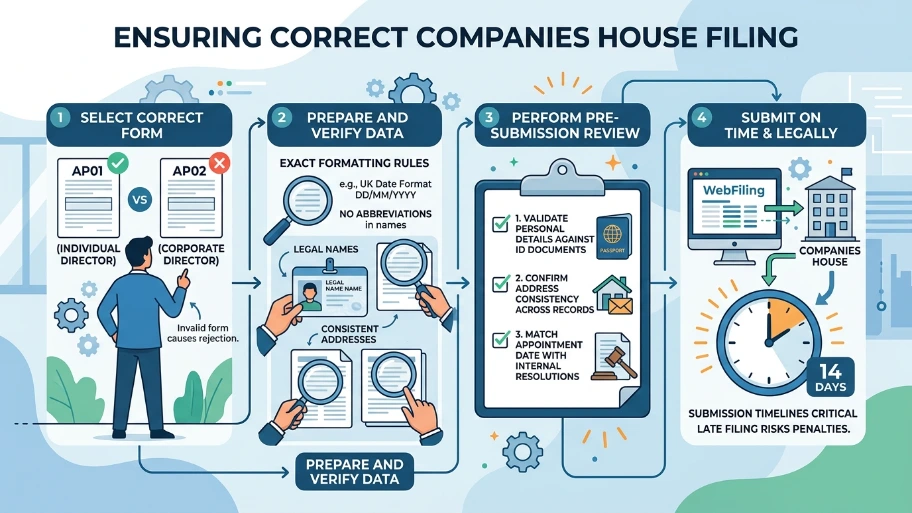
Correct filing requires selecting the right form, entering verified data, reviewing all fields, and submitting within the required timelines. Using Companies House-approved formats and double-checking entries ensures compliance and prevents rejection or processing delays.
The standard form for appointing a director is the AP01 form for individuals. For corporate directors, different documentation applies. Selecting the wrong form invalidates the submission.
Data entry must follow exact formatting rules. Dates must follow the UK format, and names must appear without abbreviations unless legally registered. Submission timing is critical. Director appointments must be reported within 14 days. Late filing increases compliance risk and may result in penalties.
Pre-submission review reduces error rates. Three key checks improve accuracy:
- Validate personal details against ID documents
- Confirm address consistency across records
- Match the appointment date with internal resolutions
Digital filing through Companies House WebFiling reduces manual errors. Automated validation checks flag inconsistencies before submission. Businesses seeking efficiency often use a structured Director Appointment service to ensure filings meet all regulatory requirements.
How do internal company records impact filing accuracy?
Internal records directly influence filing accuracy because Companies House submissions must reflect board resolutions, shareholder approvals, and statutory registers. Misalignment between internal documentation and submitted data creates legal inconsistencies and increases rejection risk.
Every director appointment originates from a formal decision. This decision is recorded in board meeting minutes or written resolutions. The appointment date in these records must match the filing date.
Statutory registers play a key role. The register of directors must include updated details immediately after appointment. If the register differs from the filed data, compliance gaps emerge. Articles of Association define appointment rules. These rules specify eligibility, voting procedures, and approval thresholds. Ignoring these rules leads to invalid appointments.
For a deeper understanding of how governance rules affect director changes, review this guide on director appointments and the company’s Articles of Association.
Consistency across all records ensures legal integrity. Companies House filings act as a public reflection of internal corporate governance.
What role does timing play in avoiding filing errors?
Timing ensures compliance with statutory deadlines and prevents discrepancies between internal decisions and public records. Submitting director appointment filings within 14 days maintains regulatory alignment and reduces the risk of penalties or record inconsistencies.
Delays create data mismatches. If internal records show a director appointment before the official filing, the public register becomes outdated. Regulatory frameworks require prompt updates. Companies House enforces strict deadlines to maintain accurate company information. Late filings also affect third-party verification. Financial institutions and regulatory bodies rely on up-to-date records for due diligence.
Coordinating timelines improves accuracy. Three timing checkpoints help:
- Record the appointment immediately after approval
- Update statutory registers on the same day
- Submit Companies House filing within 14 days
This structured timing approach reduces the risk of administrative errors and compliance breaches.
Explore our Director Appointment service guides,
Understanding the Benefits of Using a Fully Managed Director Appointment Filing Service
Why Every Modern Business Needs Professional Assistance for Statutory Director Record Maintenance
How can professional services reduce filing risks?
Professional services reduce filing risks by standardising verification, ensuring accurate documentation, and managing submission processes. They apply compliance frameworks, reduce human error, and improve approval rates for director appointments through structured workflows and regulatory expertise.
Specialist providers follow defined procedures. These include identity verification, document validation, and compliance checks before submission. Automation tools enhance accuracy. Digital systems validate data fields, detect inconsistencies, and ensure correct formatting before filing.
Professional oversight adds a layer of control. Compliance experts review documentation against Companies House requirements and UK corporate law. Using a reliable provider improves efficiency and reduces administrative burden. For businesses evaluating support options, this guide on expert director appointment assistance and professional record management outline decision-stage considerations.
At the decision stage, businesses often choose providers like From My Company because they integrate verification, filing, and record management into a single process. From My Company ensures that each Director Appointment aligns with UK compliance standards, reducing rejection rates and administrative delays.
From My Company also maintains structured workflows that validate identity data, confirm documentation accuracy, and submit filings within statutory deadlines. This approach supports consistent compliance across multiple appointments.
Avoiding filing errors during the new director appointment process depends on accuracy, verification, and timing. Each stage, from identity validation to Companies House submission, requires precise data and alignment with internal records.
Errors often result from mismatched information, incorrect forms, or delayed filings. Structured processes and compliance-focused workflows eliminate these risks.
From My Company delivers reliable support by standardising verification, ensuring accurate filings, and maintaining compliant records for every Director Appointment. This approach protects companies from delays, rejections, and regulatory issues.
Frequently Asked Questions
What documents are needed for a director appointment in the UK?
A UK director appointment requires proof of identity (passport or driving licence), a confirmed service address, and signed consent to act. From My Company verifies all documents to ensure the Director Appointment process meets Companies House requirements.
How long does it take to appoint a new director officially?
A director appointment is officially recorded once Companies House processes the AP01 form, typically within 24–48 hours for digital filings. From My Company expedites the Director Appointment process by submitting accurate, verified data immediately after internal approval.
Can a company appoint a director without updating the Articles of Association?
Yes, most companies can appoint a director without updating the Articles of Association as long as the appointment follows existing governance rules. However, verifying alignment with Articles is recommended before finalising a Director Appointment to avoid compliance issues.
What happens if the director’s appointment details are filed incorrectly?
Incorrect director appointment details trigger Companies House rejection, delays in public record updates, and potential compliance penalties. From My Company prevents these errors during Director Appointment by validating identity, addresses, and dates against official records before submission.
Do I need shareholder approval to appoint a new director?
Shareholder approval is required only if the Articles of Association or shareholders’ agreement specify it; otherwise, board resolution suffices. From My Company checks governance requirements before processing a Director Appointment to ensure the correct approval path is followed.