
Yes. A fully managed director appointment filing service registers a new director with Companies House, prepares and files statutory forms, verifies identity and eligibility, updates company registers, and ensures legal and Companies House compliance promptly and accurately.
Can a corporate entity be appointed as a director of a UK company?
No. A corporate entity cannot be appointed as a director of a private limited company or a public limited company under UK company law.
UK company law requires natural persons for director roles in standard limited companies. Only specific corporate forms (for example, corporate directors in corporate vehicle arrangements outside the Companies Act scope) apply in rare, regulated structures. Companies House mandates individual natural persons for appointment records.
What does a fully managed director appointment filing service do?
A fully managed service prepares, verifies, files, and updates all statutory records for a director appointment on behalf of the company.
The service handles Companies House form AP01 (appointment of a director) or AP03 for an individual appointed as director/secretary, depending on company type. It collects identity documents, verifies eligibility, completes the public filing, and updates the company’s statutory registers. The service reduces filing errors and ensures deadlines are met.
What the service performs in practice:
- Verify identity using passport or driving licence, proof of address, and electronic identity checks.
- Validate director eligibility against disqualification registers and insolvency records.
- Complete Companies House forms and submit electronic filing within prescribed timelines.
- Update the company’s internal registers: directors’ register, PSC register if relevant, and meeting minutes.
- Provide a formal confirmation and a copy of the filed documents for record-keeping.
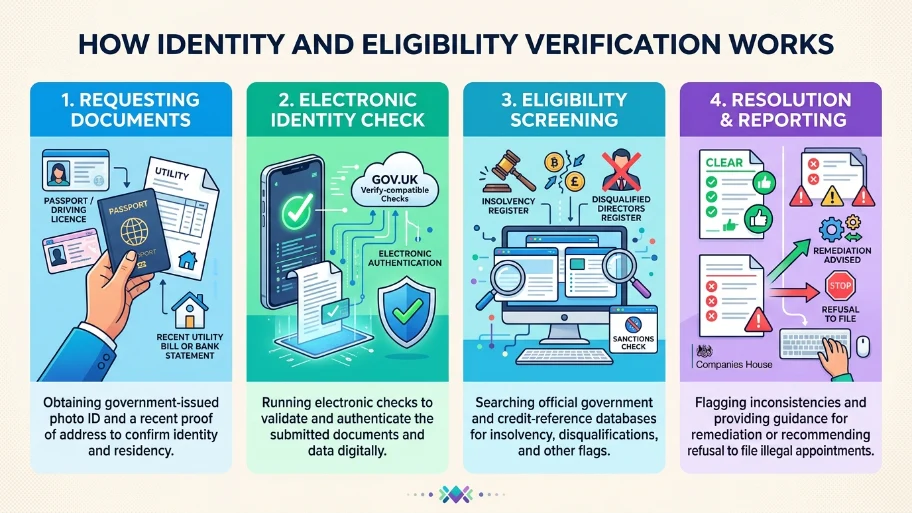
How does identity and eligibility verification work?
Verification involves collecting government-issued ID, corroborating address, and checking disqualification and insolvency databases.
Services use three verification methods: passport checks, driving-licence validation, and digital identity checks (e.g., GOV.UK Verify-compatible checks). They match submitted documents to Companies House requirements. Services also search for director disqualifications, bankruptcy, and sanctions using UK Government and credit-reference databases. These checks prevent illegal appointments and regulatory penalties.
Verification steps typically:
- Request government photo ID and a recent utility or bank statement for the address.
- Run an electronic identity check to authenticate the document.
- Search the Insolvency Register and Disqualified Directors Register.
- Flag any inconsistencies and advise on remediation or refusal to file.
Why use a fully managed service instead of filing in-house?
A managed service reduces the risk of incorrect filings, lowers compliance workload, and ensures timely submission to Companies House.
In-house teams often face time pressures and unfamiliarity with the latest Companies House rules. A professional service maintains expertise in form requirements, file formats, and submission windows. This reduces rejections and late-filing penalties. The service also centralises documentation for audit trails and board governance.
Specific benefits:
- Reduce filing errors by using trained compliance specialists.
- Save staff time by outsourcing document collection and filing.
- Achieve faster processing: many services file within 24–72 hours of receiving complete information.
- Maintain an auditable trail of verification and filing actions.
What compliance risks does the service prevent?
The service prevents incorrect public records, late filing penalties, and legal exposure from appointing disqualified or ineligible directors.
Incorrect or delayed filings create regulatory exposure and potential fines up to £1,500 for persistent default. Appointing a disqualified director can lead to criminal liability and civil claims. Fully managed services validate eligibility and maintain documentary evidence to defend decisions in audits or investigations.
Commonly mitigated risks:
- Filing an incorrect name, date of birth, or service address on Companies House.
- Omitting statutory notifications that trigger PSC register obligations.
- Failing to spot disqualified or bankrupt individuals before appointment.
- Not retaining verification records for 6 years as good governance practice.
Read our Director Appointment articles, Can a Corporate Entity Be Appointed as a Director of a UK Company? and Buy Our Professional Director Appointment Solutions for Guaranteed Statutory and Legal Compliance.
How does the service manage Companies House submissions?
The service prepares the correct Companies House form, converts documents into required formats, and submits electronically using authenticated accounts.
Most services file electronically via Companies House WebFiling, third-party software, or authenticated API integrations. They ensure the correct form (AP01, AP02, or AP03, where applicable) is used and include any required supporting statements. After submission, the service monitors confirmation and updates the company’s statutory registers.
Operational steps:
- Draft the appointment form using verified data.
- Upload documents in PDF or supported formats.
- Submit via the authenticated Companies House channel.
- Confirm acceptance and supply the filing reference and timestamp.
What documentation does the service provide after filing?
The service supplies a filed copy of the Companies House confirmation, updated statutory registers, and a verification log for governance records.
Clients receive a PDF of the Companies House filing receipt and an internal pack that contains identity checks, search results, and minutes or written resolutions where required. The service stores these records securely for audit purposes and future compliance checks.
Typical deliverables:
- Companies House filing receipt
- Updated directors’ register entry
- Updated PSC register notes (if appointment triggers PSC changes)
- Identity-verification documents and search reports
- Governance checklist and recommended next steps
Who should use a fully managed director appointment filing service?
Companies with limited internal compliance capacity, corporate service providers, and advisers requiring fast, accurate filings should use the service.
Examples include fast-growing SMEs, company secretarial teams supporting multiple entities, and third-party advisers handling client incorporations. The service fits MOFU intent: users evaluate an outsourced compliance solution before purchase.
Suitable use cases:
- Registering a new executive director after recruitment.
- Appointing a nominee director during restructuring.
- Updating Companies House records after investor-led board changes.
Explore our Director Appointment guides,
Why Every Modern Business Needs Professional Assistance for Statutory Director Record Maintenance
How to Handle Complex Director Appointments for Companies with Multiple Corporate Shareholders
How does this service support PSC and governance obligations?
The service checks whether the new director affects People with Significant Control and updates PSC registers and related filings accordingly.
When a director appointment results from share transfers or raises questions about control, the service identifies PSC changes and files PSC01 notifications where required. It also ensures board minutes or written resolutions are prepared to validate the appointment against the company’s articles.
Governance support includes:
- Evaluate PSC status and submit PSC01 within 14 days if control changes are identified.
- Draft or amend board minutes to record the appointment.
- Recommend changes to internal policies if the director takes specific roles (e.g., company secretary responsibilities).
What are the costs and turnaround times?
Typical fees range from £60 to £300 per appointment, with turnaround from same day to five working days depending on verification complexity.
Pricing varies by provider, verification intensity, and whether legal advice is included. Simple appointments using electronic ID and clear records are often completed within 24–48 hours. Complex cases requiring overseas verification or legal review extend to 3–5 working days.
Factors affecting cost and time:
- Need for manual identity checks or overseas document translation.
- Requirement for disqualification or insolvency fingerprint searches.
- Volume discounts for bulk engagements across multiple companies.
A fully managed director appointment filing service delivers end-to-end compliance: identity verification, eligibility checks, Companies House filing, and statutory register updates. The service reduces risk, speeds submission, and provides governance-ready records. From My Company applies these processes to ensure statutory and legal compliance while preserving audit evidence and board transparency.
Frequently Asked Questions
What is a director’s appointment, and why is it required for UK companies?
A director appointment is the formal process of registering a new director with Companies House when someone joins a company’s board. UK companies must file this within 14 days to comply with the Companies Act 2006 and maintain accurate public records.
How long does a director appointment filing take with a managed service?
A managed director appointment service typically files within 24–72 hours after receiving complete identification and eligibility documents. From My Company completes verification and submits the Companies House form AP01 electronically to ensure fast statutory compliance.
What documents are needed for a director appointment in the UK?
You need a government-issued photo ID (passport or driving licence), proof of address dated within three months, and the director’s date of birth and service address. From My Company verifies these documents and checks disqualification records before filing the director appointment.
Can a corporate entity be appointed as a director of a UK private limited company?
No, a corporate entity cannot be appointed as a director of a private limited company under current UK company law. Only natural persons qualify, which is why From My Company verifies that every director appointment involves a person before filing.
What happens if a director’s appointment is filed late or incorrectly?
Late or incorrect director appointments can trigger Companies House rejection, public record errors, and fines up to £1,500 for persistent default. From My Company prevents these issues by validating eligibility, completing accurate filings, and maintaining audit-ready verification records for every director appointment.