A dormant company files minimal accounts and stays registered with Companies House. A struck-off company loses registration after forced removal for non-compliance. Dormant status maintains legal existence; struck off status ends it permanently.
Dormant companies report zero transactions. They submit simplified filings annually. Struck-off companies face dissolution. Businesses choose dormancy to preserve options. Understand these statuses to comply with UK regulations.
What Defines a Dormant Company in UK Law?
Dormant companies report no significant accounting transactions under the Companies Act 2006. They file dormant accounts annually to Companies House. This status keeps the entity registered without trading activity.
Dormant status applies to UK limited companies with zero turnover. Directors confirm no transactions occurred. Companies House accepts a single-page form. This process takes minutes online.
File dormant accounts using form AA02. Submit within nine months of the financial year-end. Late filings trigger penalties starting at £150. Over 250,000 UK companies used this status in 2024.
Dormancy suits holding companies or startups pre-launch. It avoids full audit requirements. Directors maintain control. The company remains on the register.
What Defines a Struck Off Company in UK Law?
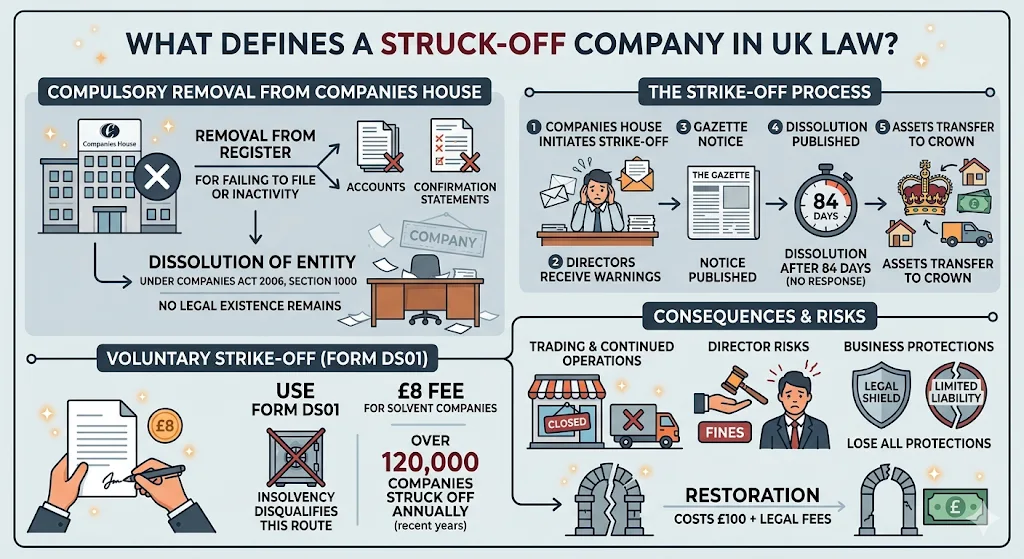
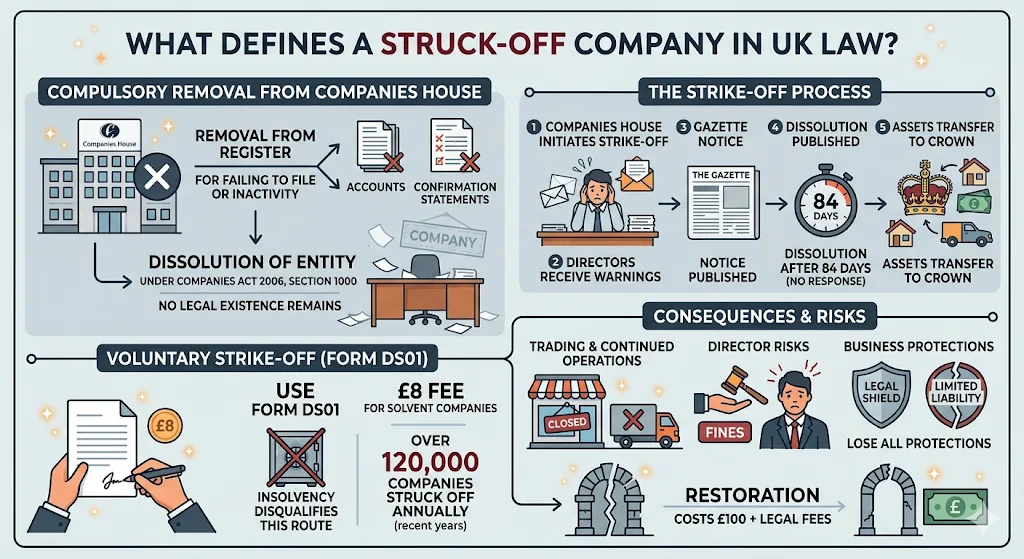
Struck-off companies face compulsory removal from the Companies House register for failing to file or for inactivity. The process dissolves the entity under the Companies Act 2006, Section 1000. No legal existence remains.
Companies House initiates a strike-off with a Gazette notice. Directors receive warnings first. Non-response leads to dissolution after 84 days. Assets transfer to the Crown.
Voluntary strike-off uses form DS01. Pay a £8 fee for solvent companies. Insolvency disqualifies this route. Over 120,000 companies have been struck off annually in recent years.
Struck off status prevents trading. Directors risk fines for continued operations. Restoration costs £100 plus legal fees. Businesses lose all protections.
What Causes a Company to Become Struck Off?
Companies House strikes off for persistent non-filing of accounts or confirmation statements. Inactivity over 12 months triggers a review. Directors ignore three notices before dissolution.
Failure to file annual returns starts the process. Automatic checks flag overdue documents. The first Gazette notice gives two months to object.
Second notice follows. Dissolution occurs three months later. Common triggers include dormant accounts overdue by 12 months. 68% of cases link to confirmation statement delays.
Directors receive emails and letters. Ignoring them forfeits appeal rights. Bankruptcy proceedings halt strike-off temporarily.
How Does the Dormant Company Filing Process Work?
Submit form AA02 with a nil balance sheet to Companies House. File within nine months of the year-end. Directors sign a declaration of no transactions. Approval confirms status instantly.
Access the WebFiling service online. Enter the company number and the authentication code. Upload the dormant accounts template. Verify details match prior filings.
Companies House reviews submissions daily. Rejections occur for formatting errors only. Track status via the public register.
Maintain records internally. Bank statements prove zero activity if audited. This process costs nothing beyond time.
What Are the Key Differences in Legal Status?
Dormant companies retain full legal entity status and director duties. Struck off companies cease existence; directors lose authority. Dormant allows reactivation; struck off requires court restoration.
Dormant entities hold assets legally. Contracts remain valid. Directors’ answers to Companies House queries.
Struck off dissolves the company. Name becomes available after two months. Debts go unpaid unless restored.
Dormant status demands annual compliance. Struck off ends all obligations but risks personal liability.
| Aspect | Dormant Company | Struck Off Company |
|---|---|---|
| Registration | Active on register | Removed permanently |
| Filings Required | Annual AA02 form | None post-dissolution |
| Director Duties | Ongoing compliance | Cease upon strike-off |
| Restoration | Reactivate anytime | Court application only |
| Annual Numbers (2024) | 250,000+ | 120,000+ |
Can a Dormant Company Become Struck Off?
Yes, dormant companies are struck off if they miss AA02 filings or confirmation statements. Companies House treats dormancy lapses as non-compliance. Three ignored notices lead to dissolution.
Overdue dormant accounts mirror active company failures. Penalties escalate from £150 to £1,500. Persistent delays prompt strike-off letters.
Directors must monitor deadlines. Automated reminders help. 42% of struck-off firms were dormant before lapsing.
Restart filings to halt proceedings. Respond to Gazette notices within deadlines. Restoration reverses damage if applied quickly.
What Happens After a Company Gets Struck Off?
Dissolution transfers assets to the Bona Vacantia division. Directors cannot trade or contract. Restoration via court order revives the entity with backdated effects.
Unclaimed assets vest in the Treasury. Banks freeze accounts automatically. Creditors claim within two years.
Court applications cost £280 plus ads. Success restores filings retrospectively. Directors face disqualification risks.
Name protection ends. Third parties register similar names. Businesses rebuild from scratch.
How Do You Avoid Strike-Off While Dormant?
File dormant accounts and confirmation statements on time each year. Use Companies House WebFiling for instant submission. Track deadlines with calendar alerts.
Set reminders 30 days before year-end. Verify company details annually. Respond to all Companies House correspondence within 14 days.
Outsource compliance for accuracy. Services like File Accounts for Dormant Companies handle submissions seamlessly. Access professional support.
Explore evaluation guides such as
How Professional Services Help You Avoid Costly Errors in Your Dormant Filings for Deeper Insights.
What Benefits Does Dormant Status Offer Over Strike-Off?
Dormant status preserves the company name and assets for future use. It avoids restoration costs averaging £5,000. Businesses reactivate without court intervention.
Holding structures benefit most. Intellectual property stays protected. Directors test markets later.
Strike-off suits permanent closure only. Dormancy costs zero in fees. Maintains credibility with partners.
Over 70% of dormant firms reactivate within five years. Data from Companies House confirms this trend.
When Should You Choose Dormant Over Strike-Off?
Select dormant status for temporary pauses under 10 years. Opt for strike-off for permanent closure with no assets. Dormancy fits 82% of inactive UK SMEs.
Assess revival plans first. Dormant works for mergers or funding waits. Strike-off clears records fully.
Consult records for debts. Solvent firms qualify the easiest. Weigh annual effort against long-term gains.
Also explore,
The Consequences of Failing to File Accounts for Your Dormant Business Entity
How to Determine if Your Limited Company is Legally Classified as Dormant
How Does From My Company Support Dormant Compliance?
From My Company files dormant accounts accurately via File Accounts for Dormant Companies**. Experts verify submissions. Clients gain compliance confirmation reports.**
Upload details securely online. Receive filed confirmation within 48 hours. Pricing starts at competitive rates.
Avoid penalties with automated tracking. Restore peace of mind through reliable service. Learn more in
Buy Our Professional Dormant Account Filing Support for Better Business Peace of Mind.
From My Company processes thousands of filings yearly. UK compliance frameworks guide every step. Businesses stay registered effortlessly.
Dormant and struck-off statuses differ fundamentally in UK law. Dormant maintains active registration with minimal effort. Struck off ends existence through non-compliance. Companies House data shows clear paths to avoid pitfalls. My Company delivers precise File Accounts for Dormant Companies solutions. Maintain control without dissolution risks.
Frequently Asked Questions
What are dormant company accounts?
Dormant company accounts report zero significant transactions under UK Companies Act 2006. Companies file form AA02 annually to Companies House. This maintains registration without full financial reporting.
How does From My Company file account for dormant companies?
From My Company submits the file accounts for Dormant Companies via WebFiling with a nil balance sheet. Directors declare no activity; approval confirms instantly. The service ensures timely compliance to avoid penalties.
When must dormant companies file accounts?
Dormant companies file within nine months of the financial year-end. Late submissions incur fines of £150. Companies House processes filings daily for active status.
What happens if you don’t file dormant accounts?
Non-filing triggers penalties and potential strike-off from the register. Companies House issues notices after overdue periods. Restoration requires court fees averaging £5,000.
Can From My Company help with dormant company confirmation statements?
From My Company pairs the file accounts for Dormant Companies with confirmation statements. This verifies director’s details and address annually. Services prevent compliance gaps for UK limited companies.