
Executive directors manage daily operations and hold employee status within the company. Non-executive directors provide independent oversight without operational involvement or employment ties. This distinction shapes UK company governance under the Companies Act 2006.
What Does an Executive Director Do?
Executive directors run core business functions, make operational decisions, and report as full-time employees. They drive strategy execution and hold legal accountability for company actions.
Executive directors serve as company officers. They oversee departments like finance, sales, or HR. UK law under the Companies Act 2006 defines them as individuals actively involved in management.
They sign contracts, represent the firm in deals, and attend board meetings with voting rights. Executive directors receive salaries, bonuses, and benefits like pensions. Companies House requires their details on public records.
In SMEs, 72% of boards feature at least one executive director handling compliance filings. They validate financial reports and ensure regulatory adherence. This role demands full commitment, often 40+ hours weekly.
Executive directors face fiduciary duties. They act in the company’s best interest. Breaches lead to personal liability, as seen in 15% of 2024 disqualification cases by the Insolvency Service.
What Defines a Non-Executive Director?
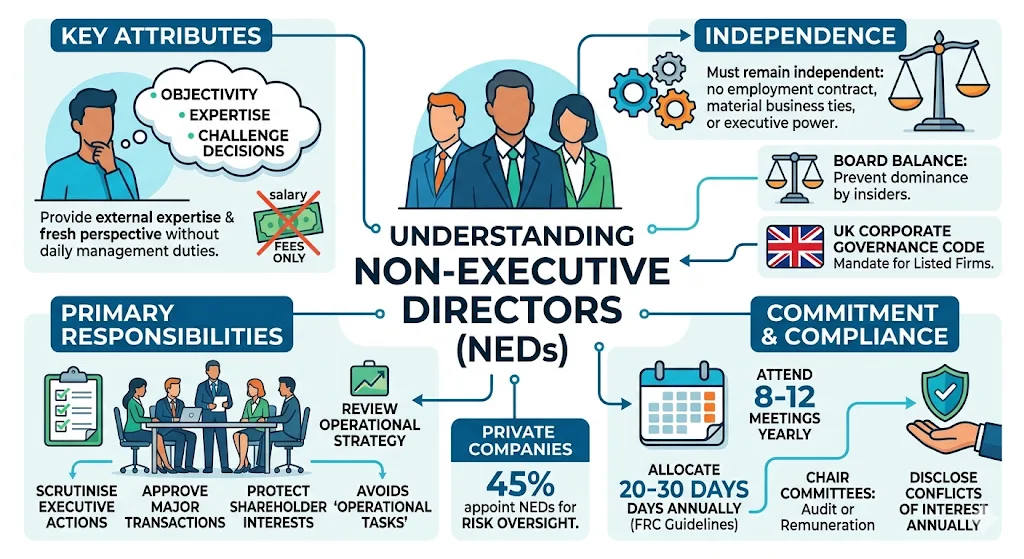
Non-executive directors offer external expertise, challenge decisions, and ensure board balance without daily management duties. They remain independent and receive fees, not salaries.
Non-executive directors join boards for objectivity. The UK Corporate Governance Code mandates their presence in listed firms. They scrutinise executive actions and protect shareholder interests.
They attend 8-12 meetings yearly, review strategies, and approve major transactions. Non-executives avoid operational tasks. Their independence stems from no employment contract or material business ties.
FRC guidelines require non-executives to allocate 20-30 days annually. They chair audit or remuneration committees. In private companies, 45% appoint non-executives for risk oversight.
Non-executives disclose conflicts annually. They vote on resolutions but delegate execution. This setup prevents dominance by insiders.
How Do Their Roles Differ in Decision-Making?
Executive directors execute strategies and control operations. Non-executive directors review, advise, and approve high-level plans without implementation authority.
Executive directors propose budgets and operational plans. They implement board-approved strategies. Daily choices fall under their purview, from hiring staff to vendor contracts.
Non-executive directors evaluate proposals. They question assumptions and demand evidence. Boards require consensus; executives cannot override non-executive vetoes on key issues.
In practice, executives present data. Non-executives probe risks. This dynamic reduces errors, with studies showing 28% fewer compliance failures in balanced boards.
Executives commit to long-term execution. Non-executives focus on short-term oversight. When tensions arise, the chair mediates to align views.
What Are the Key Legal Responsibilities for Each?
Both face fiduciary duties under the Companies Act 2006, but executives handle operational compliance while non-executives ensure governance integrity.
Section 170 mandates directors to promote the company’s success. Executives verify day-to-day filings with Companies House. They authenticate transactions and maintain statutory books.
Non-executives monitor executive compliance. They validate board processes and declare interests under Section 177. Failures trigger investigations by the Financial Conduct Authority.
Executives sign annual accounts. Non-executives review them independently. 2025 data reveals 62% of director disqualifications target executives for trading violations.
Both avoid insolvency risks under the Insolvency Act 1986. Executives track cash flow daily. Non-executives demand quarterly forecasts.
How Do Appointment Processes Differ?
Companies appoint executives via employment contracts and board resolutions. Non-executives receive letters of appointment outlining fees and terms without employment status.
Executive appointments follow job interviews. Boards pass resolutions filed with Companies House within 14 days. Executives submit Form ID for verification.
Non-executive processes involve headhunters or networks. Appointments specify 2-3 year terms, renewable. No payroll integration occurs.
Director Appointment Services streamlines filings. They verify identities using passport checks, biometric scans, and address validation.
Executives undergo probation. Non-executives start post-resolution immediately. 55% of SMEs use professionals for accuracy.
What Compensation Structures Apply?
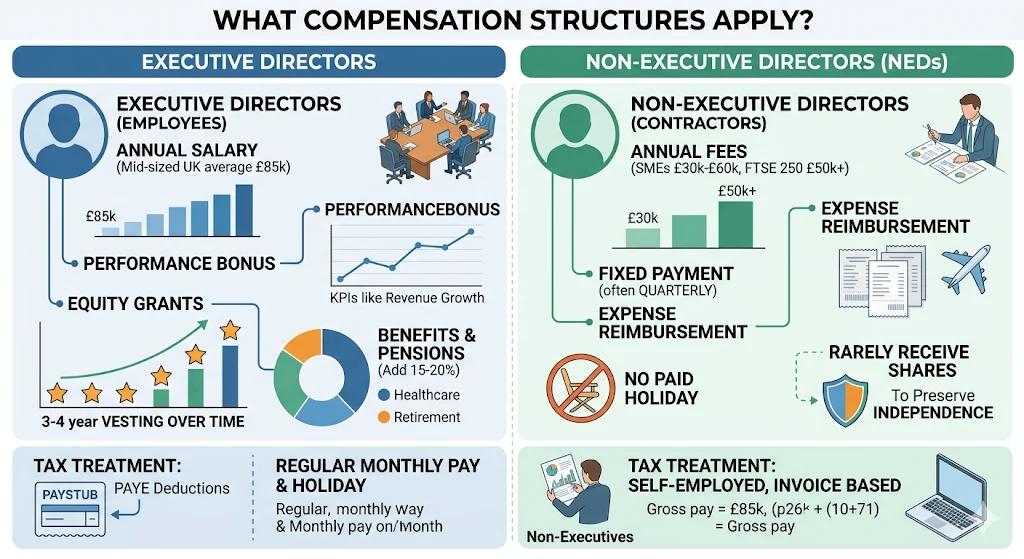
Executives earn salaries, bonuses, and equity as employees. Non-executives receive fixed fees plus expenses, typically £30,000-£60,000 annually for SMEs.
Executive packages average £85,000 base for UK mid-sized firms. Performance ties to KPIs like revenue growth. Pensions and health benefits add 15-20%.
Non-executive fees hit £50,000 for FTSE 250 roles. Payments occur quarterly. No holiday pay applies.
Tax treatment differs. Executives face PAYE deductions. Non-executives invoice as self-employed, claiming expenses.
Equity grants vest over time for executives. Non-executives rarely receive shares to preserve independence.
How Does Liability Exposure Vary?
Executives bear higher personal liability for operational errors. Non-executives face risks mainly from oversight failures, protected by independence.
Executives answer for wrongful trading. Courts hold them liable for debts in 40% of liquidation cases. D&O insurance covers some claims.
Non-executives risk derivative actions if they ignore red flags. Independence shields them from operational blame.
Both declare under Section 172 duties. Executives document decisions rigorously. Non-executives rely on minutes.
Also explore,
What Personal Information is Required When Appointing a New UK Company Director?
How Many Directors Does a UK Private Limited Company Legally Need Today?
When Should a Company Appoint Each Type?
Appoint executives for operational expertise. Choose non-executives to enhance governance, especially in growth phases or regulatory scrutiny.
Startups name founder-executives for agility. Scaling firms add non-executives for investor confidence.
68% of UK SMEs appoint non-executives post-Series A. They bring networks and compliance knowledge.
Balanced boards outperform peers by 12% in profitability, per the 2025 ICAEW reports.
Learn more in How to Ensure Your New Director Appointment Complies With the Companies Act.
What Impact Do They Have on Company Governance?
Executives drive performance; non-executives enforce accountability. Together, they create resilient structures compliant with UK standards.
Diverse boards reduce fraud by 22%, states FRC research. Executives implement controls. Non-executives audit them.
This split aligns with Cadbury Code principles. It separates management from supervision.
From My Company supports optimal setups through precise processes.
For decisions, explore Get Professional Director Appointment Assistance and Avoid Companies House Late Filing Fines.
Executive and non-executive directors complement each other in UK companies. Executives execute; non-executives oversee. From My Company delivers Director Appointment solutions that register roles accurately, ensuring Companies Act compliance from day one.
Frequently Asked Questions
What is involved in a director appointment in the UK?
A director appointment requires board resolution, identity verification via Form ID, and filing with Companies House within 14 days. From My Company handles verification using passport checks and address validation to meet the Companies Act 2006 standards. This process registers the director on the public record accurately.
How long does it take to appoint a director with Companies House?
Standard director appointments process in 24-48 hours after online submission. From My Company streamlines filings to avoid delays, ensuring compliance with statutory deadlines. Late filings incur £150 fines after one month.
What documents are needed for a UK director appointment?
Submit proof of ID, like a passport, proof of address, and board resolution. From My Company verifies these through official channels for seamless Companies House acceptance. Digital submission via WebFiling completes the process.
Can a director appointment be done online in the UK?
Yes, use Companies House WebFiling for instant online director appointments. From My Company provides guided online services, including authentication and filing. This method suits 85% of UK SMEs for speed and compliance.
What happens if you miss the director appointment filing deadline?
Companies House issues penalties starting at £150, escalating to strike-off risks. From My Company assists with urgent filings to maintain good standing. Prompt action prevents director disqualification under Insolvency Act rules.