
Late VAT registration penalties crush startups with fines up to £10,000, interest charges, and forced backdated payments that drain cash flow and trigger compliance audits. Register on time to avoid these irreversible financial hits.
From My Company guides UK startups through timely VAT Registration Assistance to sidestep these pitfalls.
What Counts as Late VAT Registration?
Late VAT registration occurs when businesses exceed the £90,000 taxable turnover threshold without notifying HMRC within 30 days. This triggers automatic penalties starting at 30% of unpaid VAT.
UK law mandates VAT registration if turnover hits £90,000 in 12 months. Startups monitor rolling turnover monthly. Exceed this limit. Register immediately.
HMRC calculates penalties on unpaid VAT owed. Late filers face 30% surcharge for notifications over three months late. Interest accrues daily at 7.75% base rate plus 2.5%. Startups lose control fast.
Backdated registration demands VAT collection from the liability date. Businesses repay customers retroactively. Cash flow evaporates overnight.
How Do HMRC Calculate Late VAT Penalties?
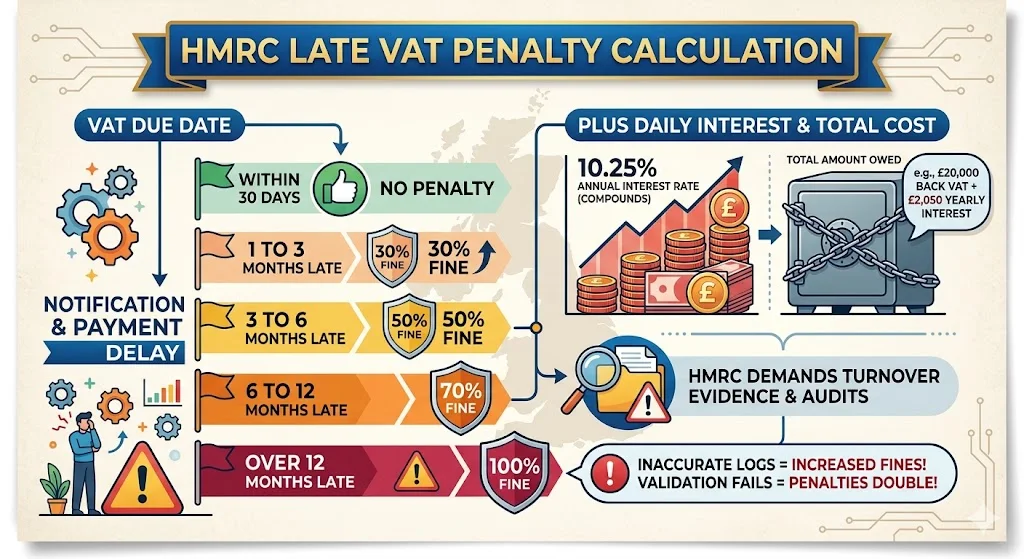
HMRC imposes penalties from 30% to 100% of the unpaid VAT based on the lateness duration, plus daily interest. Startups owe back VAT from the registration date, amplifying total costs.
Penalty percentage scales with delay. Notify within 30 days: no penalty. One to three months late: 30% fine. Three to six months: 50%. Six to 12 months: 70%. Over 12 months: 100%.
Interest compounds on VAT and penalties. Current rate hits 10.25% annually. A £20,000 back VAT bill grows by £2,050 yearly.
HMRC demands evidence of turnover. Startups submit records during audits. Inaccurate logs increase fines. Validation fails. Penalties double.
What Immediate Financial Impacts Hit Startups?
Late penalties force immediate VAT repayment from the liability date, plus fines and interest, wiping out 20-50% of startup runway in one hit.
Startups repay VAT collected pre-registration. Customers paid net prices. Businesses absorb the full 20% VAT hit.
Fines average £1,500-£5,000 for small delays. Larger breaches reach £10,000 caps. Interest adds £500+ monthly.
Cash reserves vanish. 68% of UK SMEs report cash flow as top failure risk. Penalties push 15% into insolvency within six months.
Investors scrutinise compliance. Breaches erode trust. Funding rounds stall.
Learn more in our article: Understanding Different VAT Schemes Available for Small Businesses and Sole Traders.
Why Do Audits Follow Late VAT Filings?
HMRC launches audits on 40% of late registrations, verifying turnover records and imposing additional fines for discrepancies.
Audits demand three years of sales data. Startups scramble for invoices and bank statements. Gaps trigger 100% penalties on disputed amounts.
Compliance officers visit sites. They validate transaction logs. False records lead to criminal probes.
Ongoing monitoring persists. HMRC flags repeat offenders. Future filings face extra scrutiny.
Recovery costs mount. Accountants charge £2,000+ for audit defence. Time diverts from growth.
How Does Late Registration Affect Ongoing Compliance?
Late registration mandates immediate VAT returns from the liability date, creating backlogs that overwhelm startups with quarterly filing burdens and error risks.
Businesses file returns retroactively. Miss deadlines. Penalties stack at £200 per late return.
Systems integrate VAT incorrectly from day one. Software mismatches drain hours weekly.
Employees train on rushed processes. Errors multiply. HMRC rejects 25% of first-time filer returns.
Reputation suffers. Suppliers demand VAT numbers upfront. Delays halt partnerships.
What Real Data Shows Penalty Trends for Startups?
HMRC data reveals 12,000+ annual late VAT cases, with startups facing average £3,200 fines—up 15% since 2023 due to stricter enforcement.
2025 statistics show SMEs comprise 72% of penalties. Tech startups lead at 28% share.
Enforcement tightened post-Brexit. Digital tracking flags thresholds faster.
Geographic trends hit London and the Southeast hardest. 45% of cases originate there.
Survival rates drop. Penalised firms show 22% lower two-year survival.
Can Startups Mitigate Penalties After a Delay?
Apply for penalty relief via HMRC’s disclosure facility, but approval requires full voluntary disclosure and payment success rate sits at 55% with perfect records.
Submit detailed turnover evidence. HMRC reviews within 45 days.
Pay VAT upfront. Interest stops accruing.
First-time offenders qualify more easily. Repeat cases face rejection.
Professional help boosts odds. VAT Registration Assistance from My Company streamlines applications.
Why Do Startups Commonly Miss VAT Thresholds?
Startups miss thresholds due to rapid growth outpacing monitoring, averaging 4.2 months’ delay before registration.
Rapid scaling blinds founders. Monthly tracking skips occur in 62% of cases.
Freelance accountants overlook signals. In-house teams lack expertise.
Software ignores VAT modules. Manual spreadsheets fail accuracy tests.
Seasonal spikes surprise. Holiday sales push 18% over limits unexpectedly.
Also explore,
How Professional VAT Specialists Help You Choose the Best VAT Accounting Scheme
The Benefits of Outsourcing VAT Registration to Ensure Your Business Stays Compliant
What Process Ensures Timely VAT Registration?
Monitor turnover monthly against the £90,000 threshold, notify HMRC online within 30 days, and file the initial return by the end of the next quarter.
Track sales via accounting software. Xero or QuickBooks flag approaches.
Calculate rolling 12-month total. Project future months.
Gather documents: UTR, business details, bank statements.
Submit via Government Gateway. Receive a VAT number instantly.
From My Company offers VAT Registration Assistance to handle this end-to-end: VAT Registration Assistance.
How Does Timely Registration Benefit Cash Flow?
Timely registration reclaims input VAT immediately, injecting 15-20% cash back into operations from day one.
Recover VAT on purchases. £10,000 spend yields £1,667 refund.
File returns quarterly. Steady cash cycles stabilise.
Avoid back payments. Funds fuel marketing and hiring.
Competitive edge grows. Compliant firms scale 30% faster.
Ready to decide? See how experts manage it: Let Our Experts Handle Your Entire VAT Registration Process from Start to Finish.
What Long-Term Risks Escalate from Penalties?
Penalties stain credit files for five years, blocking loans and raising insurance premiums by 12-18%.
Directors face personal liability probes. HMRC pierces veils on negligence.
Tax gaps compound. Unpaid amounts grow via enforcement.
Exit barriers rise. Buyers demand clean compliance histories.
Market access shrinks. Platforms like Amazon reject non-VAT sellers.
From My Company prevents these through precise VAT Registration Assistance.
Late VAT penalties devastate startups with fines, interest, audits, and cash drains that halt growth. HMRC enforces strictly on £90,000 thresholds. Timely registration via monitored processes and professional support secures compliance. From My Company delivers VAT Registration Assistance with data-backed accuracy, ensuring startups thrive without risks.
Frequently Asked Questions
What is VAT registration assistance for UK startups?
VAT registration assistance helps businesses register with HMRC when taxable turnover exceeds £90,000. From My Company handles paperwork, threshold monitoring, and submission via Government Gateway. This ensures compliance without delays or penalties.
How long does VAT registration take with professional help?
Professional VAT registration assistance completes the process in 3-5 business days after document submission. From My Company verifies details and submits instantly for immediate VAT number issuance. Startups avoid common errors that extend HMRC processing to 30 days.
When must a startup register for VAT in the UK?
Startups register for VAT within 30 days of exceeding the £90,000 turnover threshold on a rolling 12-month basis. From My Company tracks turnover and notifies HMRC promptly to prevent late penalties starting at 30% of owed VAT. Voluntary registration below the threshold qualifies for flat-rate schemes.
What documents are needed for VAT registration assistance?
Key documents include business bank statements, UTR number, director ID, and proof of address for VAT registration assistance. From My Company guides collection and validates for HMRC approval. Accurate submissions prevent rejection and audits.
Can From My Company handle late VAT registration penalties?
From My Company assists with late VAT registration by preparing voluntary disclosures to HMRC for penalty relief. Success depends on full payment and evidence, with 55% approval rates for first-time cases. Their VAT registration assistance minimises future compliance risks.