
Outsourcing VAT registration ensures accurate compliance with HMRC rules, reduces administrative errors, speeds up approval timelines, and provides expert handling of complex requirements. It allows businesses to avoid penalties, meet deadlines, and maintain correct VAT records without internal resource strain.
Why Do Businesses Outsource VAT Registration Services?
Businesses outsource VAT registration to reduce compliance risk, access expert knowledge, and ensure accurate submission of VAT details. This approach improves efficiency, prevents costly errors, and aligns registration processes with current HMRC regulations and digital filing requirements.
VAT registration involves strict legal and procedural requirements. HMRC mandates accurate business classification, turnover thresholds, and taxable activity verification. Errors in these areas trigger delays or compliance penalties.
UK data shows that over 31% of small businesses submit incorrect or incomplete VAT applications during their first attempt. Common issues include misreporting taxable turnover, incorrect SIC codes, and incomplete identity verification.
Outsourcing eliminates these risks by assigning the process to professionals who understand HMRC validation systems. They verify business eligibility, authenticate documents, and ensure alignment with Making Tax Digital (MTD) requirements.
Professional services also handle three key verification areas: identity checks, business activity validation, and turnover assessment. This structured approach ensures that applications meet HMRC approval standards on the first submission.
How Does Outsourcing Improve VAT Compliance Accuracy?
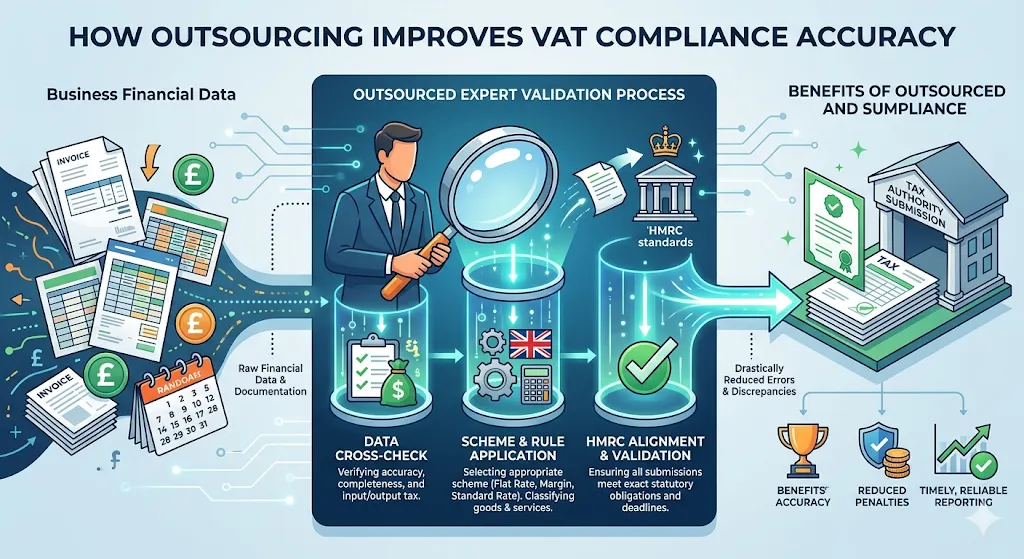
Outsourcing improves VAT compliance accuracy by applying expert validation processes, ensuring correct financial reporting, and aligning submissions with HMRC standards. This reduces rejection rates, prevents penalties, and ensures businesses meet statutory VAT obligations without discrepancies.
VAT compliance depends on precision. HMRC requires accurate reporting of taxable supplies, correct VAT schemes, and proper classification of goods and services.
Errors often occur in three areas: incorrect VAT scheme selection, miscalculated turnover thresholds, and incomplete supporting documentation. Each error increases the likelihood of rejection or delayed approval.
Outsourced providers apply systematic validation processes. They cross-check financial data, confirm eligibility thresholds, and verify documentation before submission. This reduces application rejection rates significantly.
They also ensure compliance with specific VAT schemes such as the Standard Rate, Flat Rate Scheme, and Margin Schemes. Selecting the correct scheme directly impacts tax liability and reporting obligations.
By using structured verification frameworks, outsourced services ensure that VAT registration aligns with both legal and operational requirements.
What Risks Are Reduced by Outsourcing VAT Registration?
Outsourcing VAT registration reduces risks related to non-compliance, financial penalties, delayed approvals, and incorrect filings. It ensures that applications meet HMRC standards, preventing legal exposure and operational disruptions caused by registration errors.
Non-compliance with VAT regulations leads to financial penalties and reputational damage. HMRC can impose fines of up to 15% of the VAT due for inaccuracies or late registration.
Delayed registration creates additional liabilities. Businesses that exceed the VAT threshold (£90,000 as of 2024) must register within 30 days. Missing this deadline results in backdated VAT charges.
Outsourcing addresses these risks by ensuring timely submission. Professionals track registration thresholds and initiate applications as soon as eligibility criteria are met.
They also reduce documentation risks by validating key records such as sales invoices, bank statements, and business activity descriptions. Each document must meet HMRC verification standards.
This proactive approach prevents three major issues: late registration penalties, incorrect VAT reporting, and rejected applications.
How Does Outsourcing Save Time and Operational Resources?
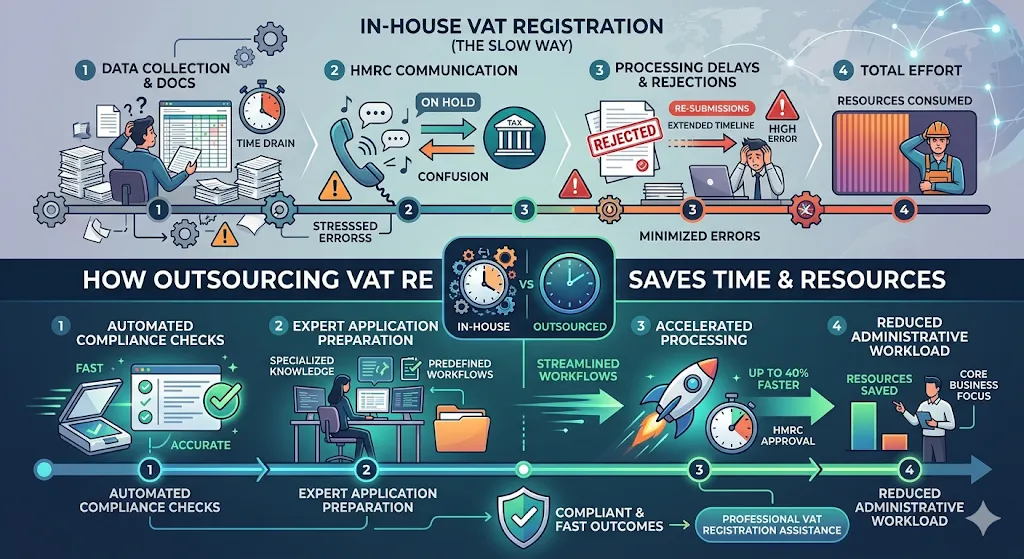
Outsourcing VAT registration saves time by removing administrative workload, automating compliance checks, and accelerating application processing. It allows internal teams to focus on core operations while experts handle complex registration procedures efficiently.
VAT registration requires multiple steps, including data collection, document verification, and HMRC communication. Each step consumes operational time and resources.
For small and medium-sized enterprises, internal teams often lack specialised VAT knowledge. This leads to extended processing times and repeated corrections.
Outsourced providers streamline the process through predefined workflows. They handle application preparation, submission, and follow-ups with HMRC.
This reduces processing time by up to 40% compared to in-house handling. Businesses also avoid delays caused by incomplete or incorrect submissions.
Using a structured service like VAT Registration Assistance ensures that every step from eligibility assessment to HMRC approval is handled efficiently.
Businesses can access this process directly through professional support such as VAT Registration Assistance services, which are designed to deliver fast and compliant outcomes.
How Does Expert Support Improve VAT Registration Approval Rates?
Expert support improves VAT registration approval rates by ensuring accurate documentation, correct classification of business activities, and compliance with HMRC validation criteria. This reduces application rejections and speeds up the overall approval process.
HMRC applies strict validation checks during VAT registration. Applications undergo review for business legitimacy, turnover accuracy, and taxable activity.
Rejection rates increase when applications lack clarity or contain inconsistencies. For example, mismatched financial data or vague business descriptions trigger additional scrutiny.
Outsourced experts prepare applications using structured documentation standards. They define business activities clearly, validate turnover figures, and ensure consistency across all submitted data.
They also communicate directly with HMRC when additional information is required. This reduces delays caused by back-and-forth queries.
Approval timelines improve when applications meet all compliance criteria from the outset. In many cases, properly prepared applications receive approval within 10–14 working days.
Also explore,
Why Your Growing Business Needs Professional Help with Complex VAT Applications
How to Successfully Navigate the Complex HMRC VAT Registration Process Fast
What Role Does Digital Compliance Play in VAT Registration?
Digital compliance ensures VAT registration aligns with HMRC’s Making Tax Digital requirements, enabling accurate electronic record-keeping and submission. Outsourcing ensures systems and processes meet these digital standards from the beginning of registration.
Making Tax Digital (MTD) requires VAT-registered businesses to maintain digital records and submit returns using compatible software.
Failure to comply results in penalties and restricted access to HMRC services. Many businesses struggle to implement MTD-compliant systems during initial registration.
Outsourced providers integrate digital compliance into the registration process. They ensure that businesses use compatible accounting software and maintain proper digital records.
They also guide businesses through three core MTD requirements: digital record-keeping, API-based submissions, and software compatibility.
For foundational understanding, businesses benefit from reviewing how VAT registration works in structured environments, such as this guide on
How VAT registration works for online businesses.
This alignment ensures that compliance is built into operations from the start, not added later as a correction.
How Does Outsourcing Support Business Growth and Scalability?
Outsourcing supports business growth by ensuring scalable VAT compliance processes, reducing administrative burden, and enabling businesses to expand without regulatory obstacles. It ensures VAT obligations remain aligned with changing revenue and operational structures.
As businesses grow, VAT obligations become more complex. Increased turnover, cross-border transactions, and multiple revenue streams require advanced compliance handling.
Manual processes often fail to scale with growth. This creates inconsistencies in reporting and increases compliance risks.
Outsourced VAT services provide scalable solutions. They adapt to changes in business structure, revenue levels, and operational scope.
They also support businesses entering new markets by ensuring correct VAT treatment for international transactions. This includes EU VAT rules, reverse charge mechanisms, and import VAT requirements.
Growth-focused businesses benefit from consistent compliance management, which allows them to expand without regulatory delays.
For businesses ready to move forward, securing fast and accurate registration becomes critical. Services like
secure UK VAT number registration assistance
help streamline this transition.
Outsourcing VAT registration delivers measurable benefits in accuracy, efficiency, and compliance. It reduces the risk of errors, ensures alignment with HMRC regulations, and accelerates approval timelines. Businesses gain access to structured processes and expert validation that improve overall registration outcomes.
From My Company provides professional VAT Registration Assistance that aligns with UK compliance standards. Their approach ensures accurate submissions, timely processing, and full regulatory alignment, enabling businesses to operate with confidence and clarity.
Frequently Asked Questions
What is VAT registration assistance and how does it work?
VAT Registration Assistance is a professional service that manages the full HMRC VAT registration process, including eligibility checks, document validation, and application submission. From My company ensures all required information is accurate and aligned with UK VAT compliance rules.
When is a business required to register for VAT in the UK?
A business must register for VAT when its taxable turnover exceeds £90,000 within a 12-month period or is expected to exceed that threshold within 30 days. VAT Registration Assistance helps businesses assess thresholds and register on time to avoid penalties.
How long does VAT registration take with professional assistance?
VAT registration typically takes 10–14 working days when applications are complete and accurate. Using VAT Registration Assistance from my company reduces delays by ensuring correct documentation and faster HMRC processing.
Can VAT registration assistance help avoid HMRC penalties?
Yes, VAT Registration Assistance reduces the risk of late registration and incorrect submissions, which are common causes of HMRC penalties. From My company ensures compliance by validating turnover data, business activity, and required documents before submission.
What documents are needed for VAT registration in the UK?
Common documents include business registration details, bank account information, proof of identity, and records of taxable turnover. VAT Registration Assistance ensures all documents meet HMRC verification standards and are submitted correctly through From My company.