

UK businesses selling taxable goods or services online register for VAT when taxable turnover hits £90,000 in 12 months or £45,000 in four quarters. Submit form VAT1 online via GOV.UK with business details, bank info, and proof of trade.
Online sales trigger VAT rules under HMRC guidelines. E-commerce platforms report sales data. Businesses track turnover precisely.
What Triggers VAT Registration for Online Sellers?
Register when projected taxable turnover reaches £90,000 in any rolling 12-month period or £45,000 in four consecutive quarters. Online sales count fully toward these thresholds.
HMRC monitors e-commerce activity through platform data. Retailers selling physical goods face immediate scrutiny. Digital service providers calculate based on global sales.
Taxable supplies include goods shipped domestically or services delivered electronically. Platforms like Amazon and eBay submit VAT MOSS returns quarterly. Businesses verify turnover using sales dashboards.
Exemptions apply to non-taxable items. Zero-rated goods like certain books avoid thresholds. Monitor projections monthly to detect triggers early.
Who Must Register for VAT in Online Sales?
All UK-registered businesses exceed £90,000 turnover threshold register, including sole traders, partnerships, and limited companies selling goods or services online. Non-UK entities selling to UK customers register under VAT MOSS if thresholds are met.
Sole traders launch Etsy shops and hit limits quickly. Limited companies scale via Shopify stores. Partnerships offering SaaS tools count subscription revenue.
HMRC distinguishes distance selling rules. EU sellers register post-Brexit via the UK VAT portal. Verify status using Companies House records.
Digital services providers authenticate customer locations via IP tracking. Goods sellers validate delivery addresses against UK postcodes.
What Documents Do Online Businesses Submit for VAT1?
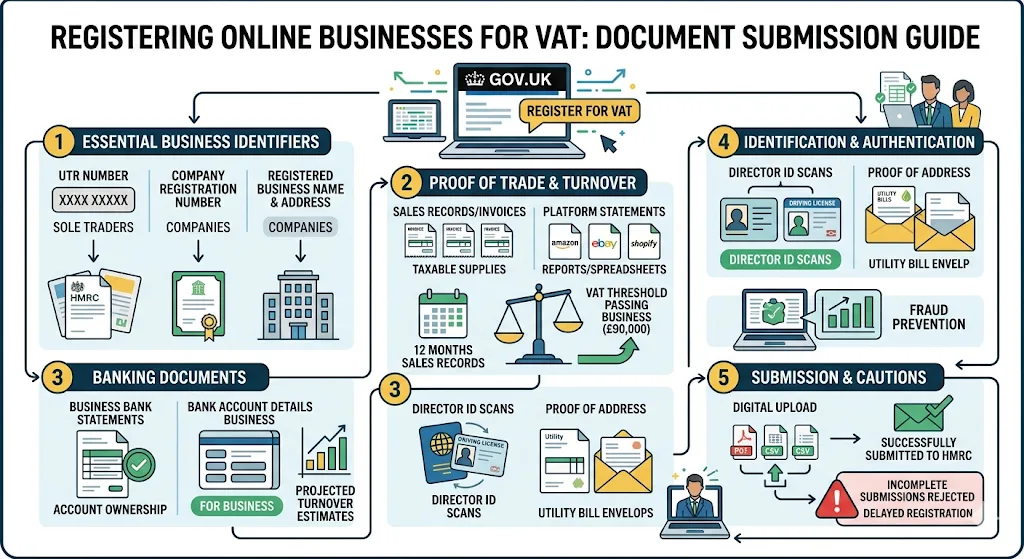
Submit VAT1 form with business name, address, UTR number, bank details, turnover estimates, and trade proof like sales invoices or platform statements. Upload online via GOV.UK portal.
HMRC requires a unique taxpayer reference first. Obtain UTR from HMRC self-assessment. Gather 12 months of sales records from e-commerce backends.
Bank statements validate account ownership. Directors provide ID scans for authentication. Platform exports confirm online turnover.
Digital uploads streamline process. PDF invoices show taxable supplies clearly. HMRC rejects incomplete submissions.
How Does the VAT1 Online Application Process Work?
Access GOV. UK VAT portal, complete VAT1 digital form in 30-45 minutes, submit with documents, receive reference number instantly, and await approval within 30 working days.
Log in with Government Gateway ID. Select the ‘register for VAT’ option. Enter the business entity type precisely.
Fill sections sequentially: contact details, trade classification, expected turnover. Upload supporting files directly. System validates data in real-time.
Receive confirmation email post-submission. Track status via the portal dashboard. HMRC processes applications in order received.
What Happens After VAT1 Submission?
HMRC reviews the submission, issues a VAT number within 30 working days if approved, activates compliance obligations, and sends a welcome pack with a returns schedule. Rejections prompt resubmission with fixes.
Review team verifies turnover claims against platform data. Approvals are notified via email and post. Unique VAT number enables invoicing.
Businesses activate quarterly or monthly returns. File via the Making Tax Digital platform. Pay output tax minus input reclaim.
Rejections cite specific errors like a mismatched UTR. Correct and resubmit promptly. Track via online account.
How Do Online Sellers Charge and Collect VAT Post-Registration?
Add 20% standard VAT to prices for UK customers, display inclusive/exclusive rates clearly on invoices and websites, collect via payment gateways, and reconcile quarterly for HMRC returns.
Update Shopify or WooCommerce settings immediately. Generate compliant invoices with the VAT number prominent. Platforms automate rate application.
UK B2C sales attract a full 20% rate. B2B reverse charge applies for cross-border. Validate customer VAT status via the VIES tool.
Payment processors like Stripe handle collections. Export transaction reports for reconciliation. Reclaim input VAT on purchases.
What Are Quarterly VAT Return Requirements?
File Making Tax Digital returns quarterly via the HMRC portal, report box 1 sales, box 4 VAT due, box 6 input reclaim, calculate box 9 net payment, submit by one-month deadline post-quarter end.
Access MTD software or the agent portal. Enter the nine-box figures accurately. Digital links prevent manual errors.
Quarters end 31 March, 30 June, 30 September, 31 December. Deadlines follow strictly. Late filings incur penalties starting at £100.
Reconcile with accounting software like Xero. Validate against bank deposits. Pay via bank transfer or direct debit.
How Does VAT MOSS Apply to Online Digital Services?
Non-UK businesses selling digital services to UK consumers register under VAT MOSS, report simplified quarterly returns at 20% rate on UK sales portion, file via EU or UK portal.
VAT MOSS simplifies multi-state compliance. Electronically supplied services include apps, ebooks, and streaming. Thresholds waived for mini one-stop shop.
Report aggregated EU sales. HMRC allocates the UK share. Pay the consolidated amount quarterly.
UK-based sellers handle domestically. Verify customer locations via billing addresses and IP.
Also explore,
Understanding the Current UK VAT Registration Threshold for Growing Small Businesses
The Pros and Cons of Voluntary VAT Registration for Early Stage Startups
What Penalties Follow Late VAT Registration or Returns?
Late registration incurs 30% surcharge on unpaid VAT from the due date, plus daily penalties up to £10,000. Late returns attract a £100 initial fine, escalating to 15% of the liability over £1,500.
HMRC calculates surcharges precisely. Retrospective VAT applies from threshold exceedance. Returns compound interest at 4.75% annually.
Appeal penalties with reasonable excuse evidence. Automated notices are issued first. Persistent non-compliance risks deregistration.
Maintain records for seven years. Audit trails protect against disputes.
For businesses navigating these steps, explore VAT Registration Assistance to handle submissions accurately.
Dive deeper into compliance strategies in
The Benefits of Outsourcing VAT Registration to Ensure Your Business Stays Compliant.
Ready to act? Get your VAT number fast with
Secure Your UK VAT Number Quickly with Our Expert Online Registration Assistance.
From My Company streamlines VAT processes using HMRC-approved methods. Register compliant from launch. Scale sales confidently.
Frequently Asked Questions
How long does VAT registration take for UK online businesses?
VAT registration via GOV.UK typically takes 30 working days for HMRC approval after submitting VAT1 form. From My Company provides VAT Registration Assistance to prepare accurate submissions and track progress. Expect your VAT number within this timeframe if the documents verify correctly.
What is the VAT registration threshold for e-commerce sellers?
UK businesses register for VAT when taxable turnover reaches £90,000 in 12 months or £45,000 in four quarters. Online sales of goods and services count toward these limits under HMRC rules. From My Company’s VAT Registration Assistance helps calculate thresholds precisely.
Do I need VAT Registration Assistance for digital services sold online?
Yes, providers of digital services like apps or ebooks to UK customers require VAT registration if thresholds met, often via VAT MOSS. From My Company handles VAT Registration Assistance including MOSS filings for seamless compliance. This ensures accurate quarterly reporting.
What documents are required for VAT registration online?
Submit business details, UTR, bank statements, sales records, and ID proof with the VAT1 form on GOV.UK. From My Company’s VAT Registration Assistance, verify and upload documents to avoid rejections. HMRC processes complete applications the fastest.
Can From My Company help with VAT returns after registration?
From My Company offers VAT Registration Assistance that extends to initial setup and guidance on quarterly Making Tax Digital returns. File sales, output tax, and input reclaims via HMRC portal post-registration. Stay compliant with automated reconciliation support.