
Bangladeshi applicants registering a UK company must submit certified identity and address documents, a registered office in the UK, proof of non-UK residency, and pay formation fees; expect 24–72 hours for standard digital formation, but verification delays of 3–21 days are common.
What documents must Bangladeshi applicants provide when registering a UK company?
Applicants must submit certified proof of identity, certified proof of address, a passport copy, and a UK registered office address; additional documents include PSC (Persons with Significant Control) statements and, for non-resident directors, bank-reference or AML documentation.
Bangladeshi nationals register a UK company by supplying documentary identity and address evidence. Typical identity documents: a valid passport bio-page and a government-issued photo ID. Typical address documents: a utility bill, bank statement, or government letter dated within the last three months. Certifications must follow recognised formats: notarisation by a Bangladeshi notary public, apostille where requested, or certification by a regulated UK professional (solicitor, accountant). Provide a UK-registered office address. Declare PSCs and provide their identity evidence. Submit Anti-Money Laundering (AML) documents, such as recent bank-reference letters, when requested by banks or formation agents.
How long does the UK company formation process take for applicants in Bangladesh?
Standard electronic filings are complete in 24–72 hours; expect verification and banking steps to extend the timeline to 3–21 days, with banking and AML checks often creating the longest delays.
The Electronic Companies House filings register companies quickly once documents are accepted. Formation agents typically file within 24 hours. Verification by formation agents and identity certification often adds 1–7 days. Opening a UK business bank account or merchant services triggers additional KYC/AML checks that commonly add 7–14 days. If HMRC requires supplementary tax registrations or if documents need apostilles, the overall process can reach 21 days. Plan timelines around the slowest expected item: bank onboarding.
Read our articles, UK Company Formation from Bangladesh: Taxes & Risks (2026) and Register Your UK Company from Bangladesh with Full Compliance & Banking Setup.
What approval odds do Bangladeshi applicants face when registering a UK company?
Approval odds are high for correctly documented applications; reject rates increase when documents lack certification, addresses are missing, or AML concerns exist. Rejection happens in about 5–15% of first-time filings.
Companies House accepts applications that meet statutory requirements. Rejection reasons include uncertified documents, inconsistent identity fields, unverifiable addresses, or mismatched PSC declarations. Formation agents report first-time rejection rates near 5% for UK residents and 8–15% for non-residents without certified documents. Banks apply stricter risk models and may decline accounts in 20–40% of non-resident cases, based on geographic risk factors and industry type. Prepare with certified documents and transparent source-of-funds statements to maximise approval chances.
What common verification hurdles do Bangladeshi applicants encounter?
Hurdles include improper document certification, mismatched name formats, unverifiable addresses, and stricter bank KYC linked to Bangladesh-origin activity; these issues cause most delays and rejections.
Certification errors are frequent: documents notarised without an apostille or certified by unregulated agents may be rejected. Name-format mismatches occur when Bengali-to-English transliteration varies between passport and utility bills. Address verification fails when applicants use temporary addresses, overseas PO boxes, or non-standard documents. Banks perform enhanced due diligence for clients linked to higher-risk jurisdictions. Expect requests for source-of-funds documents, business activity proof, and detailed ownership disclosures. Address these hurdles by following precise certification instructions from the formation agent and confirming acceptable document lists before submission.
How should applicants prepare their identity and address documents for smoother processing?
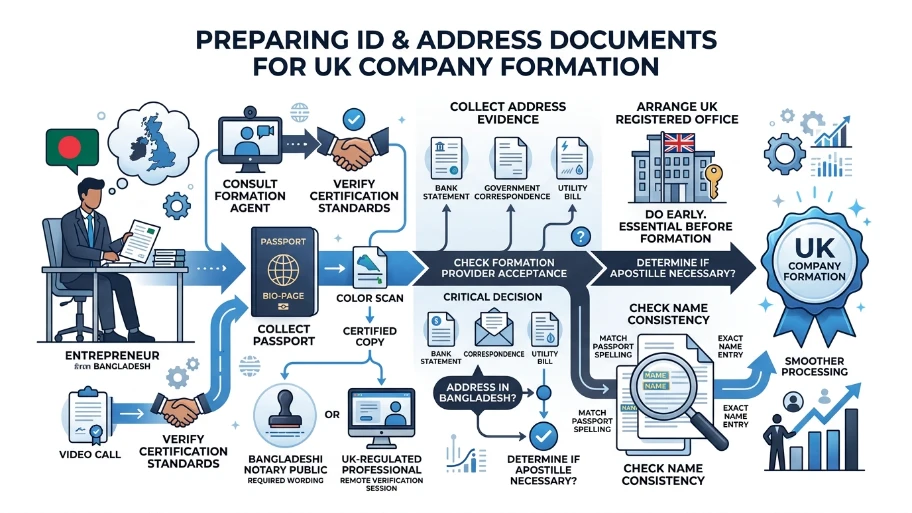
Collect a certified passport copy, a certified recent utility or bank statement, and a UK registered office arrangement; verify certification standards with your formation agent in advance.
Obtain a clear colour scan of the passport bio-page. Secure a certified copy: a Bangladeshi notary public signature with required wording, or certification by a UK-regulated professional after a remote verification session. For address evidence, use a recent bank statement, government correspondence, or a utility bill. If your address is in Bangladesh, check that the formation provider accepts foreign documents and whether an apostille is necessary. Arrange a UK-registered office service early; formation cannot proceed without it. Keep name spellings consistent across all documents and enter names exactly as they appear on the passport.
What role does a UK-registered office play for non-resident applicants?
A UK registered office provides legal correspondence, a public Companies House address, and statutory compliance contact details; use a professional registered-office service to meet UK requirements.
Companies House requires a physical UK address for service of notices and public records. Non-resident applicants typically purchase a registered-office package from a formation agent or a mail-forwarding provider. This service receives statutory mail and forwards it promptly. The registered office does not need to be where directors work. Choose a provider that offers same-day scanning and forwarding to avoid missed deadlines for filings. Confirm the registered office provider’s experience with non-resident customers and their capacity to handle PSC and annual return documents.
What additional checks do UK banks and payment providers require?
Banks require enhanced KYC: passports, proof of address, source-of-funds statements, company activity details, and sometimes in-person verification or video interviews.
Bank account approval depends on client risk profiles. Provide a business plan, invoices, contracts, or client lists when asked to prove company activity. Supply recent bank statements showing personal funds used to capitalise the business. Expect banks to request director verification by video call or in-branch visit for high-value or high-risk sectors. Some banks refuse clients linked to certain high-risk industries or countries. Use providers that specialise in non-resident banking or fintech business accounts to improve acceptance odds.
What fees and costs should Bangladeshi applicants budget for?
Budget for Companies House fees (£12–£100), registered-office services (£30–£200/year), document certification/apostille (£50–£150), and bank onboarding fees or minimum deposits (varies).
Companies House charges range by filing method: £12 for online filing, higher for paper or expedited services. Registered-office services vary by provider and include features. Certification costs depend on whether you use a Bangladeshi notary, a UK solicitor, or apostille services; apostille fees in Bangladesh and courier charges add to the total. Bank account providers may require minimum deposits or monthly fees. Factor in formation-agent fees for PSC registration, shareholder agreements, and VAT registration if applicable. Request an itemised fee schedule from your chosen formation partner.
How does tax and compliance look for UK companies owned by Bangladeshi residents?
UK companies pay Corporation Tax on UK profits; non-resident directors must still file statutory accounts and tax returns; treat UK tax residency and Bangladesh tax obligations separately.
A UK-registered company with UK-sourced profits pays UK Corporation Tax at scheduled rates. Directors have statutory obligations: maintain accounting records, file annual accounts with Companies House, and submit Corporation Tax returns to HMRC. Non-resident directors may also face Bangladesh tax rules depending on their residence status and double-taxation agreements. Register for VAT if taxable turnover exceeds thresholds. Use a UK accountant or tax adviser to handle filings, payroll if employing, and payroll taxes (PAYE) for staff.
How can applicants increase their approval odds and reduce delays?
Use a specialist formation agent, pre-validate documents, obtain proper certifications, and prepare bank KYC materials, including source-of-funds and a clear business plan.
Engage a formation provider experienced with Bangladeshi clients. Ask for a checklist covering certification formats, apostille needs, and acceptable address evidence. Pre-validate documents with the provider before formal filing. Prepare bank-compatible KYC packs: business activity evidence, invoices, contracts, and personal bank statements. Choose a registered-office service and consider specialist non-resident bank providers or fintech accounts. Maintain consistent name spellings and document formats to avoid time-consuming clarifications.
Bangladeshi applicants can register UK companies efficiently when they submit certified identity and address documents, secure a UK-registered office, and prepare thorough bank KYC evidence. Formation itself often completes within 24–72 hours, but verification and banking steps extend the practical timeline to 3–21 days. Using a specialist formation partner and pre-validating documents reduces rejection risk and shortens delays. From My Company supports full compliance and can guide document certification, registered-office setup, and KYC preparation to improve approval odds.
Frequently Asked Questions
Can Bangladeshi nationals register a UK company without living in the UK?
Yes, Bangladeshi nationals can register a UK company as non-UK residents from Bangladesh. From My Company handles full compliance for Bangladeshi applicants, including document certification, PSC registration, and a UK-registered office address.
What documents do Bangladeshi applicants need to form a UK company?
Bangladeshi applicants must provide a certified passport copy, certified proof of address (utility bill or bank statement), and a UK-registered office address. From My Company guides Bangladesh clients on accepted certification formats and apostille requirements.
How long does UK company formation take for applicants in Bangladesh?
Standard electronic filings are complete in 24–72 hours, but verification and banking steps often extend the timeline to 3–21 days for Bangladeshi applicants. From My Company supports Bangladesh clients through document validation and bank KYC preparation to reduce delays.
Do Bangladeshi directors need to visit the UK to register a company?
No, Bangladeshi directors do not need to visit the UK to register a company. The entire process is remote, and From My Company manages formation, registered office setup, and compliance for applicants in Bangladesh.
What are the main risks for Bangladeshi residents owning a UK company?
Key risks include tax obligations in both the UK and Bangladesh, complex bank onboarding due to enhanced KYC, and document certification errors. From My Company helps Bangladesh clients navigate Corporation Tax, VAT registration, and source-of-funds documentation for smoother approval.