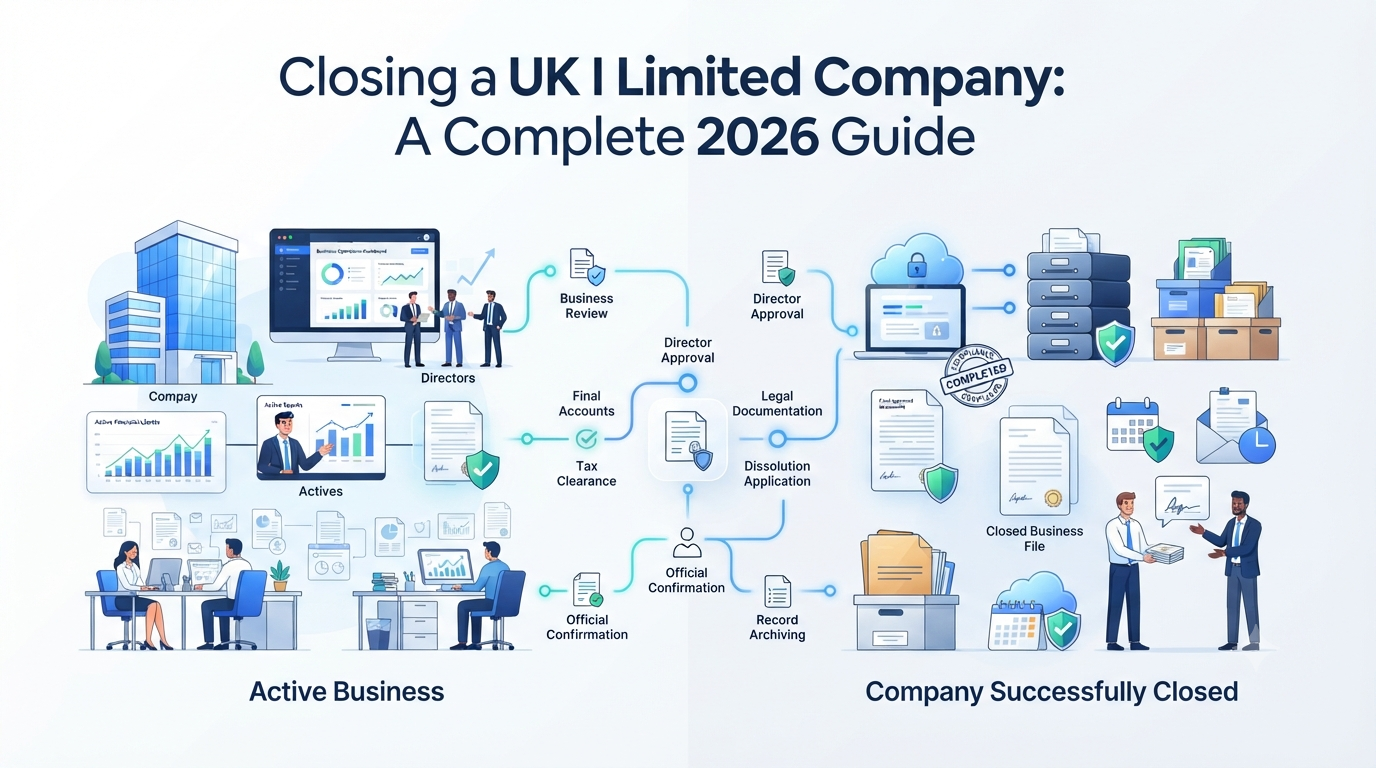
Closing a UK Limited Company
Closing a UK limited company is one of the most significant decisions a business owner can make. Whether your business is being wound down after years of trading, you’re closing a company that never really launched, or your circumstances have changed, getting the closure right matters. There are several routes to closure, from straightforward strike-off to formal liquidation, and choosing the right one depends on your company’s specific situation. At Form My Company, we help UK company owners understand their closure options and, for straightforward strike-off situations, handle the process. This guide explains everything you need to know about closing a UK limited company in 2026.
Why Do UK Companies Close?
There are many reasons owners choose to close their UK company:
Business no longer viable. The commercial reality has changed and closure is the right call.
Owners moving on. Retirement, career changes, or life circumstances.
Company completed its purpose. Some companies are formed for specific projects or transactions.
Merger or acquisition. Where the closed company is absorbed into a larger entity.
Simplification. Removing dormant or unused corporate entities to reduce compliance burden.
Cost efficiency. Avoiding ongoing filing fees and compliance costs.
Regulatory reasons. Where the specific company structure is no longer suitable.
Insolvency. When the company cannot meet its debts.
Cross-border restructuring. Where UK operations are shifted or ended.
Simply not viable to keep going. Dormant companies that no longer serve any purpose.
Whatever the reason, choosing the right closure route affects timing, cost, and tax implications.
The Main Routes to Closing a UK Company
There are essentially three main routes to closing a UK limited company, each suited to different circumstances:
Route 1: Strike-off (Dissolution). For companies with no remaining trading activity, minimal debts, and straightforward closure needs. Handled through Companies House.
Route 2: Members’ Voluntary Liquidation (MVL). For solvent companies with more complex closure needs, often involving assets to distribute to shareholders. Requires a licensed Insolvency Practitioner.
Route 3: Creditors’ Voluntary Liquidation (CVL). For insolvent companies where the company cannot pay its debts. Requires a licensed Insolvency Practitioner.
Choosing the right route depends on your company’s specific circumstances, assets, debts, and closure objectives.
Route 1: Strike-Off (Dissolution)
Strike-off is the simplest and most common closure route for straightforward situations. It works when:
Your company has stopped trading. No active business operations.
No transactions in the last 3 months. With some limited exceptions.
No creditors. Or all creditors have been notified and don’t object.
No employees. All employees have left and been paid.
No outstanding tax obligations. With HMRC.
No active legal proceedings. Against the company.
Basic corporate obligations are up to date. Confirmation statement filed, accounts filed.
Directors are agreed. On dissolution.
When these conditions apply, strike-off is often the most practical route.
The Strike-Off Process
Verify eligibility. Confirm all conditions apply.
Cease trading. Formally end business operations.
Settle affairs. Pay outstanding debts, notify HMRC of cessation, close bank accounts.
Distribute remaining assets. To shareholders in accordance with the Articles of Association.
File final accounts. For the period up to closure.
File final Corporation Tax return. With HMRC.
Notify HMRC. Of intention to close.
File Form DS01. Companies House form for strike-off application.
Pay the £8 filing fee. Currently the fee for DS01.
Notify shareholders. Of the strike-off application.
Notify creditors. Any known or potential creditors.
Wait for Companies House. They typically take 3 months to review and gazette the application.
Strike-off occurs. After the notice period, the company is removed from the register.
Company ceases to exist. For most legal purposes.
The process typically takes 3 to 6 months from filing.
DS01 Filing Requirements
Form DS01. Application for striking off.
Company details. Name, registration number, current details.
Director confirmations. Signatures from all directors.
Filing fee. £8 payable to Companies House.
Notification obligations. To shareholders, creditors, and other stakeholders.
Statutory declarations. Confirming eligibility.
Costs of Strike-Off
DS01 filing fee. £8 to Companies House.
Professional fees. Typically £150 to £600 for a service provider to coordinate strike-off.
Final accounts. Typically £200 to £500 for an accountant to prepare final accounts.
Miscellaneous. Bank closure costs, any outstanding debts, etc.
Total. Usually £400 to £1,500 for a straightforward strike-off with professional support.
Compared to formal liquidation, strike-off is significantly cheaper and simpler.
Route 2: Members’ Voluntary Liquidation (MVL)
MVL is for solvent companies with more complex closure needs. It’s used when:
Company has significant assets. To distribute to shareholders.
Tax advantages sought. MVL can be more tax-efficient than strike-off for larger distributions.
Retiring or exiting owners. Wanting to extract value from the business.
Corporate restructuring. Winding up companies as part of broader changes.
Post-sale of business assets. Where the corporate shell needs closing.
The MVL Process
Appoint a licensed Insolvency Practitioner (IP). Required by law.
Declaration of Solvency. Directors’ formal statement that the company can pay all debts within 12 months.
Convene shareholders’ meeting. Special resolution to wind up the company.
IP takes control. Managing the winding-up process.
Realise assets. Convert company assets to cash.
Settle debts. Pay all creditors.
Distribute to shareholders. Distribute remaining funds.
Final accounts and returns. For the winding-up period.
Deregistration. From HMRC.
Companies House strike-off. Final step after MVL completion.
Company ceases to exist. Formally.
MVL typically takes 6 to 12 months, sometimes longer for complex cases.
Costs of MVL
IP fees. Typically £3,000 to £15,000+ depending on complexity.
Legal fees. For any specific legal matters.
Accountant fees. For final accounts and tax matters.
Statutory advertisements. Required notices.
Total. Usually £5,000 to £25,000+ for a straightforward MVL.
MVL is significantly more expensive than strike-off, but tax-efficient for larger distributions.
When MVL Makes Sense
Assets over £25,000. Where MVL’s tax efficiency outweighs the higher fees.
Higher-rate taxpayers. Where capital treatment beats income treatment.
Investors’ relief eligibility. Where BADR (formerly Entrepreneurs’ Relief) applies.
Complex asset structures. That need professional winding-up.
Sale of business as going concern. Followed by winding up the corporate shell.
Retirement or estate planning. Where MVL fits into broader financial planning.
For most small dormant or straightforward companies, strike-off is sufficient. For companies with substantial assets, MVL is often worth the investment.
Route 3: Creditors’ Voluntary Liquidation (CVL)
CVL is for insolvent companies that cannot pay their debts. It’s used when:
Company is insolvent. Assets are less than liabilities.
Trading unable to continue. Not able to meet obligations.
Directors want to end the company formally. Rather than face compulsory action.
Assets need proper realisation. Under IP supervision.
Creditors need protecting. Through formal insolvency process.
CVL is a formal insolvency procedure with legal protections for directors and creditors.
The CVL Process
Appoint a licensed Insolvency Practitioner (IP). Required by law.
Formal shareholders’ resolution. To wind up.
Formal creditors’ meeting. To confirm the appointment.
IP takes control. Managing the insolvency process.
Investigation of directors’ conduct. Under Section 214 (wrongful trading) rules.
Realise assets and settle claims. In statutory priority order.
Final accounts and reports. For the insolvency.
Companies House dissolution. After completion.
CVL is complex and involves specific legal protections and obligations for directors.
Director Considerations in CVL
Wrongful trading risk. Directors can be personally liable if they continued trading knowing insolvency was inevitable.
Fraudulent trading. More serious offences.
Director disqualification. Possible outcomes.
Personal liability. For guarantees or specific circumstances.
Legal advice essential. For directors of insolvent companies.
CVL is genuine legal territory that requires professional advice for directors.
When Strike-Off Isn’t Available
Strike-off is only for straightforward closures. It’s not available if:
The company has traded in the last 3 months. With some limited exceptions.
There are outstanding creditors. Who haven’t agreed.
There are active legal proceedings. Against the company.
Employees are still employed. Who need proper redundancy.
HMRC has outstanding obligations. For unpaid tax or filings.
The company holds significant assets. That need formal distribution.
Directors don’t agree. Any director’s objection can block strike-off.
Companies House is investigating. For any compliance issues.
Third parties have interests. Requiring formal winding-up.
If any of these apply, MVL or CVL may be needed instead.
Tax Considerations for Company Closure
Tax matters significantly:
Final Corporation Tax return. Required for the period to closure.
Capital vs income treatment. MVL provides capital treatment on distributions; strike-off with cash distributions is income.
BADR/Investors’ Relief. May apply to reduce capital gains tax.
Employer tax obligations. For any final salaries or benefits.
VAT deregistration. If registered.
PAYE deregistration. If applicable.
Dividend timing. Before closure can affect tax positioning.
Loss relief. Final year losses may offset earlier profits.
Balance sheet distribution planning. For assets and shareholder loans.
Tax planning around closure often makes a significant difference to owner outcomes. Getting expert help is usually worth it for closures with material value.
Non-Resident Owner Considerations
For non-resident owners closing UK companies:
Coordinating from abroad. Time zones and communication add friction.
UK tax obligations. Corporation Tax and other UK obligations still apply.
Home country tax implications. Your country of residence may also tax the closure.
Bank account closure. UK business banking needs formal closure.
HMRC deregistration. For VAT, PAYE, and Corporation Tax.
Companies House filings. Standard closure process.
Ongoing UK compliance. Until closure is complete.
Professional support. Working with a UK-based service provider makes the process significantly smoother.
For non-resident owners, coordinating closure with professional UK support is essentially standard practice.
Common Mistakes When Closing a Company
A few issues come up regularly:
Choosing the wrong route. Strike-off when MVL would be more tax-efficient, or vice versa.
Missing eligibility conditions. For strike-off.
Not notifying HMRC properly. For Corporation Tax, VAT, and PAYE closure.
Failing to file final accounts. Companies House and HMRC obligations remain until closure.
Not settling all creditors. Before strike-off application.
Distributing assets before formal closure. Can create legal complications.
Ignoring wrongful trading concerns. For insolvent situations.
Not seeking IP help when needed. For MVL or CVL.
Missing the notice period. Companies House requires 3 months’ notice period.
Reactivating incorrectly. If circumstances change during the process.
Not planning for tax implications. Especially for larger distributions.
Assuming closure is simple. For complex situations.
Getting professional advice before starting the closure process helps avoid these issues.
What Happens After Closure
Once your company is closed:
Ceases to exist legally. For most purposes.
Bank accounts closed. Formally.
Tax obligations end. Except for any final filings.
Historic records preserved. For statutory record-keeping periods.
Restoration possible. For a limited period after strike-off, restoration is possible if issues arise.
Assets become bona vacantia. Property owned by struck-off companies passes to the Crown.
Continuing obligations end. For future compliance.
Reputation preserved. With appropriate closure documentation.
Understanding the “after” helps you plan the closure properly.
Restoration After Strike-Off
If you close by strike-off and then discover issues:
Restoration is possible. For 6 years after strike-off (though timelines vary).
Court application. Required for restoration.
Costs involved. Legal fees, Companies House restoration fee.
All missed compliance must be brought current. For the restored company.
Ongoing compliance resumes. As if never closed.
Some transactions may need reversal. For assets distributed post-strike-off.
Restoration is a formal legal process, not automatic.
Choosing the Right Route for Your Company
The route depends on specifics:
Small, dormant, no assets. Strike-off is typically ideal.
Small, ceased trading, minor assets. Strike-off is usually sufficient.
Medium company with assets to distribute. MVL often better for tax efficiency.
Solvent company being sold. MVL after asset sale.
Insolvent company. CVL is the appropriate route.
Complex ownership. Professional advice essential.
Cross-border considerations. May affect route choice.
Talk to a qualified adviser before choosing your closure route, especially for anything beyond a straightforward strike-off.
How Form My Company Helps
We support UK company owners considering closure. For straightforward strike-off situations, we can:
Assess your eligibility. For strike-off vs. other routes.
Coordinate the strike-off process. Including DS01 filing.
Handle statutory notifications. To Companies House.
Update your compliance records. For the closure.
Coordinate with HMRC. For final tax matters.
Support during the 3-month notice period. Handling any issues.
Bundle with your ongoing compliance. So closure integrates with your wider services.
Provide UK correspondence address. For any final statutory matters.
Point you toward specialists for MVL or CVL. Where a licensed Insolvency Practitioner is needed.
Support non-resident owners. With the practical challenges of closing from abroad.
Post-closure support. For any final matters.
For strike-off situations, we provide efficient, coordinated closure support. For MVL or CVL, we can refer you to qualified specialists.
Consider Your Closure Options Carefully
Closing a UK limited company is a significant decision with real tax, legal, and financial implications. Choosing the right route (strike-off, MVL, or CVL) depends on your specific situation, and getting professional advice before proceeding usually makes a real difference. With Form My Company, we can help you understand your options and, for straightforward strike-off situations, handle the process. For more complex needs, we can point you toward qualified specialists. Get in touch today to discuss the right approach for your company.
Frequently Asked Questions
What are the main ways to close a UK limited company?
Three main routes: Strike-off (dissolution) for straightforward closures, Members’ Voluntary Liquidation (MVL) for solvent companies with assets to distribute, and Creditors’ Voluntary Liquidation (CVL) for insolvent companies. Choice depends on your specific situation.
What is strike-off?
The simplest closure route. You apply to Companies House using Form DS01 and the £8 filing fee. Company is dissolved after a 3-month notice period. Available when the company has stopped trading, has no significant debts, and meets other eligibility conditions.
Do I need an Insolvency Practitioner to close my company?
For strike-off, no. For MVL or CVL, yes, an IP is legally required. For most straightforward small company closures, strike-off doesn’t require IP involvement.
How long does it take to close a company?
Strike-off typically takes 3 to 6 months. MVL takes 6 to 12 months or longer. CVL varies significantly by complexity, often 12+ months.
What are the tax implications of closing a company?
Vary by route. MVL provides capital treatment on distributions (potentially subject to BADR/Investors’ Relief). Strike-off with cash distributions typically results in income treatment. Professional tax advice is usually worth getting for material closures.
What happens to company assets when closed?
For strike-off, assets distributed before closure are handled directly. Any assets remaining at strike-off become “bona vacantia” and pass to the Crown. For MVL or CVL, an IP manages asset realisation and distribution.
Can I restore my company after strike-off?
Yes, within 6 years typically. Restoration requires a court application and payment of specific fees. All missed compliance must be brought current for the restored company.
Can Form My Company help me close my UK company?
Yes, for strike-off situations. We coordinate the DS01 filing, statutory notifications, and Companies House interaction. For more complex needs (MVL or CVL), we point you toward qualified Insolvency Practitioners. We support both UK-based and non-resident owners.