
Expert VAT advice ensures accurate cross-border tax compliance, prevents costly penalties, and optimises reclaim opportunities across multiple jurisdictions. Businesses trading internationally face complex VAT rules, and professional guidance enables correct registration, reporting, and transaction structuring under UK and global tax frameworks.
What makes VAT complex for international trading businesses?
VAT becomes complex in international trade because transactions cross multiple tax jurisdictions, each with different rules for registration, invoicing, reporting, and exemptions. Businesses must apply correct VAT treatment for imports, exports, and intra-community supplies while maintaining compliance with evolving regulatory frameworks.
International VAT complexity arises from jurisdictional differences. The UK applies post-Brexit VAT rules that differ from EU directives. A business selling goods to Germany, for example, must follow EU distance selling thresholds while also complying with UK export documentation.
Transaction classification adds another layer. Businesses must distinguish between zero-rated exports, standard-rated domestic sales, and reverse charge mechanisms. Each classification impacts reporting obligations and VAT recovery eligibility.
Currency conversion rules also affect VAT calculations. HMRC requires conversion using approved exchange rates. Incorrect conversions distort VAT returns and trigger compliance risks during audits.
Digital services increase complexity further. For example, selling software subscriptions to EU customers requires VAT registration under the One Stop Shop (OSS) scheme. This obligation exists even without a physical presence in the EU.
Why does incorrect VAT handling create financial risks?
Incorrect VAT handling leads to penalties, interest charges, and denied input tax claims. HMRC imposes fines of up to 100% of unpaid VAT for deliberate errors, while inaccurate filings disrupt cash flow and increase audit exposure for international trading businesses.
Financial risks begin with misreported VAT returns. Errors in output tax or input tax calculations directly affect liability. For example, underreporting £20,000 in VAT can result in penalties exceeding £10,000 depending on intent and disclosure timing.
Cash flow disruption occurs when VAT is overpaid or unrecoverable. Businesses that fail to reclaim eligible VAT on imports or expenses lose working capital that impacts operational liquidity.
Audit frequency increases when inconsistencies appear in filings. HMRC uses risk-based algorithms to flag irregular patterns. Repeated discrepancies trigger investigations that require extensive documentation and time.
Incorrect application of VAT schemes also creates liabilities. For instance, using the Flat Rate Scheme incorrectly for international transactions leads to repayment demands and potential deregistration.
How does expert VAT advice improve compliance accuracy?
Expert VAT advice ensures compliance accuracy by applying correct tax treatments, validating transaction classifications, and aligning reporting processes with HMRC and international regulations. Specialists interpret complex rules and implement structured systems that reduce error rates in VAT submissions.
Professional advisors analyse transaction flows. They identify whether supplies qualify as zero-rated exports or require VAT application under destination-based rules. This classification directly affects reporting accuracy.
Experts implement structured reporting systems. These systems include digital recordkeeping aligned with Making Tax Digital (MTD) requirements. Automated validation reduces manual errors and ensures consistent data submission.
They also monitor regulatory updates. VAT rules change frequently, especially in cross-border trade. Advisors ensure businesses adapt processes immediately when new thresholds, rates, or reporting obligations are introduced.
Specialists conduct periodic audits. Internal VAT reviews detect discrepancies early. Early correction prevents penalties and improves long-term compliance stability.
When is VAT registration required for international trade?
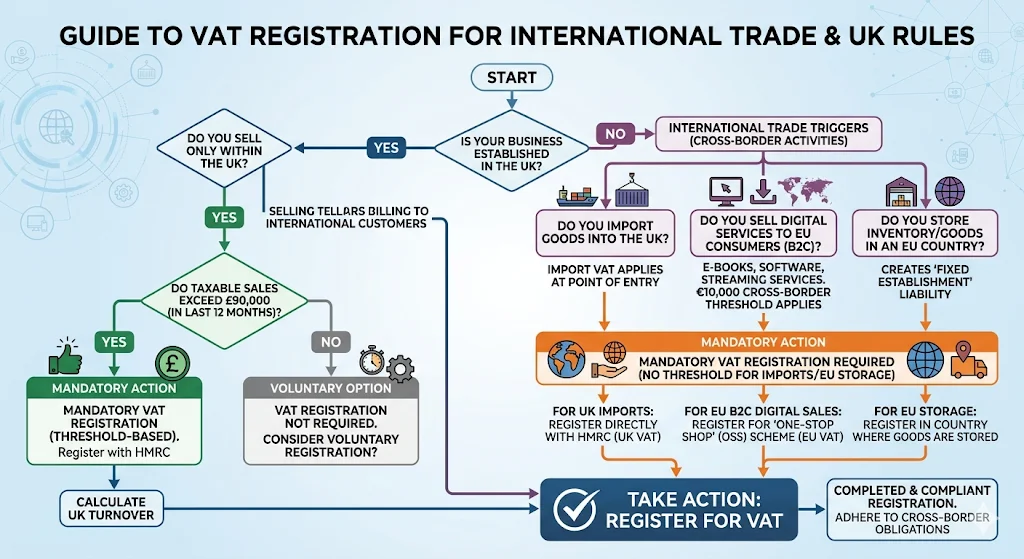
VAT registration is required when taxable turnover exceeds £90,000 in the UK or when businesses engage in cross-border activities such as importing goods, storing inventory abroad, or selling digital services to overseas customers under destination-based VAT rules.
Threshold-based registration applies within the UK. Once turnover crosses £90,000 in 12 months, registration becomes mandatory. This threshold includes taxable supplies only.
International triggers operate differently. A business importing goods into the UK must register for VAT regardless of turnover. Import VAT obligations exist at the point of entry.
Distance selling rules apply to EU markets. If a UK business sells goods to EU consumers, it must register under OSS once it exceeds €10,000 in annual sales across EU countries.
Digital services follow destination taxation. Selling e-books, software, or streaming services to EU customers requires VAT registration in the customer’s country or through OSS schemes.
Businesses that want structured support often rely on VAT Registration Assistance to complete registrations accurately and align them with cross-border obligations.
How does VAT advice optimise international tax efficiency?
Expert VAT advice optimises tax efficiency by identifying reclaim opportunities, structuring supply chains strategically, and applying schemes that minimise VAT liabilities. Accurate planning ensures businesses recover eligible input VAT and avoid unnecessary tax exposure across jurisdictions.
Input VAT recovery is a primary efficiency driver. Businesses importing goods can reclaim VAT paid at customs if the documentation is accurate. Missing import records results in permanent cost increases.
Supply chain structuring affects VAT liability. For example, storing goods in EU warehouses shifts VAT obligations to local jurisdictions. Advisors recommend structures that minimise multi-country registration burdens.
Special VAT schemes improve efficiency. Examples include the Margin Scheme for second-hand goods and the OSS scheme for digital services. Applying the correct scheme reduces administrative workload and tax duplication.
Timing strategies also matter. Delaying VAT payments through postponed accounting improves cash flow. This approach allows businesses to declare and recover import VAT within the same return cycle.
What role does VAT registration assistance play in compliance?
VAT registration assistance ensures accurate application submission, correct scheme selection, and alignment with international trading requirements. It reduces rejection risks, accelerates approval timelines, and establishes a compliant foundation for ongoing VAT reporting and cross-border operations.
Registration errors create long-term issues. Incorrect business activity descriptions or missing documentation delay approval. These delays affect the ability to trade legally in certain jurisdictions.
Professional assistance validates application data. This includes verifying turnover thresholds, selecting appropriate schemes, and ensuring the correct classification of goods or services.
It also ensures multi-jurisdiction alignment. Businesses trading internationally often require multiple VAT registrations. Coordinating these registrations prevents duplication and compliance gaps.
Many businesses streamline this process through structured VAT Registration Assistance, which integrates HMRC requirements with international tax obligations.
How do VAT rules differ across key international markets?
VAT rules differ across markets in rates, thresholds, reporting frequency, and registration requirements. The UK applies a standard rate of 20%, while EU countries range from 17% to 27%, and each jurisdiction enforces distinct compliance frameworks for cross-border transactions.
Rate variation directly affects pricing. Hungary applies a 27% VAT rate, while Luxembourg applies 17%. Businesses must adjust pricing strategies based on destination country rules.
Registration thresholds vary widely. The UK sets a £90,000 threshold, while many EU countries enforce zero thresholds for non-resident businesses selling locally.
Reporting frequency differs by jurisdiction. The UK typically requires quarterly returns, while countries like Germany may require monthly filings depending on turnover levels.
Documentation standards also differ. Some countries require electronic invoicing with real-time reporting, such as Italy’s SDI system. Non-compliance leads to immediate penalties.
Understanding these differences is essential when analysing how VAT registration impacts pricing strategy and profit margins, especially in multi-country operations.
Why is ongoing VAT monitoring essential for international businesses?
Ongoing VAT monitoring ensures continuous compliance by tracking regulatory changes, verifying transaction accuracy, and updating reporting processes. International tax rules evolve frequently, and consistent monitoring prevents errors, penalties, and operational disruptions.
Regulatory updates occur regularly. For example, post-Brexit changes introduced new customs procedures and VAT treatments for UK-EU trade. Businesses must update processes immediately when such changes occur.
Transaction verification ensures accuracy. Each sale or purchase must be reviewed for correct VAT treatment. Automated systems help flag inconsistencies before submission.
Audit readiness depends on monitoring. Maintaining accurate records and reconciliations reduces audit risk. HMRC requires businesses to retain VAT records for at least six years.
Monitoring also supports scalability. As businesses expand into new markets, VAT obligations increase. Continuous oversight ensures new operations remain compliant from the start.
Also explore,
How VAT Registration Assistance Can Help You Reclaim Significant Pre-Registration Costs
Understanding the Documentation Needed for a Successful Business VAT Registration Application
How does expert VAT support influence strategic business decisions?
Expert VAT support influences strategic decisions by guiding market entry, pricing models, and supply chain design. Accurate tax insights allow businesses to evaluate expansion opportunities and avoid jurisdictions with high compliance burdens or unfavourable VAT structures.
Market entry decisions rely on VAT feasibility. Entering a country with complex reporting requirements increases administrative costs. Advisors help assess whether the market justifies the compliance burden.
Pricing models depend on VAT treatment. Businesses must decide whether to absorb VAT costs or pass them to customers. This decision affects competitiveness and profit margins.
Supply chain design impacts tax exposure. Choosing warehouse locations, distribution routes, and invoicing structures determines VAT liabilities across regions.
Decision-makers often rely on expert consultation before expansion. Businesses ready to act can book a consultation for fast VAT registration assistance with our expert team to ensure accurate implementation from the outset.
International VAT compliance requires precise execution across multiple jurisdictions. Errors lead to financial penalties, operational delays, and lost tax recovery opportunities. Expert VAT advice provides structured compliance, accurate registration, and efficient tax management.
From My Company delivers professional support through VAT Registration Assistance, ensuring businesses align with UK and international VAT frameworks. This approach enables accurate reporting, reduced risk exposure, and scalable international operations.
Frequently Asked Questions
What is VAT Registration Assistance and why is it important?
VAT Registration Assistance is a professional service that helps businesses register for VAT accurately with HMRC and relevant international authorities. From My Company provides VAT Registration Assistance to ensure correct setup, reducing errors and aligning registration with cross-border trading requirements.
When does a business need VAT Registration Assistance?
A business needs VAT Registration Assistance when its taxable turnover exceeds £90,000 or when it engages in international trade, such as importing goods or selling to EU customers. From My Company supports businesses in identifying these triggers and completing compliant registrations.
How long does VAT registration take in the UK?
VAT registration in the UK typically takes 10 to 30 working days, depending on application accuracy and HMRC review requirements. Using VAT Registration Assistance from My Company helps avoid delays by ensuring all documents and details are correctly submitted.
Can VAT Registration Assistance help with international VAT compliance?
Yes, VAT Registration Assistance supports international compliance by handling registrations across multiple jurisdictions and applying correct VAT schemes such as OSS. From My Company ensures businesses meet both UK and overseas VAT obligations accurately.
Can VAT Registration Assistance help with international VAT compliance?
Yes, VAT Registration Assistance supports international compliance by handling registrations across multiple jurisdictions and applying correct VAT schemes such as OSS. From My Company ensures businesses meet both UK and overseas VAT obligations accurately.
What documents are required for VAT registration?
VAT registration requires business details, turnover records, bank information, and descriptions of trading activities. VAT Registration Assistance from From My Company verifies these documents before submission to reduce rejection risks and ensure compliance.