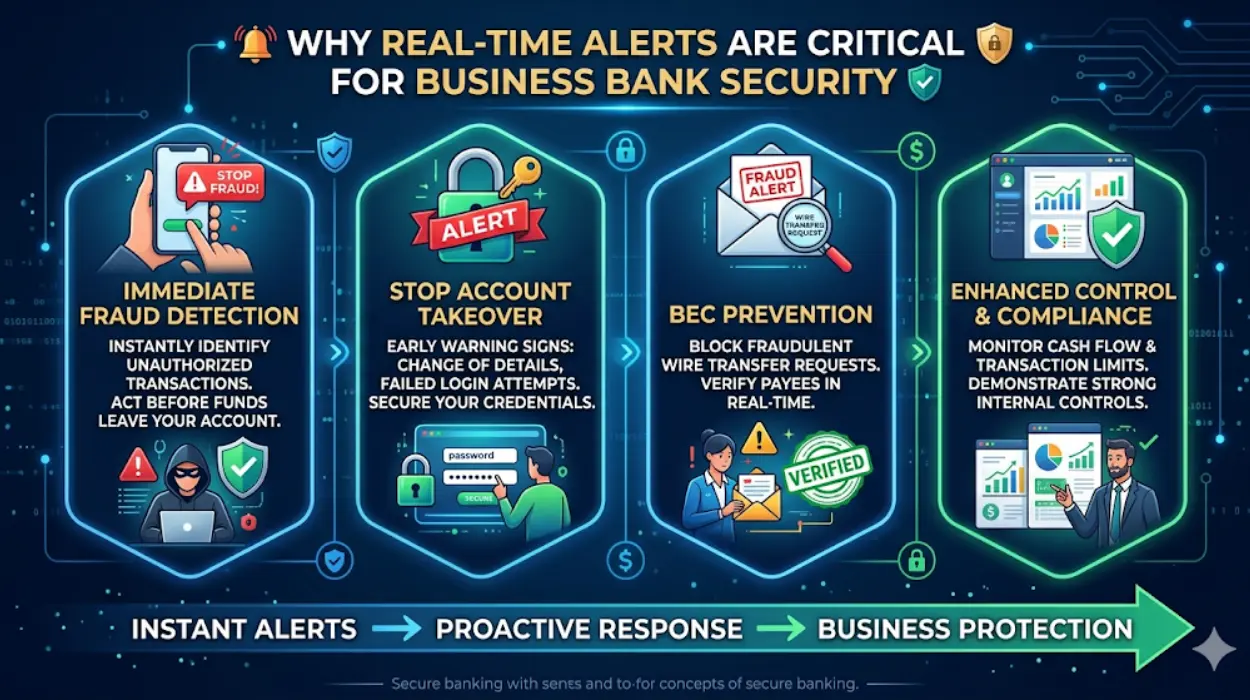
Real-time alerts are critical for business bank security because they detect and respond to suspicious activities the moment they occur. These instant notifications enable companies to prevent financial fraud before losses escalate, keeping corporate funds and credentials secure.
The Growing Threat of Business Bank Fraud
Business banking systems have become prime targets for cybercriminals seeking vulnerabilities in digital payment processes, online banking credentials, and company identity records. Fraudsters exploit delays in detection often taking advantage of gaps between transactions and human review.
Digital transformation has brought extraordinary convenience to banking. However, that same connectivity introduces risk. A single unauthorised transaction or change in company details can compromise an entire business account. For this reason, real-time alerts act as the first line of defence, ensuring that abnormal activities are identified before they evolve into full-scale financial breaches.
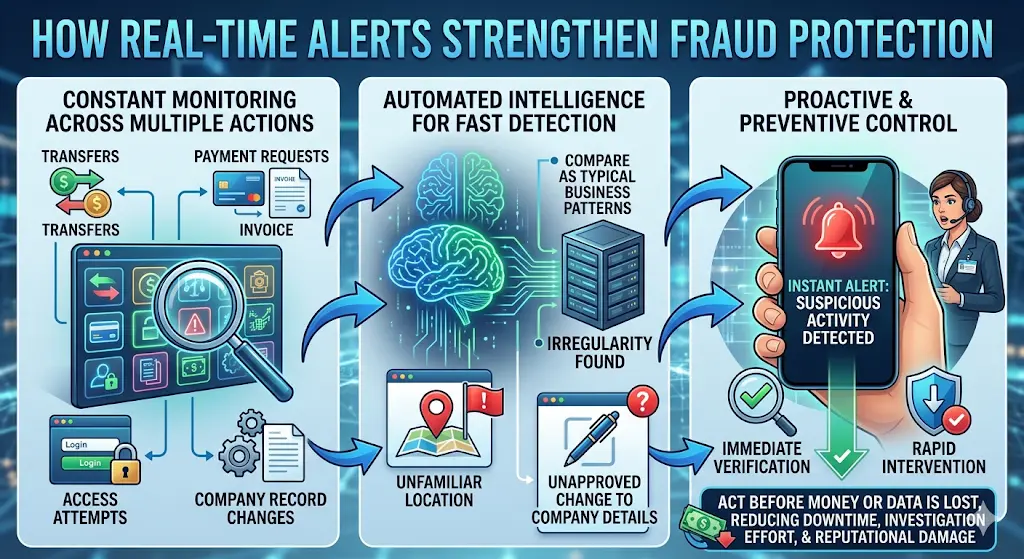
How Real-Time Alerts Strengthen Fraud Protection
Real-time alert technology is specifically designed to provide continuous monitoring across multiple account actions. Such systems track transfers, payment requests, access attempts, and even company record changes the kind that often precede bank fraud.
These alerts work through automated intelligence that compares every transaction against typical business patterns. When an irregularity is found such as a payment from an unfamiliar location or an unapproved change to company details the system sends an instant alert to account administrators. Early awareness enables immediate verification and, if necessary, rapid intervention from the financial provider or internal security team.
In practical terms, this proactive approach transforms fraud detection from reactive resolution to preventive control. Businesses can act before money or data is lost, significantly reducing downtime, investigation effort, and reputational damage.
Why Timing Matters: The Critical Role of Speed
In modern bank security, timing is everything. Traditional manual reviews and end-of-day reconciliations are no longer sufficient to safeguard digital assets. Fraud unfolds within seconds; therefore, detection must operate with the same speed.
When alerts are delayed, unauthorised users have enough time to move funds, alter authorisation settings, or manipulate digital access points. In contrast, real-time monitoring closes that opportunity window, enabling businesses to stop threats in their earliest stage.
Consider an example: if an unusual international transfer occurs outside business hours, a real-time alert allows the finance team to confirm its legitimacy before final processing. Without that instant awareness, the transfer could go unnoticed until the next working day by which time funds might be irrecoverable.
Integration with Fraud Protection Systems
Real-time alerting works best when integrated into a comprehensive Fraud Protection strategy. Effective systems do not only detect single anomalies; they also interpret behavioural patterns, transaction frequency, and identity changes over time.
Form My Company’s Fraud Protection service offers this integrated approach. It combines proactive monitoring with secure company data tracking to ensure that suspicious changes such as unauthorised updates to directors, officers, or company details trigger immediate alerts. This combination shields both the financial and corporate identity layers of a business.
For example, the Fraud Protection service empowers companies to automate risk detection instead of relying solely on periodic reviews. When combined with real-time alerts, this creates a double barrier: automatic vigilance and instant awareness.
The Connection Between Business Bank Fraud and Company Records
Fraudulent access to a business bank account often begins with subtle changes elsewhere particularly in company record information. Cybercriminals and identity thieves frequently alter details at Companies House or other registries to impersonate legitimate directors or authorise new payment accounts.
This is why it’s important to understand the link between company record changes and bank fraud. As detailed in our related article, The Link Between Company Record Changes and Business Bank Fraud, such data manipulation can make fraudulent activity appear legitimate to financial institutions.
Real-time alerts complement this process by ensuring that any associated changes trigger immediate investigation. If the system detects a mismatch between the company’s verified details and new updates, an alert prompts timely verification before criminals can exploit the change.
Real-Time Alerts in Modern Banking Ecosystems
Business banking platforms are increasingly integrating alert systems into their core security frameworks. These include multi-layered notification options, such as:
- Automated SMS and email notifications for account changes.
- Push notifications for large or unusual transaction amounts.
- Dashboard prompts for access attempts outside typical patterns.
Each of these alert modes contributes to a holistic detection network. The goal is not only to inform but also to create a traceable early-warning system that enables direct action. By recognising activity as it happens rather than after processing businesses achieve stronger operational transparency and control.
This proactive architecture ensures that even if one security layer is bypassed, others stand ready to respond within seconds.
Benefits Beyond Fraud Detection
While security is the primary focus, real-time alerts deliver secondary advantages that strengthen overall financial management:
- Operational Efficiency: Automated alerts reduce time spent manually checking accounts or reviewing statements. Alerts arrive only when anomalies occur, letting finance teams focus on core priorities.
- Accountability & Oversight: Alerts create a detailed timeline of user actions and approvals, helping businesses maintain regulatory compliance and audit accuracy.
- Customer Confidence: By implementing visible fraud monitoring measures, businesses reinforce credibility with clients, investors, and payment partners.
- Peace of Mind for Executives: Business owners and directors gain assurance that their assets are being monitored 24/7, even outside office hours.
These cumulative benefits make real-time alerts a foundational component of secure financial operations, not just an optional add-on.
Real-Time Alerts and Regulatory Compliance
Financial governance frameworks increasingly require real-time control measures to satisfy risk management and compliance obligations. Regulatory standards, including Anti-Money Laundering (AML) requirements and Know Your Customer (KYC) protocols, rely on rapid detection of unusual activity.
Real-time alerts support compliance by automatically flagging transactions that breach internal thresholds or external regulations. This technology ensures that businesses meet monitoring obligations efficiently, producing digital audit trails that can be referenced during reviews or investigations.
By integrating alerts into corporate banking and company-monitoring solutions, firms not only safeguard against crime but also maintain consistent adherence to applicable legal standards.
Why Proactive Fraud Monitoring Delivers Competitive Advantage
Fraud loss is not just a financial issue it’s a brand and trust issue. Businesses seen as slow to respond to fraud risks often face reputational harm that can outlast any monetary loss.
Proactive fraud monitoring, enabled by real-time alerts, positions a company as trustworthy, secure, and technically capable. Clients and partners increasingly value organisations that demonstrate strong internal controls, especially when financial data and identity verification are at stake.
For organisations seeking to strengthen this aspect of reputation and security, our resource Stop Unauthorised Changes with Our Proactive Fraud Monitoring explores how continuous real-time oversight translates directly into measurable stability and trust.

Implementing Real-Time Alerts Across Business Systems
The effectiveness of real-time alerts depends on thoughtful implementation. Businesses should ensure that their alert systems cover not just bank activity, but also:
- Changes in registered company information.
- Unscheduled access to cloud-based accounting tools.
- Updates to approved payment beneficiaries.
- Alterations to system authorisation roles.
Centralising all these alerts into one secure dashboard streamlines visibility and response. It enables leadership teams to view all potential fraud indicators from company changes to financial anomalies in one clear interface.
Integration with corporate administration systems ensures that any inconsistency across platforms is detected early, creating a synchronised shield of awareness.
Form My Company’s Approach to Real-Time Fraud Protection
Form My Company (FMC) has designed its Fraud Protection service around the principle of active prevention. Instead of waiting for fraud to occur, FMC builds security layers that detect and neutralise suspicious changes in real time.
Through the use of continuous data monitoring, audit trails, and configurable alert frameworks, businesses can define risk parameters suited to their operations. Whether a director’s record changes, a new officer appears, or an unusual payment is scheduled, alerts help prevent misuse before it becomes a problem.
This proactive approach blends technology and vigilance key attributes for businesses handling sensitive financial operations, supplier payments, or high-volume digital transactions. By implementing FMC’s framework, organisations take control of how fraud is detected, communicated, and resolved.
Real-time alerts stand as one of the most effective tools in the modern fight against business bank fraud. Their ability to identify anomalies instantly transforms financial security from reactive damage control to proactive prevention. Integrating them with Form My Company’s Fraud Protection solution ensures complete coverage across company identity and financial activities.
By acting within seconds rather than days, businesses not only protect their funds but also reinforce trust, compliance, and operational confidence in every transaction.
What is business fraud protection and why is it important?
Business fraud protection involves continuous monitoring and security measures that detect and prevent unauthorised financial activity or identity misuse. At Form My Company, our Fraud Protection service helps businesses safeguard their corporate details and banking information from cyber threats and fraudulent changes.
How does Form My Company’s Fraud Protection service work?
Form My Company’s Fraud Protection system monitors company data and official records in real time to identify suspicious updates or unauthorised access. When anomalies are detected, instant alerts enable businesses to verify and act before financial damage occurs.
Can real-time alerts prevent business bank fraud?
Yes, real-time alerts are a core feature of effective fraud protection. They provide immediate notifications of irregular activity, allowing companies to stop unauthorised transactions or profile changes before funds or identities are compromised.
What types of fraud can Fraud Protection detect?
Fraud Protection can detect a range of risks, including unauthorised company record changes, bank account manipulation, identity theft, and suspicious director or officer updates. Early detection reduces the chance of data misuse or financial loss.
Who should use Fraud Protection services for their business?
Any registered business from small enterprises to large corporations can benefit from Form My Company’s Fraud Protection service. It’s especially valuable for businesses handling frequent transactions or sensitive company data, where fraud risks are higher.