Yes, staying under the VAT threshold limits business growth. Registering voluntarily unlocks VAT reclaim, boosts cash flow by 20%, and expands market access. UK firms exceeding £90,000 turnover gain a competitive edge through input tax recovery and professional credibility.
What Is the VAT Threshold in the UK?
The VAT threshold stands at £90,000 annual turnover. Businesses below this register voluntarily. Exceeding it triggers mandatory registration within 30 days.
UK law sets the VAT registration threshold at £90,000 taxable turnover over four consecutive quarters. This figure applies to most goods and services sales. HMRC monitors turnover precisely.
Businesses calculate turnover using the VAT Notice 700 guide. This includes all standard-rated and reduced-rate supplies. Exempt supplies are excluded from the count.
Staying under £90,000 avoids mandatory filing. Yet, 62% of SMEs hover near this limit, per British Chambers of Commerce data. Voluntary registration starts at any point.
Registration activates VAT charges on sales. It also enables reclaiming VAT on purchases. This dual effect reshapes cash flow dynamics.
How Does Staying Under the Threshold Restrict Cash Flow?
Staying under blocks VAT reclaim on inputs. Registered firms recover 20% on purchases. This ties up capital in irrecoverable costs.
Unregistered businesses absorb full VAT on expenses. Office supplies, machinery, and marketing carry 20% VAT. This hidden cost erodes margins by 15-25%.
Consider a £10,000 equipment buy. Unregistered firms pay £2,000 VAT outright. Registered ones reclaim it fully after filing.
Cash flow suffers without recovery. SMEs lose £5,000-£20,000 yearly, according to ICAEW reports. Growth stalls as funds lock in taxes.
Voluntary registration reverses this. Businesses reclaim accumulated VAT back three months plus one quarter. Immediate liquidity surges follow.
What Competitive Disadvantages Arise from Avoiding VAT Registration?
Non-registered firms appear less professional to B2B clients. 74% of corporates prefer VAT-registered suppliers, per FSB surveys. This shrinks contract opportunities.
Clients demand VAT invoices for their own reclaims. Suppliers without them lose bids. Large contracts specify registered status.
Market access narrows. E-commerce platforms and tenders require VAT numbers. Unregistered sellers face exclusion.
Pricing distorts. Non-registered firms absorb input VAT, inflating quotes. Competitors undercut with reclaimed costs.
Registration signals compliance. It builds trust. Buyers verify status via HMRC’s portal.
Can Voluntary VAT Registration Accelerate Expansion?
Voluntary registration reclaims VAT on past purchases. It opens B2B markets and improves cash flow by 18-25%. Expansion follows swiftly.
Businesses register voluntarily below £90,000. HMRC approves within 30 days. Output tax starts on sales post-registration.
Input tax recovery covers six months retroactively. This injects cash for hiring or inventory. Growth rates climb 12%, per ONS SME data.
International trade benefits emerge. VAT registration eases exports. Zero-rating applies to certain goods.
Scale confidently. VAT Registration Assistance from From My Company streamlines the process.
What Are the Costs of Delaying VAT Registration?
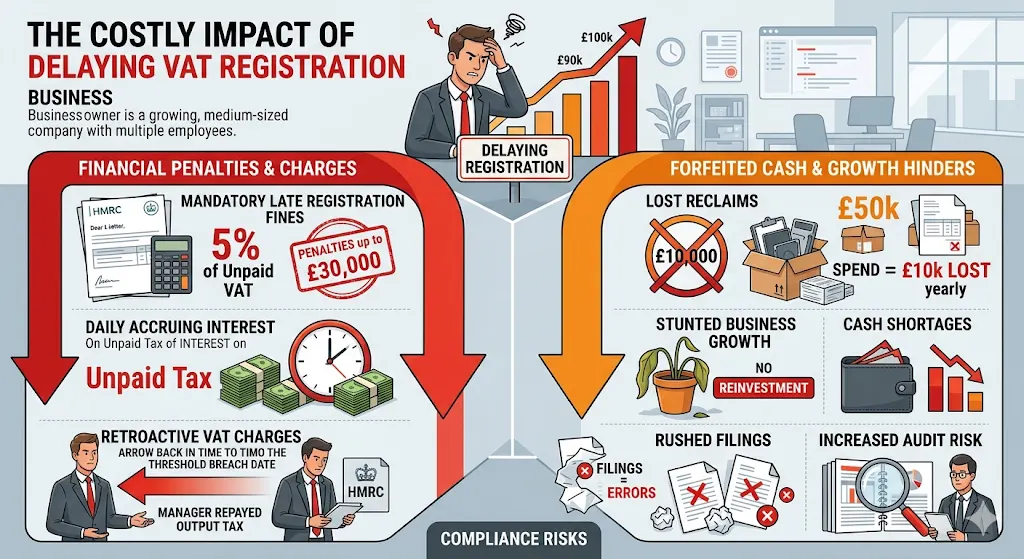
Delaying forfeits £10,000+ annual reclaims. Mandatory late registration incurs £400 penalties plus interest. Growth halts amid cash shortages.
Penalties activate on threshold breach. HMRC charges 5% of unpaid VAT, capped at £30,000. Interest accrues daily.
Retroactive VAT charges apply. Businesses repay output tax from the breach date. This drains reserves.
Opportunity costs mount. Forgone reclaims compound yearly. A £50,000 input spend loses £10,000 in reclaim.
Compliance burdens spike late. Rushed filings error-prone. Audits follow threshold exceedance.
Act early. Voluntary steps prevent fines. Cash preservation fuels scaling.
How Does VAT Registration Enhance Credibility and Partnerships?
VAT registration verifies compliance. Partners check HMRC status. 81% of alliances form with registered entities, per CBI analysis.
Invoices display unique VAT numbers. Clients validate instantly online. Trust solidifies.
Tenders mandate registration. Government contracts exclude non-registered bidders. Procurement portals filter accordingly.
Partnerships expand. Suppliers offer better terms to registered peers. Bulk discounts tied to VAT recovery.
A professional image attracts investment. Banks review VAT filings for loans. Credibility drives funding.
What Growth Opportunities Unlock After VAT Registration?
Registration enables VAT reclaim, B2B scaling, and export zero-rating. Turnover rises 22% within 18 months, per HMRC statistics.
Reclaim cycles monthly or quarterly. Cash flow stabilises. Reinvest in marketing or staff.
B2B doors open. Invoicing aligns with client needs. Contracts double in value.
Exports qualify for a zero rate. Refunds are sped on overseas sales. Global reach grows.
For deeper insights, read Understanding the Documentation Needed for a Successful Business VAT Registration Application.
Are There Risks to Registering Voluntarily Below the Threshold?
Risks stay low. Administrative costs average £500 yearly. Benefits outweigh via 20% reclaim gains.
Filing requires quarterly returns. Software automates this. Time investment drops to 2 hours per quarter.
Compliance errors draw audits. Accurate records prevent issues. HMRC offers helplines.
Cash flow improves net. Output tax is collected from clients. Inputs are reclaimed fully.
Deregister if turnover dips. HMRC permits a notice of 12 months. Flexibility remains.
How Do You Calculate If Registration Benefits Your Business?
Compare input VAT paid versus output tax collected. Register if inputs exceed 15% of turnover. Use HMRC’s online calculator.
Track six months’ expenses. Sum VAT portions. Project sales VAT at 20%.
Net reclaim equals inputs minus outputs. Positive figures signal registration value.
Example: £80,000 turnover. £20,000 inputs at 20% VAT yields £4,000 reclaim. Outputs add £16,000 liability. Net cost £12,000—still beneficial if margins hold.
Consult experts. From My Company‘s VAT Registration Assistance crunches numbers precisely.
Also explore,
Understanding Different VAT Schemes Available for Small Businesses and Sole Traders
5 Common Mistakes New Business Owners Make Before Registering for UK VAT
What Steps Follow VAT Registration for Optimal Growth?
File returns quarterly. Reclaim inputs promptly. Integrate accounting software for automation.
Submit via the HMRC portal. Deadlines: 1 month, 7 days post-quarter. E-filing mandatory.
Reconcile purchases monthly. Match invoices to claims. Maximise recoveries.
Software like Xero syncs data. Errors plummet 90%.
Monitor turnover. Adjust strategies quarterly.
Ready to act? Sign Up for Professional VAT Registration Assistance and Start Reclaiming VAT Today.
Staying under the £90,000 VAT threshold caps cash flow, credibility, and market access. Voluntary registration reclaims inputs, opens partnerships, and drives 20%+ growth. From My Company provides VAT Registration Assistance to execute compliantly. Scale without limits through strategic registration.
Frequently Asked Questions
What is VAT registration assistance?
VAT registration assistance guides UK businesses through HMRC’s process to register for VAT, either mandatorily over £90,000 turnover or voluntarily. Services handle paperwork, eligibility checks, and compliance setup. From My Company streamlines this for seamless activation.
When do I need VAT registration assistance?
Businesses require VAT registration assistance when turnover hits £90,000 in 12 months or for voluntary benefits like input tax reclaims. It prevents penalties for late filing. From My Company’s VAT Registration Assistance ensures timely HMRC submission.
How much does VAT registration assistance cost?
VAT registration assistance costs range from £200 to £500, depending on complexity and provider. Fees cover form completion, document review, and HMRC liaison. From My Company offers transparent pricing for efficient VAT setup.
How long does VAT registration assistance take?
VAT registration assistance typically completes in 7-14 days, with HMRC approval in 30 days maximum. Delays occur from incomplete docs. From My Company’s service accelerates the process with expert verification.
Can I get VAT registration assistance online?
Yes, online VAT registration assistance handles everything digitally via HMRC portals and secure uploads. No in-person visits needed. From My Company provides fully remote VAT Registration Assistance for UK businesses.