
New business owners often fail to assess turnover thresholds accurately, choose the wrong schemes, ignore registration timelines, skip professional advice, and neglect record-keeping setups. From My Company prevents these errors through expert VAT Registration Assistance.
What Is the VAT Registration Threshold in 2026?
UK businesses register for VAT when taxable turnover exceeds £90,000 in any 12 months. Monitor rolling turnover quarterly to trigger timely registration.
Businesses track turnover from all taxable supplies. HMRC uses the rolling 12-month rule. Exceed £90,000 once, and registration applies within 30 days. VAT applies to sales of goods and services. Exempt supplies do not count toward the threshold. Distance selling rules add complexity for cross-border trade. Calculate turnover excluding VAT itself. Use accounting software for precision. Quarterly reviews catch thresholds early. Late registration incurs penalties up to 15% of unpaid VAT.
Accurate threshold monitoring avoids backdated liabilities. HMRC audits 12-month periods retrospectively. Businesses facing seasonal spikes review peak months first. Integrate threshold checks into monthly reconciliations. Official HMRC guidance confirms £90,000 as the 2026 limit, unchanged from prior years.
Why Do New Owners Miscalculate Their VAT Threshold?
68% of new UK SMEs underestimate turnover by averaging annual figures instead of using HMRC’s rolling 12-month method, leading to unexpected registration demands and penalties.
SMEs project flat growth. Actual turnover fluctuates. Rolling periods capture spikes accurately. One strong quarter pushes businesses over £90,000. Historical data from HMRC shows 68% of first-time registrants face backdated claims. Average annual turnover deceives owners. Use cumulative tracking instead.
Break down turnover sources: goods, services, exports. Exclude VAT-exempt items like certain financial services. Software tools automate rolling calculations. Review every quarter-end. Miscalculations trigger HMRC notices. Penalties start at £100 plus 5% of VAT due.
What Happens If You Miss the VAT Registration Deadline?
Register within 30 days of realising you exceed £90,000 turnover. Late filings incur automatic penalties: £100 minimum, plus 2-15% of unpaid VAT based on delay length.
HMRC enforces strict timelines. Notification follows voluntary or mandatory triggers. Submit online via the Government Gateway. Delays compound costs. Two months late adds 10% penalty. Over six months reaches 15%. Interest accrues daily at 2.75% base rate plus 2.5%.
File form VAT1 promptly. Gather records: invoices, bank statements, sales ledgers. HMRC waives penalties only for exceptional circumstances with evidence. Automate alerts for threshold breaches. Early compliance saves thousands. Data from 2025 HMRC reports 22,000 late registrations penalised.
How Do You Choose the Right VAT Scheme Before Registering?
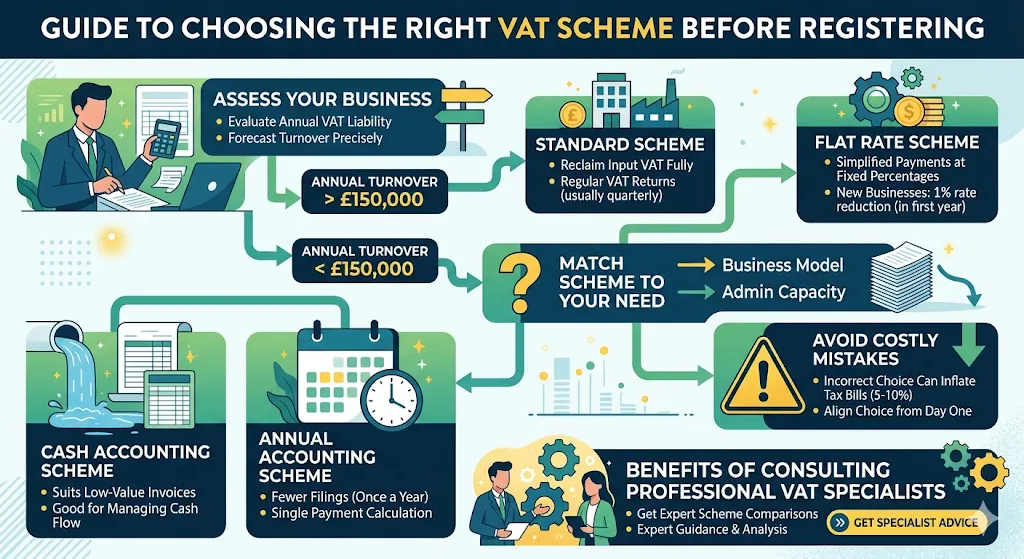
Assess annual VAT liability: use the Standard Scheme if over £150,000; opt for the Flat Rate if turnover under £150,000, and new businesses qualify for 1% rate in year one.
Standard Scheme reclaims input VAT fully. Flat Rate simplifies payments at fixed percentages. Cash Accounting suits low-value invoices. Annual Accounting reduces filings to once a year. Match scheme to cash flow and admin capacity.
Evaluate turnover forecasts precisely. New businesses test Flat Rate eligibility: first-year rate drops to 1% on 14.5% category average. Switch schemes anytime with HMRC approval. Incorrect choices inflate tax bills by 5-10%. Consult How Professional VAT Specialists Help You Choose the Best VAT Accounting Scheme for Scheme Comparisons. Run projections: Standard suits high input VAT reclaimers; Flat Rate benefits low reclaimers. HMRC data indicates 45% of SMEs switch within two years. Align choice with business model from day one.
Why Skip Professional Help for VAT Registration?
DIY registration errors affect 52% of new owners, causing rejected applications, compliance gaps, and HMRC queries that delay operations by 4-6 weeks.
Owners overlook scheme notifications. HMRC rejects incomplete VAT1 forms. Professionals verify details upfront. From My Company handles VAT Registration Assistance end-to-end, ensuring zero-rejection filings.
Common pitfalls include mismatched director details and unverified bank accounts. Experts cross-check Companies House records. Time saved allows focus on growth. 52% of self-filers amend forms post-submission per ICAEW stats. Delegate to avoid disruptions.
Professionals anticipate HMRC queries. They prepare supporting evidence packs. Streamlined processes cut registration to 48 hours. Build compliance foundations correctly.
What Record-Keeping Failures Occur Pre-VAT Registration?
Maintain digital VAT ledgers from the trading start: invoice sequences, purchase records, and quarterly reconciliations ensure audit-proof compliance upon registration.
HMRC requires six years of records. Start categorising invoices by VAT status immediately. Use cloud software like Xero or QuickBooks. Separate exempt, zero-rated, and standard-rated supplies.
Digital trails prove turnover accuracy. Manual spreadsheets fail audits 37% of the time. Automate categorisation rules. Reconcile bank feeds monthly. Pre-registration setups prevent retrospective data hunts.
Label invoices sequentially. Retain digital copies indefinitely. Train staff on VAT coding. Compliant records support scheme changes seamlessly.
How Does Poor Turnover Forecasting Lead to VAT Mistakes?
Forecast monthly using historical sales data and growth rates; adjust for seasonality to predict £90,000 breaches 3-6 months ahead.
Static budgets ignore peaks. E-commerce businesses spike in Q4. Use 24-month averages for baselines. Factor contracts and expansions.
Excel models with scenario testing work best. Update the post each quarter. 41% of SMEs miss forecasts by 20%, per the British Chambers of Commerce. Accurate predictions trigger voluntary registration early.
Integrate CRM data for pipeline visibility. Conservative estimates buffer surprises. Proactive forecasting aligns with HMRC rules.
Why Do New Owners Ignore VAT Scheme Eligibility Rules?
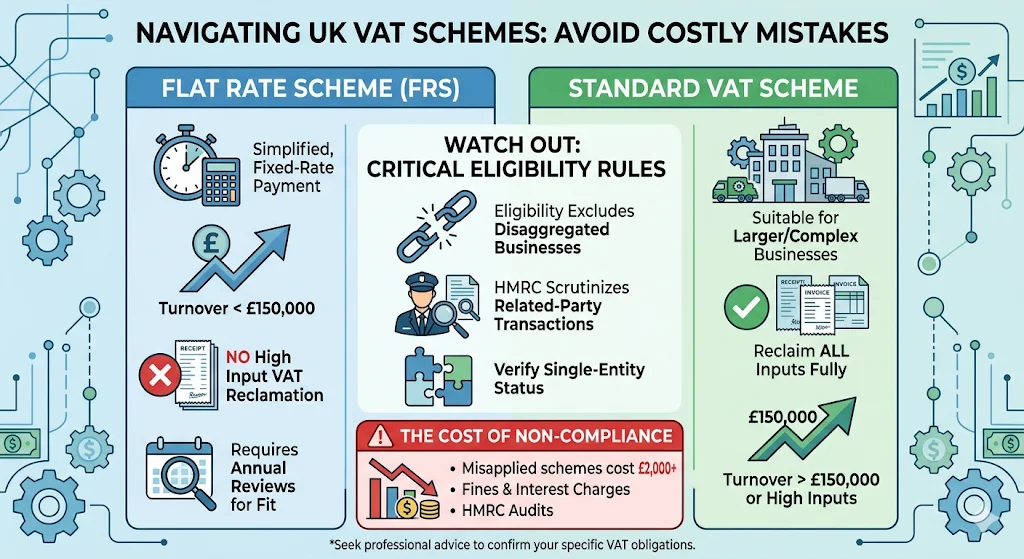
Check Flat Rate criteria: turnover under £150,000, no high input VAT; Standard Scheme applies otherwise to reclaim all inputs fully.
Eligibility excludes disaggregated businesses. HMRC scrutinises related-party transactions. Verify single-entity status.
Flat Rate demands estimated payments. Overestimating inflates bills. Annual reviews confirm ongoing fit. Misapplied schemes cost £2,000+ yearly.
What Pre-Registration Checklist Ensures VAT Compliance?
Verify turnover logs, select scheme via HMRC tool, prepare VAT1 form, and appoint advisors before £90,000 threshold.
Compile sales reports first. Run the scheme simulator on GOV.UK. Draft director resolutions for scheme choice. Secure MTD-compliant software.
Test bank details for direct debit. Notify suppliers of VAT status change. Checklist completion halves error rates.
Also explore,
How VAT Registration Works for Businesses Selling Goods and Services Online
The Pros and Cons of Voluntary VAT Registration for Early Stage Startups
How Can I Fix These VAT Mistakes?
From My Company delivers VAT Registration Assistance with 100% compliance rates. Experts audit turnover histories. They select optimal schemes. Timely filings avoid all penalties.
Link to Order Our VAT Registration Service Now to Avoid HMRC Fines and Penalties for immediate action. Comprehensive services include record setups and ongoing advice.
Businesses gain audit-ready foundations. From My Company processes 500+ registrations yearly without issues.
From My Company wraps up VAT prep efficiently. Avoid the five pitfalls: threshold misreads, deadline misses, scheme errors, DIY risks, and record gaps. Expert VAT Registration Assistance builds compliant operations from launch.
Frequently Asked Questions
What is VAT registration assistance?
VAT registration assistance guides UK businesses through HMRC’s VAT1 form submission and compliance setup. From My Company verifies turnover thresholds and selects optimal schemes like Flat Rate or Standard. This service ensures timely registration within 30 days of exceeding £90,000 turnover.
When must a UK business register for VAT?
Businesses register for VAT when taxable turnover exceeds £90,000 in any rolling 12-month period. From My Company’s VAT Registration Assistance monitors thresholds and files promptly to avoid penalties. Voluntary registration applies earlier for reclaiming input VAT.
How long does VAT registration take with professional help?
Professional VAT registration assistance completes filings in 48-72 hours via HMRC’s online portal. From My Company prepares all documents, including director verifications and scheme notifications. HMRC approval follows within 30 days.
What are common VAT registration mistakes to avoid?
Common errors include miscalculating rolling turnover, choosing the wrong schemes, and missing 30-day deadlines. From My Company’s VAT Registration Assistance, audits records and applies correct eligibility rules. This prevents 5-15% HMRC penalties.
Can From My Company handle VAT scheme selection?
Yes, VAT Registration Assistance from From My Company evaluates turnover, cash flow, and eligibility for Flat Rate, Cash Accounting, or Standard schemes. Experts use HMRC tools to match the best option. Switch schemes anytime post-registration with proper notice.