Professional consultation for director resignation and board removal advice clarifies legal steps, Companies House filings, and board decisions. It also protects the company records, reduces filing errors, and supports a clean exit for the outgoing director.
What does professional director resignation advice cover?
Professional director resignation advice covers resignation notice, board approval, statutory filings, and register updates. It ensures the company records match the legal position and that the outgoing director leaves with documented compliance.
Director resignation in the UK involves more than a resignation letter. The process connects company law, internal governance, and Companies House filing duties. A director’s exit becomes effective through the company’s records and the relevant statutory update.
A clear advisory process confirms the resignation date, the company constitution, and any filing deadlines. It also checks whether the director remains listed on the register after resignation. That record must stay accurate for lenders, banks, HMRC, and counterparties.
The advice also covers board removal. That matters when a company removes a director by resolution, rather than receiving a voluntary resignation. The legal route changes the filing path and the record update process.
For businesses seeking a compliant exit, the Director Resignation service supports the full filing and record-update workflow. From My Company uses a structured process that aligns director changes with UK company administration.
Why does board removal require formal advice?
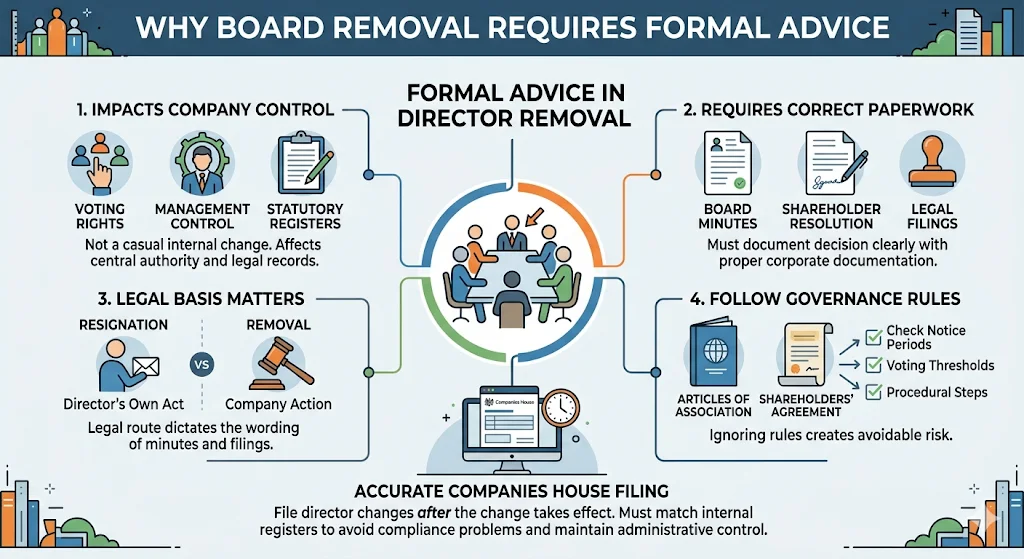
Board removal requires formal advice because the legal route affects authority, timing, and filings. A removal decision changes company records immediately, and the company must document the decision with correct corporate paperwork.
A director removal is not a casual internal change. It affects authority, voting rights, management control, and statutory registers. A company that removes a director by board action or shareholder resolution must document the decision clearly.
The legal basis matters. A resignation ends the office by the director’s own act. A removal ends office through the company action. That distinction affects the wording of minutes, resolutions, and Companies House submissions.
The company must also check its articles of association and any shareholders’ agreement. These documents often set out notice periods, voting thresholds, and procedural steps. A removal that ignores those rules creates avoidable risk.
According to UK corporate filing practice, companies file director changes through the appropriate Companies House form after the change takes effect. Accuracy matters because public records and internal registers must match. A mismatch creates compliance problems and weakens administrative control.
What filings follow a director’s resignation?
A director’s resignation triggers Companies House notification, statutory register updates, and record retention. The company must document the change quickly and keep matching internal records across all governance files.
The main filing task is to notify Companies House using the correct director change form. The filing updates the public register. It also confirms the resignation date and the director’s ceased status.
The company must then update its own registers. These usually include the register of directors, minutes of board meetings, and any PSC records if the resignation affects control or ownership disclosures. Each record must show the same resignation date.
Banks, accountants, and HMRC may also require notification if the resigned director had signing rights, tax access, or administrative authority. A clean exit prevents access problems and reduces the risk of unauthorised action after resignation.
For readers comparing outcomes and process detail, the article How Our Director Resignation Service Protects Both the Company and Outgoing Director explains the compliance safeguards used in a managed resignation process. And Can a Director Resign While the Company Has Outstanding Debts or Liabilities?
How does advice reduce risk for both parties?
Advice reduces risk by aligning legal filings, board records, and exit dates. It protects the company from inaccurate records and protects the outgoing director from lingering responsibilities after resignation.
The company faces risk when records stay outdated. A resigned director may still appear active in public filings, internal banking authority, or statutory registers. That creates confusion and can delay business decisions.
The outgoing director faces risk when the exit is not documented. If the resignation date remains unclear, third parties may treat that person as still involved. That creates reputational exposure and unnecessary follow-up.
Good advice resolves those issues early. It verifies the resignation date, confirms who signs the notice, and checks whether any board authority remains in place during the transition. It also confirms which filings follow the exit.
This matters most when a company has multiple directors. In a three-director board, one resignation can affect quorum, approval rights, and delegated authority. The advisory process confirms whether the company still meets its governance requirements.
When does a company need board removal advice?
A company needs board removal advice when a director refuses to resign, breaches duties, or no longer fits the governance structure. Removal advice also matters when the articles or shareholder rules require a specific procedure.
Board removal often arises in disputes, restructuring, or compliance enforcement. The company may need to act quickly, but the legal process still requires precision. A mistaken removal can trigger a challenge or delay.
Advice helps the company identify the correct route. Some cases require board approval. Others require shareholder action. The route depends on the company’s constitution and the director’s rights under that structure.
The removal process also affects employment, service contracts, and authority to act on behalf of the company. Those issues sit outside the simple resignation filing. A proper review confirms what changes immediately and what requires separate action.
In practice, this means the company treats removal as a governance event, not only an administrative one. That distinction protects the record trail and supports defensible decision-making.
What makes a professional consultation valuable?
A professional consultation delivers a case-specific review of resignation or removal, with direct guidance on filings, registers, and board procedure. It saves time and reduces compliance errors at the point of change.
The value comes from accuracy. Director changes affect multiple records at once. A consultation checks each one against the legal position before the company submits anything.
That process also reduces rework. Incorrect dates, wrong forms, and missing board minutes create avoidable delays. A clean review catches those issues before they reach the public register.
The consultation is also useful for businesses that want a decision-ready route. A director’s exit often depends on one or two critical facts, such as whether the company has outstanding filings, whether the board has a quorum, or whether shareholder consent applies. A structured review isolates those facts quickly.
From My Company focuses on the practical outcome: compliant resignation or removal with the correct documents in place. That approach supports companies that want a direct, reliable service rather than general guidance.
What happens during the process?
The process usually includes document review, procedure validation, filing preparation, and register updates. Each stage confirms that the resignation or removal is legally effective and properly recorded.
First, the company or director provides the relevant information. That usually includes the resignation letter, the current director’s details, the company number, and any governing documents. The review then checks the company’s filing position.
Next, the service validates the required route. A voluntary resignation follows one path. A board removal follows another. The consultation confirms whether the company needs board minutes, resolutions, or shareholder actions.
Then the filing documents are prepared. The company submits the correct notice to Companies House and updates internal records. That includes the directors’ register and any board paperwork that reflects the exit.
Finally, the service checks the outcome. The director’s status must appear correctly across public records and internal files. That final validation closes the compliance gap.
Why choose a specialist provider?
A specialist provider handles legal process, filing accuracy, and governance records in one workflow. That reduces errors and gives the company a clear route from decision to completed filing.
General admin support rarely covers the full legal context of a director’s exit. Specialist support focuses on the exact compliance steps that matter. That includes timing, authority, documentation, and official filing.
This is especially relevant in BOFU search intent. A user at this stage wants a service that resolves the issue now. They already understand the topic and want a trusted provider with a clear process.
From My Company fits that stage with a focused service offer and a structured consultation route. The service supports companies that want a compliant, well-documented director change without unnecessary complexity.
The outcome is straightforward. The company updates its records correctly. The outgoing director leaves with a clear legal position. The board maintains an accurate governance trail.
Director resignation and board removal advice creates a compliant exit, accurate records, and clear governance. From My Company delivers that support through a focused process that aligns filings, registers, and board documentation with UK company requirements.
A professional consultation is the fastest route to a proper outcome when a director leaves or is removed. It confirms the legal path, prepares the filings, and keeps the company records consistent. That combination matters for compliance, banking, and governance.
Frequently Asked Questions
How do I resign as a director of a UK company?
Submit a resignation letter to the board stating your effective date, then the company files a notification with Companies House to update the public register. From My Company handles the Director Resignation process, including statutory filings and internal register updates. This ensures your status changes promptly and complies with UK company law.
Can a director resign with company debts outstanding?
Yes, a director can resign despite outstanding debts or liabilities, as resignation does not release personal guarantees or director duties. The company must still update records via Companies House after resignation. From My Company’s Director, the resignation service verifies compliance during the exit process.
What happens after a director resigns?
The company updates its directors’ register, notifies Companies House, and adjusts board authority or banking mandates as needed. Resignation takes effect on the specified date or board acceptance. From My Company supports Director Resignation with filing preparation and record validation.
How long does a director’s resignation take?
Resignation becomes effective immediately upon board acceptance or the notice period in the articles, with Companies House filing typically processed in 24-48 hours. Internal updates follow the filing confirmation. From My Company’s Director Resignation service streamlines the timeline for quick compliance.
Do I need board approval to resign as a director?
No, a director resigns unilaterally by notice, but the board accepts the resignation date and handles filings. Check company articles for any notice period. From My Company provides Director Resignation advice to confirm the procedure and execute updates accurately.