Professional filing is cheaper because it prevents costly errors, late penalties, and rejected submissions. A single incorrect confirmation statement can trigger £150+ penalties, correction fees, and administrative delays, while expert filing ensures accuracy, compliance, and first-time approval at a predictable, lower total cost.
What makes submission errors so expensive for UK companies?
Submission errors increase costs through penalties, resubmission fees, and operational delays. Companies House charges up to £150 for late filings, while incorrect data can trigger multiple correction cycles, each consuming time, administrative resources, and potential legal risk exposure.
Errors create a chain reaction. A rejected confirmation statement stops compliance status updates. This affects credit checks and lender trust. UK lenders often review Companies House records before approving financing. A single inaccurate filing delays this process.
Administrative costs escalate quickly. Internal teams spend hours correcting data, verifying records, and resubmitting documents. A typical correction cycle involves three steps: identifying the issue, amending records, and resubmitting. Each step consumes time and payroll cost.
Penalties add measurable financial pressure. Companies House applies late filing penalties starting at £150 and increasing for repeated delays. If filings remain unresolved, the company risks strike-off proceedings, which introduce legal and reinstatement costs.
How does professional filing reduce compliance risks?
Professional filing reduces compliance risks by verifying data accuracy, aligning submissions with Companies House standards, and ensuring timely submission. Experts apply structured validation processes that eliminate common errors such as incorrect shareholder details, SIC codes, or registered office inconsistencies.
Professionals follow a defined compliance workflow. This includes identity verification, record validation, and document authentication. Each step ensures alignment with UK corporate regulations.
Three common error areas illustrate this:
- Incorrect PSC (Person with Significant Control) details due to outdated ownership records
- Mismatched SIC codes that do not reflect business activity
- Invalid registered office addresses that fail verification checks
Professional services validate these elements before submission. This prevents rejection and eliminates rework cycles.
Compliance accuracy also protects legal standing. A correctly filed confirmation statement confirms that the company records are up to date. This ensures directors meet statutory obligations under the Companies Act 2006.
Why is first-time accuracy critical in confirmation statements?
First-time accuracy prevents rejection, avoids duplicate filings, and maintains uninterrupted compliance status. Companies House systems flag inconsistencies immediately, and even minor discrepancies can result in rejected submissions, requiring full reprocessing and additional administrative effort.
A confirmation statement confirms company data annually. It includes shareholder structure, SIC codes, and registered address. Any inconsistency signals non-compliance.
Companies House uses automated validation checks. These systems compare submitted data against existing records. If mismatches appear, the filing is rejected instantly.
Each rejection restarts the process. This includes re-verification and re-submission. Businesses lose time and risk missing filing deadlines.
Using a professional service to file a confirmation statement ensures submissions meet validation criteria on the first attempt. This eliminates repeated processing and protects compliance continuity.
What hidden costs do businesses overlook in DIY filing?
DIY filing appears cost-effective but introduces hidden costs such as time loss, internal resource allocation, and error correction expenses. Businesses often underestimate the operational impact of repeated submissions and the financial consequences of compliance failures.
Time is the most underestimated cost. A typical DIY filing requires reviewing records, cross-checking ownership data, and understanding regulatory requirements. This process takes several hours per filing.
Internal staff often lack specialised compliance knowledge. Errors occur during data entry or the interpretation of requirements. This leads to resubmissions and additional time investment.
Three hidden cost categories include:
- Labour cost: staff time spent correcting and resubmitting filings
- Opportunity cost: delayed strategic work due to administrative burden
- Risk cost: penalties and compliance issues arising from inaccuracies
Professional filing removes these inefficiencies. It converts unpredictable costs into a fixed, controlled service expense.
How do professional services streamline the filing process?
Professional services streamline filing by applying structured workflows, automated validation tools, and compliance expertise. This reduces processing time, eliminates manual errors, and ensures submissions meet regulatory standards without delays or repeated corrections.
The process follows a clear sequence. First, data collection ensures all company records are current. Second, validation checks confirm accuracy. Third, the submission aligns with Companies House requirements.
Automation plays a key role. Professional platforms use validation tools to detect inconsistencies before submission. This prevents rejection at the source.
Experts also maintain updated knowledge of regulatory changes. Filing requirements evolve, especially around ownership transparency and PSC reporting. Professionals apply current standards without requiring businesses to track updates.
For a deeper understanding of how filing requirements work, see this guide on lawful purpose declarations in company filings: Understanding the Lawful Purpose Statement in Your Filing.
Why do late filing penalties make DIY filing more expensive?
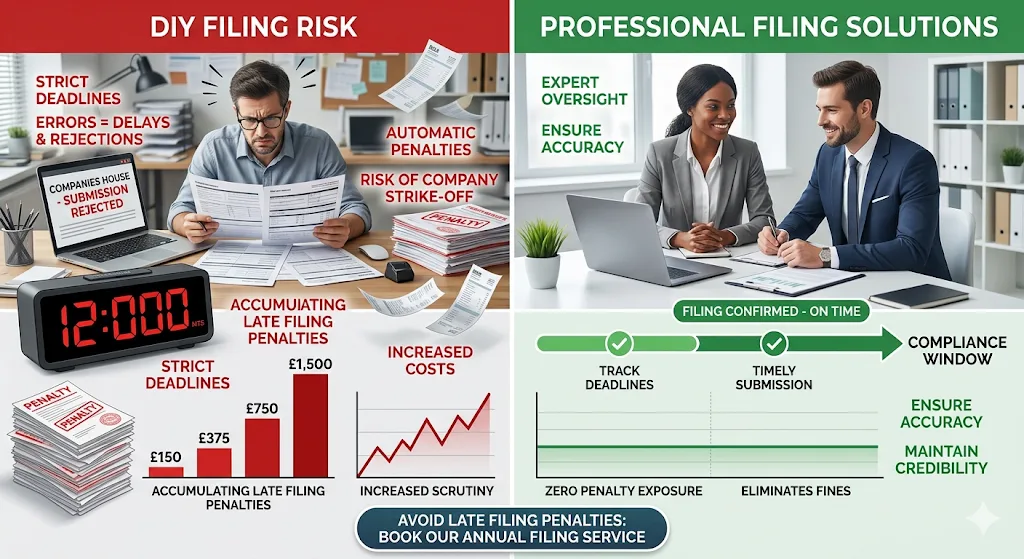
Late filing penalties increase total costs significantly, especially when combined with correction delays. Companies House imposes fines starting at £150, escalating for repeated offences, while unresolved filings risk company strike-off and legal reinstatement expenses.
Deadlines are strict. A confirmation statement must be filed at least once every 12 months. Missing this deadline triggers automatic penalties.
DIY filing increases the risk of delays. Errors cause rejections, which consume time. Each correction pushes the submission closer to or beyond the deadline.
Repeated late filings increase penalties. Companies with consistent delays face higher fines and increased scrutiny. This affects credibility with regulators and financial institutions.
Professional services ensure timely submission. They track deadlines and complete filings within compliance windows. This eliminates penalty exposure.
Businesses seeking to avoid escalating fines often rely on structured filing solutions such as this commercial option to avoid late filing penalties: Avoid Late Filing Penalties: Book Our Annual Filing Service.
How does professional filing improve business credibility?
Professional filing improves credibility by maintaining accurate public records, ensuring compliance status, and reinforcing trust with stakeholders. Lenders, investors, and partners rely on Companies House data to evaluate a company’s reliability and governance standards.
Companies House acts as a public record system. Anyone can access company data, including shareholders and filing history. Inaccurate or outdated information raises concerns.
Lenders use this data during credit assessments. A clean filing record supports loan approvals. Inconsistent filings can delay or reject applications.
Investors also review compliance history. Accurate confirmation statements demonstrate strong governance. This increases investor confidence.
Professional filing ensures records remain consistent and up to date. This strengthens external perception and supports business growth.
Also explore,
Choosing an Agent to Manage Your Annual Companies House Duty
How to Ensure Your Lawful Purpose Statement is Correctly Filed
Why is professional filing more predictable in cost?
Professional filing offers predictable costs through fixed service fees, eliminating unexpected penalties, correction expenses, and administrative overhead. Businesses gain financial clarity by avoiding variable costs associated with errors, delays, and repeated submissions.
DIY filing introduces uncertainty. Costs vary depending on errors and delays. A single mistake can multiply expenses through penalties and rework.
Professional services operate on defined pricing. This includes verification, submission, and compliance checks. Businesses know the total cost in advance.
Predictability supports budgeting. Companies can allocate resources without factoring in unexpected compliance costs.
From My Company delivers structured filing solutions that remove cost variability. Their approach ensures businesses maintain compliance without financial surprises.
How does expert filing support long-term compliance strategy?
Expert filing supports long-term compliance by maintaining accurate records, tracking deadlines, and ensuring regulatory alignment. This creates a stable compliance framework that reduces risk exposure and supports sustainable business operations.
Compliance is not a one-time task. It requires consistent updates and monitoring. Each filing contributes to a company’s regulatory history.
Professional services maintain ongoing records. They track changes in ownership, address, and business activity. This ensures future filings remain accurate.
Three long-term benefits include:
- Reduced audit risk due to consistent records
- Improved operational efficiency through structured compliance processes
- Enhanced regulatory alignment with evolving Companies House requirements
From My Company integrates these practices into its filing services. This ensures businesses maintain compliance without internal complexity.
Professional filing delivers measurable cost savings by preventing errors, avoiding penalties, and ensuring first-time accuracy. It replaces unpredictable expenses with structured, reliable processes.
From My Company provides a compliance-focused approach to filing confirmation statements. Their service ensures accuracy, timeliness, and regulatory alignment, helping businesses maintain compliance without incurring unnecessary costs.
Frequently Asked Questions
What is a confirmation statement and why is it required in the UK?
A confirmation statement verifies that a company’s details on Companies House records are accurate and up to date. When businesses use services like File a Confirmation Statement with From My Company, they ensure compliance with the Companies Act 2006 and avoid penalties for incorrect or outdated filings.
How often do you need to file a confirmation statement?
UK companies must file a confirmation statement at least once every 12 months, even if no changes have occurred. Using a structured service, such as filing a Confirmation Statement, helps track deadlines and ensures submissions are completed within the required review period.
What happens if you file a confirmation statement late?
Late filing can result in penalties starting at £150 and may lead to company’s strike-off if ignored. From My Company helps reduce this risk by managing deadlines and ensuring timely submission through its File a Confirmation Statement service.
Can I file a confirmation statement myself, or should I use a professional service?
You can file it yourself through Companies House, but errors in shareholder data, SIC codes, or addresses often cause rejection. Professional services like File a Confirmation Statement by From My Company apply validation checks that improve accuracy and reduce costly resubmissions.
What information is required to file a confirmation statement?
You need to confirm key company details, including registered office address, SIC codes, shareholder structure, and Persons with Significant Control (PSC). From My Company ensures all required data is verified and correctly submitted when you File a Confirmation Statement, reducing compliance risks.