
A director’s resignation is a voluntary decision made by the director to step down, while removal from the board is a formal action initiated by shareholders or the company to terminate a director’s position under legal procedures defined by UK company law.
What is a director’s resignation in a UK company?
A director’s resignation is the formal act of a company director voluntarily leaving their position, typically confirmed through written notice and recorded with Companies House to maintain accurate corporate records and legal compliance.
A director’s resignation begins with the individual choosing to step down. This decision is not imposed by the company. The director submits a written notice, often aligned with company articles or service agreements.
The company must then update internal records and notify Companies House. This ensures public registers reflect the current board structure. UK law requires this update to maintain transparency and regulatory accuracy.
Resignation does not require shareholder approval. The director retains control over the timing, unless contractual obligations specify notice periods. For example, a director’s contract may require 30 days’ notice before resignation becomes effective.
The process remains administrative but legally significant. Failure to report changes can result in penalties or incorrect filings. Businesses often rely on structured services, such as a director resignation service, to ensure compliance and accurate submission.
For a complete breakdown of the filing process and compliance requirements, refer to this guide on the Director Resignation Service.
What does it mean to be removed from the board of directors?
Being removed from the board means a director is forcibly dismissed through a shareholder resolution, typically under Section 168 of the Companies Act 2006, following formal notice and voting procedures.
Removal is not voluntary. Shareholders initiate the process when a director fails to meet expectations or breaches responsibilities. This mechanism protects company governance.
The process requires specific legal steps. Shareholders must issue a special notice, usually at least 28 days before the resolution meeting. The director has the right to respond in writing or speak at the meeting.
A simple majority vote (over 50%) can approve removal. This applies even if the director opposes the decision. The company must then file the termination with Companies House.
Unlike resignation, removal can involve disputes. It may also trigger contractual consequences such as compensation or legal claims. For example, removing a director without following due process can result in unfair dismissal claims.
This structured process ensures accountability. It balances shareholder authority with director rights under UK corporate law.
What are the key legal differences between resignation and removal?
The key legal difference lies in control and procedure: resignation is initiated by the director with minimal formalities, while removal requires shareholder approval, statutory notice, and strict compliance with Companies Act provisions.
Control defines the distinction. In resignation, the director decides independently. In removal, shareholders exercise authority over board composition.
Legal procedures differ significantly. Resignation involves submitting notice and updating records. Removal requires formal resolutions, notice periods, and voting protocols.
Documentation also varies. A resignation typically requires:
- A written resignation letter
- Board acknowledgment
- Companies House filing (Form TM01)
Removal involves additional layers:
- Special notice under Section 168
- Shareholder resolution
- Meeting minutes documenting the vote
- Filing with Companies House
Liability considerations differ. A resigning director may still hold responsibility for actions taken during their tenure. A removed director may pursue legal remedies if procedures were not correctly followed.
These differences highlight the importance of accurate process execution. Businesses must align actions with statutory frameworks to avoid legal exposure.
How does each process impact company compliance and records?
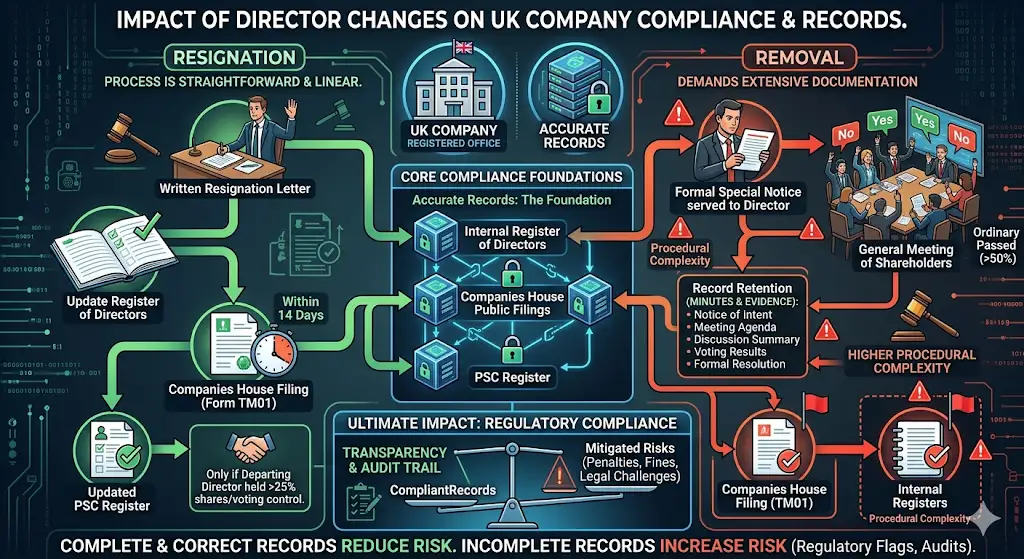
Both resignation and removal require timely updates to statutory registers and Companies House filings, but removal demands more extensive documentation due to its procedural complexity and potential legal implications.
Accurate records form the foundation of UK company compliance. When a director leaves, the company must update:
- Companies House filings within 14 days
- Internal registers of directors
- PSC register if applicable
In a resignation, updates are straightforward. The company records the departure and files the necessary form. The process is linear and administrative.
Removal introduces additional compliance layers. Companies must retain evidence of:
- Notice served to the director
- Shareholder voting results
- Meeting documentation
If records are incomplete or incorrect, regulatory risks increase. For example, Companies House may flag inconsistencies between filings and internal registers.
Updating the PSC register becomes critical when the departing director also holds significant control. Learn why this matters in this guide on updating your PSC register after a director’s resignation.
Compliance accuracy ensures transparency. It also protects the company during audits or legal reviews.
When should a company choose removal instead of resignation?
A company uses removal when a director refuses to resign, breaches duties, or undermines governance, requiring shareholder intervention to enforce accountability and protect the company’s operational integrity.
Resignation is the preferred path when cooperation exists. It avoids conflict and reduces administrative burden. However, not all situations allow voluntary exit.
Removal becomes necessary in defined scenarios:
- A director breaches fiduciary duties, such as acting against the company’s interests
- Governance failures occur, including repeated non-compliance
- Operational disruption arises due to inactivity or misconduct
For example, if a director fails to submit statutory filings for three consecutive reporting periods, shareholders may act to remove them.
Timing also plays a role. Immediate removal may be required when risks threaten financial or legal stability. In such cases, shareholder action ensures swift resolution.
The decision depends on risk level, cooperation, and legal obligations. Companies must evaluate each case based on governance impact and compliance requirements. Also, read our articles, updating your PSC register after a director’s resignation and Activate Our Managed Director Resignation Service to Seamlessly Update Your Company Board.
What are the procedural steps for director resignation vs removal?
Director resignation follows a simple process of notice and filing, while removal involves formal notice, shareholder resolution, and documented voting procedures to comply with statutory requirements.
Director resignation steps
The resignation process includes:
- Submit a written resignation notice to the company
- Record the resignation in the board minutes
- File Form TM01 with Companies House within 14 days
- Update internal registers and PSC records if relevant
This process typically completes within 1–3 working days when documentation is prepared correctly.
Director removal steps
The removal process includes:
- Issue a special notice to the company (minimum 28 days)
- Notify the director of the proposed resolution
- Conduct a shareholder meeting and vote
- Record meeting minutes and voting outcomes
- File termination with Companies House
This process can take 3–6 weeks due to statutory notice requirements.
The difference in timelines reflects procedural complexity. Removal requires structured governance actions, while resignation remains administrative.
Businesses seeking efficiency often evaluate structured solutions such as Activate Our Managed Director Resignation Service to Seamlessly Update Your Company Board when planning board changes.
Also explore,
Can a Director Resign While the Company Has Outstanding Debts or Liabilities?
How a Director’s Resignation Affects Company Shareholdings and Future Business Operations Today
How does each option affect directors’ legal responsibilities?
Both resignation and removal end a director’s role, but neither eliminates liability for actions taken during tenure, and removal may introduce additional legal risks if procedures are mishandled.
A director’s duties remain enforceable even after departure. These duties include:
- Acting in the company’s best interests
- Avoiding conflicts of interest
- Maintaining accurate records
Resignation does not erase past obligations. Regulatory bodies can still investigate actions taken during the director’s tenure.
Removal introduces additional considerations. If the process violates statutory rules, the director may challenge the decision. This can lead to legal disputes or compensation claims.
For example, failing to provide proper notice under Section 168 invalidates the removal process. This exposes the company to legal risk.
Clear documentation and compliance reduce these risks. Companies must ensure each step aligns with legal requirements to protect both parties.
Director resignation and removal serve distinct governance purposes within UK companies. Resignation offers a voluntary, efficient exit path controlled by the director. Removal provides a structured mechanism for shareholders to enforce accountability when necessary.
The choice between these options depends on cooperation, risk level, and compliance obligations. Each process carries specific legal, procedural, and documentation requirements that directly impact company records and regulatory standing.
From My Company delivers structured support for director resignation processes, ensuring accurate filings, compliant documentation, and seamless updates to company records. This approach reduces administrative burden while maintaining full alignment with UK corporate regulations.
Frequently Asked Questions
How do I resign as a company director in the UK?
To complete a Director Resignation in the UK, a director submits written notice to the company and the business files Form TM01 with Companies House within 14 days. From My company ensures the resignation is properly recorded and compliant with statutory requirements.
How long does a director’s resignation take to process?
A Director Resignation is typically processed within 1–3 working days once all documentation is prepared and submitted. Companies House updates the public register shortly after filing, and From My Company helps ensure accurate and timely submission.
Is a director still liable after resigning from a company?
Yes, a director remains legally responsible for actions taken during their tenure even after completing a Director Resignation. From My company highlights that resignation ends the role but not accountability for past compliance or decisions.
Do I need shareholder approval to resign as a director?
No, a Director Resignation does not require shareholder approval because it is a voluntary action by the director. From My company ensures the process follows company articles and UK legal requirements without unnecessary delays.
What documents are required for a director resignation?
A Director’s resignation requires a formal resignation letter, internal record updates, and a Companies House filing using Form TM01. From My company manages these steps to maintain accurate company records and regulatory compliance.