
You can order a professional Director Appointment package online by submitting verified director details, completing identity checks, and authorising filings with Companies House. A compliant service processes documentation, validates identities, and updates statutory registers within hours, ensuring accurate, legally recognised director records.
What is a professional Director Appointment package and what does it include?
A professional Director Appointment package includes identity verification, consent collection, Companies House filing, and statutory register updates. It standardises director onboarding using compliant workflows, ensuring accurate appointment records, validated identities, and immediate alignment with UK corporate governance requirements.
A Director Appointment package formalises the process of adding a new director to a UK company. It captures key data fields such as full legal name, service address, residential address, nationality, and date of birth. Each field maps directly to Companies House schema requirements.
The package also enforces identity verification using three methods: passport checks, biometric scans, and address validation. These checks align with UK anti-fraud frameworks and reduce filing rejection rates.
Consent is recorded through signed statements confirming that the director agrees to act. This step creates an auditable trail. The service then submits the AP01 form electronically and updates the company’s statutory registers, including the register of directors and directors’ residential addresses.
How does the online filing process achieve fast statutory updates?
Online filing accelerates statutory updates by transmitting validated data directly to Companies House systems. Automated checks detect errors before submission, while digital authentication enables same-day processing, reducing manual review delays and ensuring near real-time updates to public company records.
Digital submission uses structured data fields that match Companies House APIs. This removes formatting inconsistencies that often occur with paper forms. When data passes validation rules, the system accepts the filing without manual intervention.
Authentication uses secure credentials tied to the company’s authentication code. This confirms authority to file and prevents unauthorised changes. Once submitted, most filings update the public register within 24 hours.
Error detection occurs at two stages: pre-submission validation and Companies House acceptance checks. Common issues include mismatched dates, incomplete addresses, and duplicate director entries. Automated systems flag these issues instantly, allowing correction before submission.
Why is identity verification critical in director appointments?
Identity verification ensures that appointed directors are real, authorised individuals. It prevents fraudulent appointments, supports anti-money laundering compliance, and strengthens trust in UK company records by validating credentials against official documents and biometric data before filing.
Verification protects both the company and the public register. When a director’s identity is confirmed using official documents, the risk of impersonation drops significantly. This matters because fraudulent appointments can lead to financial crime exposure.
UK compliance frameworks increasingly require robust identity checks. These include document authenticity checks, facial recognition matching, and address verification against trusted databases. Each method adds a layer of assurance.
Accurate identity data also improves downstream processes. Banks, investors, and regulators rely on Companies House records. Verified director data speeds up due diligence and reduces onboarding friction for financial services.
What steps are involved when you order a Director Appointment service?
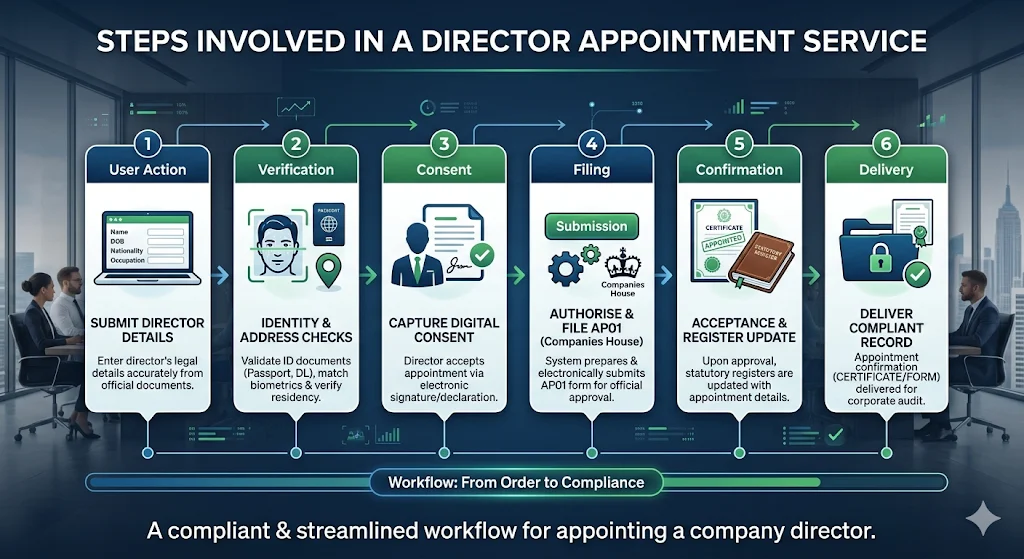
Ordering a Director Appointment service involves submitting director details, completing identity checks, confirming consent, and authorising electronic filing. The provider validates data, files with Companies House, and updates statutory registers, delivering a compliant appointment record within a defined processing window.
The process begins with data submission. You enter the director’s legal details exactly as shown on official documents. Precision matters because mismatches trigger rejections.
Next, identity verification runs through integrated checks. The system validates documents and matches biometric data. Address verification confirms residency details using trusted datasets.
Consent is captured through a digital declaration. This confirms the individual agrees to act as a director. The service then prepares the AP01 filing and submits it electronically.
After acceptance, the provider updates the statutory registers. This includes recording the appointment date and maintaining internal registers. A confirmation record is generated for audit purposes. For a compliant and streamlined workflow, use the Director Appointment service.
How do professional services reduce errors and compliance risks?
Professional services reduce errors by enforcing structured data entry, automated validation, and compliance checks aligned with UK regulations. They minimise rejection rates, ensure accurate filings, and maintain audit-ready records, lowering legal risk and administrative burden for company officers.
Structured forms guide users through required fields in a fixed sequence. This prevents omissions and ensures consistency. Validation rules check formats such as dates, postcodes, and nationality codes.
Compliance checks align with Companies House requirements and UK corporate law. The system verifies that mandatory fields are complete and logically consistent. For example, it flags future appointment dates or invalid address formats.
Audit trails record each action: data entry, verification, consent, and submission. These logs support internal governance and external reviews. When regulators request evidence, the company can produce time-stamped records.
Error reduction has a measurable impact. Electronic filings typically achieve acceptance rates above 95%, compared to lower rates for manual submissions due to formatting and completeness issues.
When should a company use a Director Appointment package instead of manual filing?
A company uses a Director Appointment package when speed, accuracy, and compliance certainty are required. It is especially effective during rapid scaling, investor onboarding, or governance restructuring, where timely updates and verified director records directly affect legal standing and stakeholder confidence.
Manual filing suits simple, low-urgency cases. It requires careful form completion and postal submission. Processing times are longer, and error correction cycles add delays. A package becomes essential when timelines are tight. For example, during funding rounds, investors often require updated director records before closing. Delays can affect transaction schedules.
Governance changes also benefit from structured workflows. When multiple directors are appointed or resign, coordinated filings reduce inconsistencies. The package standardises each step and ensures records remain aligned.
If you want a deeper breakdown of how structured workflows improve filings, read how professional services streamline the director appointment and identity verification filing process.
How does this process align with UK Companies House requirements?
The process aligns with Companies House requirements by using prescribed data fields, validated identity information, and authorised electronic submission. It ensures filings meet statutory standards, updates public registers accurately, and maintains compliance with UK corporate governance and reporting obligations.
Companies House defines specific fields for director appointments. These include personal details, service address, and appointment date. Electronic systems map inputs directly to these fields, reducing interpretation errors.
Authorised submission uses the company authentication code. This confirms that the filer has permission to act. It also secures the transaction against unauthorised changes. Public register updates occur after acceptance. The director appears in the company profile, and historical records remain accessible. This transparency supports stakeholders who rely on official data.
Compliance extends beyond filing. Companies must maintain internal registers that mirror public records. A professional service updates both simultaneously, ensuring consistency across documents.
Explore our Director Appointment service guides,
Let Our Specialists Handle Your Entire Director Appointment Process From Start Finish
Sign Up for Our Expert Director Appointment Support and Ensure Accurate Records
What outcomes can you expect after ordering a Director Appointment package?
After ordering a Director Appointment package, you receive confirmed Companies House acceptance, updated statutory registers, and a complete audit trail. The company gains accurate director records, reduces compliance risk, and achieves faster readiness for banking, investment, and regulatory interactions.
Confirmation arrives once Companies House accepts the filing. This includes a timestamp and reference number. The director’s details appear on the public register shortly after. Internal registers update to reflect the appointment. These records support inspections and internal governance. They also ensure alignment with annual filings such as the confirmation statement.
Operational readiness improves. Banks and partners often verify director data before onboarding or transactions. Accurate, up-to-date records reduce friction and speed up approvals. For broader context on why board composition matters for growth and governance, see why your business needs a diverse board of directors for long term success.
A professional Director Appointment package delivers fast, accurate statutory updates through validated data, identity checks, and electronic filing. It aligns with Companies House requirements and reduces rejection risk. From My Company provides a structured, compliant process that ensures reliable director records and audit-ready documentation.
Frequently Asked Questions
How do I appoint a new director in a UK company online?
You can appoint a director online by submitting personal details, completing identity verification, and filing the AP01 form with Companies House. From My company Director Appointment service handles data validation and electronic submission to ensure accurate and compliant registration.
How long does a director appointment take to be approved by Companies House?
Most online Director Appointment filings are processed within 24 hours when submitted electronically with correct data. From My company ensures pre-submission validation, which reduces delays caused by errors or incomplete information.
What information is required for a Director Appointment in the UK?
A Director Appointment requires full name, date of birth, nationality, service address, and residential address. From My company also verifies identity using official documents and biometric checks to meet UK compliance standards.
Is identity verification mandatory when appointing a director?
Identity verification is a critical compliance step that validates the director’s authenticity and prevents fraudulent appointments. From My company Director Appointment process includes document checks, biometric validation, and address verification aligned with UK regulations.
Can I update company records immediately after appointing a director?
Yes, once the Director Appointment is approved, Companies House updates the public register, usually within the same day. From My company ensures statutory registers are also updated to maintain accurate and compliant company records.