
Late filing penalties apply because Companies House requires all registered companies to submit annual accounts, regardless of trading activity. A company that has never traded is still legally active, and failure to file dormant accounts on time triggers automatic financial penalties under UK compliance regulations.
What triggers late filing penalties for non-trading companies?
Late filing penalties trigger when a registered company fails to submit its annual accounts by the statutory deadline, even if no transactions occurred. Dormant status does not remove filing obligations, as Companies House enforces compliance based on registration status, not trading activity.
Companies House treats every incorporated entity as legally active from the date of incorporation. This status creates an obligation to file annual accounts. Dormant companies must submit dormant accounts that confirm no significant accounting transactions took place during the financial year.
The filing deadline depends on incorporation timing. A new company gets 21 months from incorporation for its first accounts. Subsequent filings are due 9 months after the accounting period ends. Missing these deadlines triggers automatic penalties.
The enforcement system operates digitally. Once the deadline passes, the penalty applies instantly without manual review. There is no exemption based on inactivity, intent, or lack of business operations.
Why does Companies House require dormant companies to file accounts?
Companies House requires dormant companies to file accounts to maintain accurate public records, ensure transparency, and prevent misuse of inactive entities. Filing confirms the company’s financial status and verifies that no transactions occurred during the reporting period.
Dormant accounts serve as a formal declaration of inactivity. This protects the integrity of the UK corporate register. Without this requirement, inactive companies could become vehicles for financial concealment or identity misuse.
The filing process validates three core elements:
- Confirm no trading transactions occurred.
- Record the company’s financial position.
- Maintain an up-to-date compliance record.
Even a single transaction, such as paying a bank fee, invalidates dormant status. This shifts the company into active accounting requirements. Companies House relies on these filings to detect such changes. Regulatory frameworks operate on uniform rules. Allowing exceptions for non-trading companies would weaken enforcement consistency and create compliance gaps.
How are late filing penalties calculated in the UK?
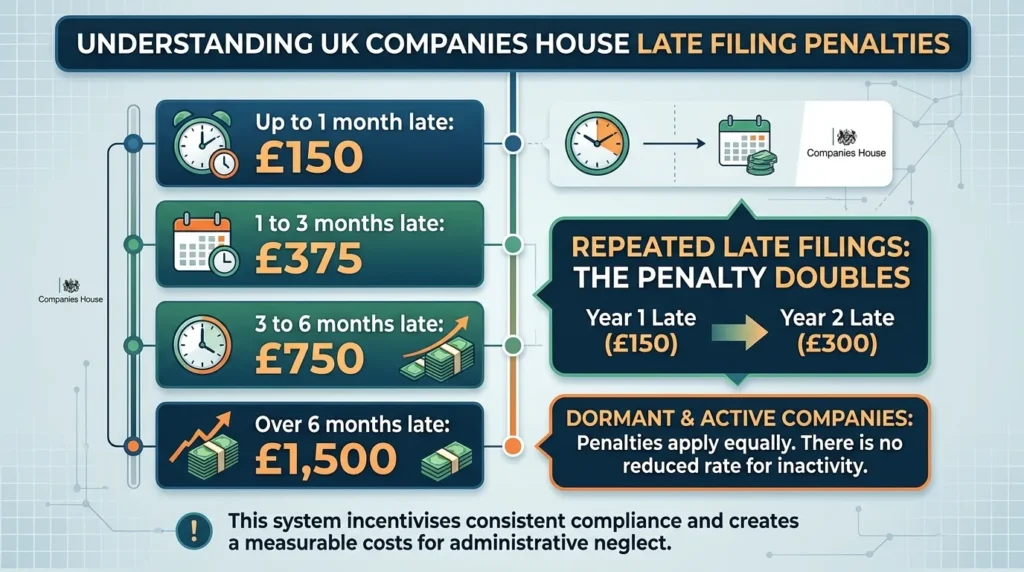
Late filing penalties are calculated based on the length of delay, starting at £150 for filings up to one month late and increasing to £1,500 for delays over six months. Repeated late filings double the penalty for consecutive financial years.
The penalty structure follows a fixed escalation model:
- Up to 1 month late: £150
- 1 to 3 months late: £375
- 3 to 6 months late: £750
- Over 6 months late: £1,500
These penalties apply equally to dormant and active companies. There is no reduced rate for inactivity.
If a company files late in two consecutive years, Companies House automatically doubles the penalty. For example, a £150 penalty increases to £300 for repeated delays. This system incentivises consistent compliance. It also creates a measurable cost for administrative neglect, even in non-operational entities.
What qualifies as a dormant company under UK law?
A dormant company is defined as a company with no significant accounting transactions during a financial year. Transactions such as share issuance, filing fees, and penalties are excluded, but any operational activity disqualifies dormant status.
Dormancy depends on financial activity, not business intent. A company may plan future operations but still qualify as dormant if no transactions occur.
Examples of allowed transactions:
- Payment for shares during incorporation
- Filing fees paid to Companies House
- Penalties for late submissions
Examples of disqualifying transactions:
- Receiving income from clients
- Paying suppliers or employees
- Bank interest charges or service fees
Accurate classification is critical. Incorrectly claiming dormant status can lead to compliance issues and potential investigations.
What happens if you ignore late filing penalties?
Ignoring late filing penalties leads to escalating fines, potential company strike-off, and legal consequences for directors. Companies House may remove the company from the register, which can result in asset forfeiture and loss of legal protections.
The enforcement process begins with penalty notices—continued non-compliance triggers further action, including strike-off procedures. Companies House publishes a notice in the Gazette, signalling the intent to dissolve the company.
If the company is struck off:
- Assets transfer to the Crown under bona vacantia rules.
- Directors lose control of the company structure.
- Legal liabilities remain enforceable.
Ignoring penalties does not eliminate them. The obligation persists, and additional enforcement measures increase financial and legal risks.
How can directors prevent late filing penalties?
Directors prevent late filing penalties by tracking deadlines, maintaining accurate records, and submitting accounts early. Using professional services ensures compliance with filing requirements and reduces the risk of administrative errors that lead to penalties.
Effective compliance relies on structured processes. Directors must monitor key dates and prepare filings in advance. Relying on last-minute submissions increases the risk of delays due to technical or documentation issues.
Three practical actions improve compliance:
- Track deadlines using digital reminders or compliance software.
- Prepare accounts at least 30 days before submission deadlines.
- Verify filing status through Companies House confirmation receipts.
Professional support strengthens compliance accuracy. Services like File Accounts for Dormant Companies ensure that responsible individuals are correctly registered and accountable for filings. This reduces governance gaps and improves oversight.
For structured compliance management, businesses often rely on a formal File Accounts for Dormant Companies that ensures accurate director records and accountability alignment. Learn more about the process through this File Accounts for Dormant Companies.
Why do administrative errors still lead to penalties?
Administrative errors lead to penalties because Companies House enforces strict liability rules. Filing deadlines are fixed, and errors such as incorrect forms, missed submissions, or system failures do not exempt companies from penalties once deadlines pass.
The compliance system does not assess intent. It evaluates outcomes. If accounts are not successfully filed by the deadline, the penalty applies regardless of the reason.
Common administrative errors include:
- Submitting incorrect account formats
- Failing to complete the authentication codes
- Missing confirmation of successful submission
Digital filing systems provide confirmation receipts. Without this confirmation, the filing is not considered complete. Directors must verify submission status to ensure compliance. Incorrect templates create additional risks. Filing errors often originate from using outdated or non-compliant formats. This increases the likelihood of rejection and delays.
A deeper explanation of this issue is covered in Understanding the Risks of Using Incorrect Templates for Your Dormant Company Accounts, which explains how formatting errors directly impact compliance outcomes.
How does proper director management impact compliance?
Proper director management ensures accountability for statutory filings, reduces compliance risks, and aligns legal responsibilities with operational oversight. Accurate director records enable clear responsibility for filing deadlines and regulatory obligations.
Every company must have at least one director responsible for compliance. This role includes submitting accounts, confirming company details, and maintaining statutory records. Misalignment in director records creates gaps in accountability. If the listed director is inactive or incorrect, filing responsibilities may be overlooked. This increases the risk of missed deadlines.
A structured File Accounts for Dormant Companies process ensures that:
- Directors are correctly registered with Companies House
- Responsibilities are clearly assigned
- Compliance obligations are actively monitored
Accurate director data also supports identity verification processes. This strengthens regulatory oversight and reduces the risk of fraudulent activity within dormant companies.
Explore our File Accounts for Dormant Companies guides,
The Essential Checklist for Maintaining a Dormant Limited Company in the UK
How to Protect Your Inactive Company Name Without Running Active Business Operations
What are the long-term risks of repeated late filings?
Repeated late filings damage a company’s compliance record, increase financial penalties, and raise red flags with regulatory authorities. Persistent non-compliance can lead to stricter scrutiny, reduced credibility, and potential disqualification of directors.
Compliance history forms part of a company’s public record. Stakeholders, including lenders and partners, may review this information when assessing credibility.
Repeated penalties signal poor governance. This affects:
- Access to financing
- Business partnerships
- Regulatory trust
Directors face personal consequences in severe cases. Persistent non-compliance can lead to disqualification proceedings under the Company Directors Disqualification Act. Maintaining a clean compliance record protects both the company and its directors from long-term operational and legal risks.
Late filing penalties apply because legal obligations depend on company registration, not trading activity. Dormant companies remain subject to strict filing requirements, and failure to comply results in automatic penalties and escalating enforcement actions.
From My Company ensures structured compliance through accurate director management and filing support. Their File Accounts for Dormant Companies aligns accountability with regulatory obligations, reducing the risk of missed deadlines and penalties. Businesses seeking reliable compliance outcomes often combine this with Secure Your Company Compliance by Purchasing Our Expert Dormant Account Support Service to maintain consistent filing accuracy and regulatory alignment.
Frequently Asked Questions
Do dormant companies still need to file accounts?
Yes. From My company notes that File Accounts for Dormant Companies are still required with Companies House each year, even when the company has not traded. Dormant accounts confirm no significant accounting transactions occurred during the financial period.
What counts as a dormant company for filing purposes?
A company is dormant when it has no significant accounting transactions during the year. This usually means no trading income, salary payments, or supplier costs, although a few legal transactions may still be allowed.
When is the deadline to file dormant company accounts?
Dormant company accounts are usually due within 9 months of the company’s year-end. If the company misses that deadline, Companies House can issue late filing penalties.
Can a dormant company file accounts online?
Yes. File Accounts for Dormant Companies can usually be submitted online using the company’s authentication code and registered details. The filing must match Companies House requirements to be accepted.
Why is filing dormant accounts important?
Filing dormant accounts keeps the company compliant and prevents penalties or strike-off action. From My company uses Director Appointment and compliance support processes to keep statutory records accurate and up to date.