
UK proof of address is an official document that confirms your name and residential address. Commonly accepted proof of address documents include utility bills, bank statements, council tax bills, tenancy agreements and official HMRC letters. The exact requirements depend on the organisation checking your documents, so always confirm its accepted document list before submitting your evidence.
If you are completing identity checks for a UK company, preparing suitable proof of address can help prevent unnecessary delays. Form My Company provides an Identity Verification Service for directors and people with significant control, also known as PSCs.
What Is Proof of Address?
Proof of address is documentary evidence that connects an individual to a residential address. Banks, financial service providers, identity verification services and other organisations may request it as part of their customer checks.
A valid document usually needs to show your full name, residential address, issuing organisation and a relevant date. The document must be genuine, readable and consistent with the personal details supplied during verification.
Proof of address is sometimes described as proof of residency. However, requirements differ according to the purpose of the check. A document accepted by a bank may not automatically meet the requirements of another provider or a specific identity verification process.
What Proof of Address Documents Are Accepted in the UK?
The following table summarises common document types that organisations may accept. It is a general guide, not a guarantee that every provider will accept every document.
| Document type | What to check |
|---|---|
| Gas or electricity bill | Your name, residential address, bill date and recognised supplier |
| Water bill | Your name, address and recent issue date |
| Bank statement | Official statement showing your name and residential address |
| Building society statement | Account holder details and address clearly displayed |
| Council tax bill | Your name, property address and relevant billing period |
| Tenancy agreement | Your name, rental property address, signatures and tenancy dates |
| Mortgage statement | Your name, property address, lender and statement date |
| HMRC letter | Official correspondence showing your name and address |
| Government benefit letter | Your name, address and details required by the checking organisation |
| Other official correspondence | Acceptance depends on the issuer, document type and verification rules |
Before submitting a document, check the organisation’s rules about acceptable issuers, document dates, original documents and digital copies.
Which Utility Bills Count as Proof of Address?
Utility bills can be used as proof of address when they display the required personal and address details. Common examples include gas, electricity and water bills. Some organisations also accept landline telephone bills.
A qualifying bill should generally include:
Your full name.
Your current residential address.
The utility provider’s name or identifying details.
A bill date that meets the organisation’s recency requirements.
Mobile phone bills are not universally accepted. Likewise, prepaid top-up receipts, payment confirmations and screenshots may not contain enough information to establish your address.
If a bill is issued in a company name rather than your personal name, do not assume it will prove your residential address. Check whether the provider permits business documents for the particular verification purpose.
For further guidance, see our related articles on documents accepted for business and identity verification and preparing documents for verification.
Are Bank and Building Society Statements Accepted?
Yes, bank and building society statements are commonly used as proof of address, provided they meet the organisation’s requirements.
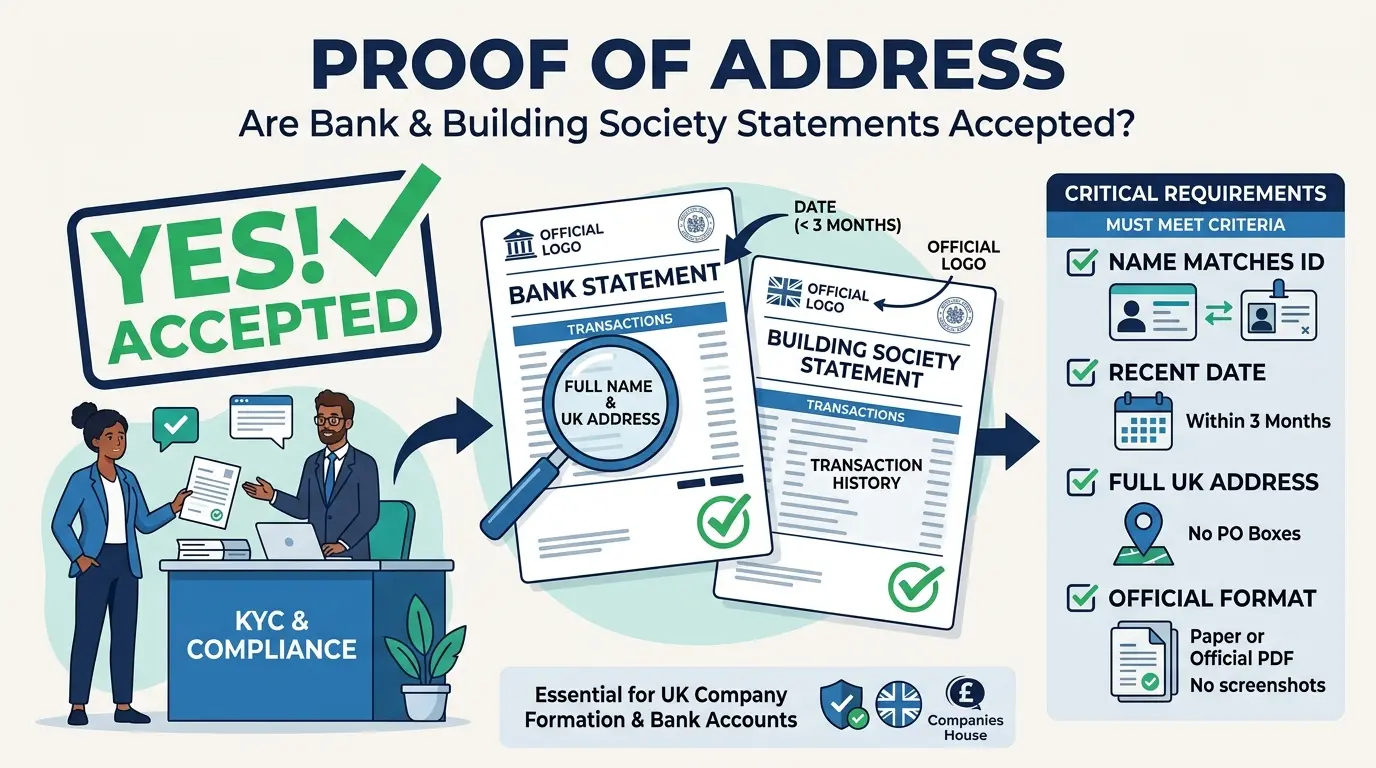
The statement should clearly identify the account holder and display the address being verified. An official statement downloaded as a PDF from online banking may be accepted, but acceptance of digital documents depends on the provider’s rules.
Screenshots showing only part of an online account may be rejected because they do not provide enough information to verify the document’s source or authenticity. Where possible, download the complete statement from the bank’s official service.
If your statement shows an old address, update your details with the bank and obtain a new statement before submitting it. A document containing an address that does not match your application can lead to additional checks.
Is a Council Tax Bill Proof of Address?
A council tax bill is commonly accepted as proof of address because it can identify the resident and the property linked to the account.
Check that the bill shows your name, the relevant property address and the billing period. Do not assume that every council tax document or payment receipt will meet the same requirements.
The acceptable age of a council tax bill varies by organisation and verification process. Some checks may permit documents older than the standard period used for other evidence, while others apply stricter rules. Confirm the required date range before submitting it.
If you have recently moved and have not received a council tax bill, ask the organisation checking your identity whether it accepts a council registration letter, tenancy agreement or another recent official document.
Is a Tenancy Agreement Proof of Address?
A tenancy agreement can count as proof of address when the organisation accepts rental documents and the agreement contains sufficient evidence of your residence.
Check that it includes your name, the property’s full address, the tenancy start date and the relevant signatures or other required details. An informal rent receipt or an unsigned document may not provide enough evidence.
A tenancy agreement may be particularly useful if you have recently moved and have not yet received a utility bill or bank statement at your new address. However, some organisations require a second document or a more recent form of evidence.
If your tenancy agreement is not accepted, ask the provider which alternative documents it allows. Do not assume that a rental contract will be accepted for every bank, financial service or identity check.
HMRC Proof of Address: Which Letters Can You Use?
HMRC correspondence may be accepted as proof of address when it displays your name and address and meets the receiving organisation’s requirements.
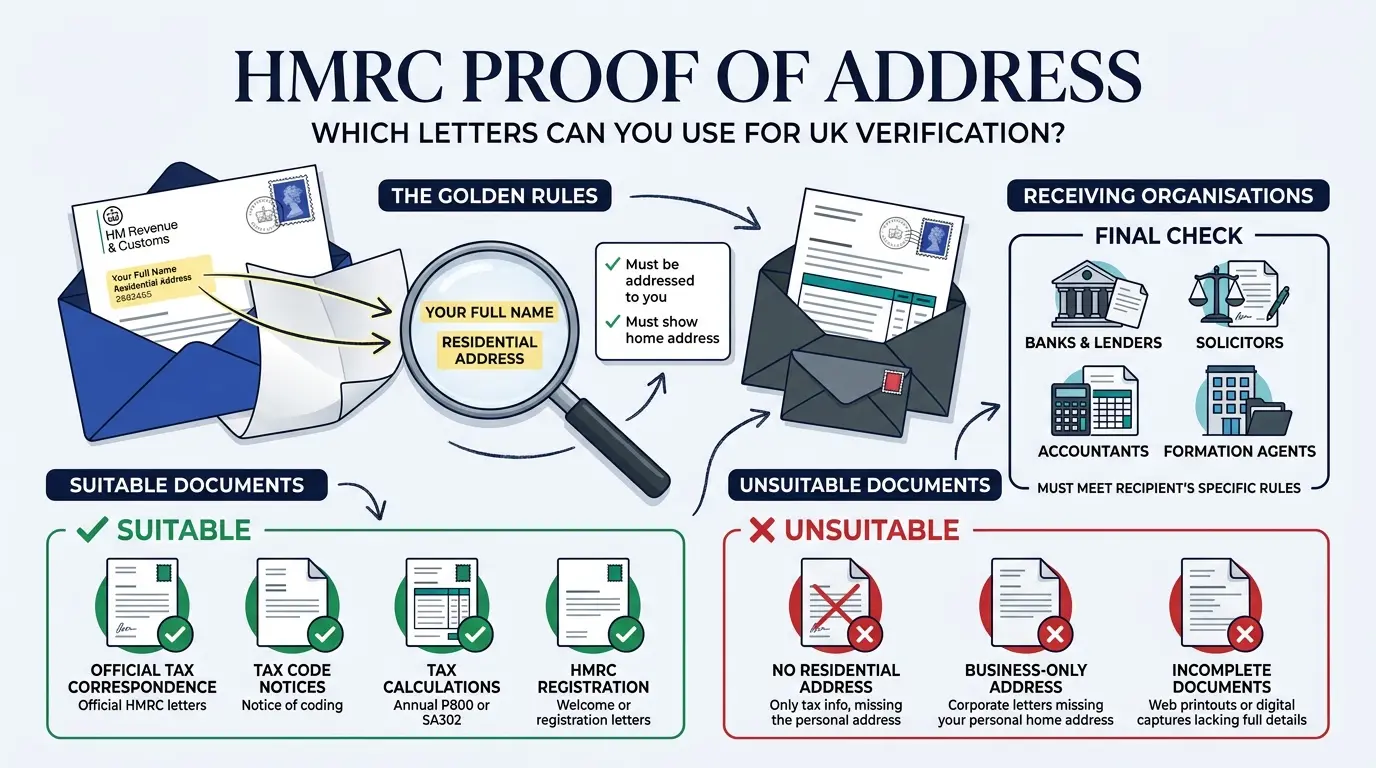
Examples of relevant documents may include official tax correspondence or other HMRC letters containing the required details. A document that confirms tax information but does not show your residential address may not be suitable.
Download or retain the complete official document rather than submitting a cropped screenshot. Check the issue date and ensure that the address matches the information supplied during verification.
The same principle applies to letters from other government bodies. An official sender alone does not guarantee acceptance: the document must contain the information required for the specific check.
Can Digital Documents and Online Statements Be Used?
Digital documents may be accepted when they are issued through an official service and contain the necessary information. Examples include complete PDF bank statements and utility bills downloaded from a provider’s online account.
Before uploading a digital document, check that:
The complete document is visible.
Your full name and address are readable.
The issuing organisation can be identified.
The issue date is visible.
The file has not been edited or altered.
A screenshot, email notification or payment confirmation may not be equivalent to an official statement. If the verification provider specifies a PDF or another file format, follow those instructions.
What Documents Are Not Accepted as Proof of Address?
Documents may be rejected when they do not establish a reliable connection between your identity and your residential address.
Potential problems include:
Documents that do not display your full name or address.
Old documents outside the provider’s permitted date range.
Cropped screenshots that omit the issuer or issue date.
Handwritten notes or informal letters that the provider does not accept.
Receipts that show a payment but do not confirm residence.
Documents containing inconsistent personal details.
Altered, incomplete or unreadable files.
Documents issued to another person when your name is required.
An electoral register entry, insurance document or letter from a landlord may be accepted by some organisations but not others. Check the relevant list instead of relying on a general assumption that a document is valid.
How Recent Must Proof of Address Be?
There is no single date limit that applies to every proof of address document in every situation. Many organisations request recent evidence, often issued within the previous three months. Some document categories may be subject to different limits.
The organisation conducting the check determines which issue dates it accepts. Council tax bills, mortgage statements and tenancy agreements may be assessed under different rules from bank statements or utility bills.
If your document is outside the required date range, obtain a newer document from an accepted issuer. For someone who has recently moved, a tenancy agreement may help explain the change of address, but the provider may still request additional evidence.
How to Get Proof of Address If You Do Not Have One
If you do not currently have an accepted proof of address document, start by checking which alternatives the organisation permits. You may already have suitable evidence available through an official online account.
Consider these steps:
Download an official bank statement. Check whether your bank statement shows your current residential address and meets the required date range.
Request a utility bill. Contact your supplier if your name or address is missing or incorrect.
Obtain your council tax correspondence. If you are registered for council tax, check whether you can download the bill or request a copy.
Use your tenancy agreement if permitted. Confirm that it contains your name, property address and relevant dates.
Check official HMRC correspondence. Look for a document that displays the details required by the organisation.
Ask about alternative evidence. If you have recently moved or live overseas, request the provider’s rules for your circumstances before uploading documents.
Do not create or edit a document to make it appear acceptable. If your circumstances are unusual, explain them to the organisation and ask which legitimate alternatives it can review.
Proof of Address for Company Directors and PSCs
Company directors and people with significant control may need to complete identity verification as part of UK company compliance. The documents and process depend on the verification route being used.
Companies House identity verification is a specific process, and the evidence required should be checked against the current official guidance. The documents needed for a bank account or another customer verification process may be different.
If you are preparing company documents, ensure that the personal details you provide are accurate and consistent. For additional context, read our guide on what a person with significant control actually means and our article about documents UK banks need to open a company account.
Form My Company offers an Identity Verification Service for directors and PSCs. Before using any service, confirm which documents are required for your circumstances and whether the provider is authorised to carry out the verification you need.
How Proof of Address Supports KYC and Compliance
Know Your Customer, commonly known as KYC, describes checks used by organisations to establish and verify customer identity. Proof of address can form part of these checks, depending on the service and applicable requirements.
For businesses, keeping identity information accurate helps support customer onboarding and recordkeeping. However, proof of address is not the same as full identity verification, and one document does not automatically satisfy every legal or regulatory obligation.
Companies House identity verification has its own requirements. Read the current Companies House identity verification guidance for details about the official process and the roles it covers.
Frequently Asked Questions
What counts as proof of address in the UK?
Common examples include utility bills, bank statements, council tax bills, tenancy agreements and official government correspondence. Acceptance depends on the organisation, the document’s contents and its date.
What is a proof of address document?
It is an official document used to confirm a person’s residential address. It generally needs to show the person’s name, address, issuer and a relevant date.
Is a council tax bill proof of address?
A council tax bill is commonly accepted if it shows your name and property address and meets the organisation’s requirements. Check the permitted document age before submitting it.
Does a tenancy agreement count as proof of address?
It can. The agreement should contain your name, the property’s address and relevant tenancy details. Some organisations may require additional or more recent evidence.
Can I use an HMRC letter as proof of address?
An HMRC letter may be accepted if it displays your name and residential address and meets the receiving organisation’s requirements. Not every HMRC document contains the necessary address information.
How recent does proof of address need to be?
Many organisations request documents issued within three months, but the rules vary by provider and document type. Always check the specific requirements for your verification.
Can I use a digital bank statement?
An official PDF downloaded from your bank may be accepted if it displays the required information. Screenshots and incomplete online records may not be sufficient.
What can I use if I do not have a utility bill?
Depending on the provider’s rules, alternatives may include a bank statement, council tax bill, tenancy agreement or official government letter. Ask the organisation which documents it accepts.
Is proof of address the same as proof of residency?
The terms are related, but they are not always interchangeable. Proof of address confirms the address shown on a document, while proof of residency may involve additional requirements depending on the purpose of the check.