
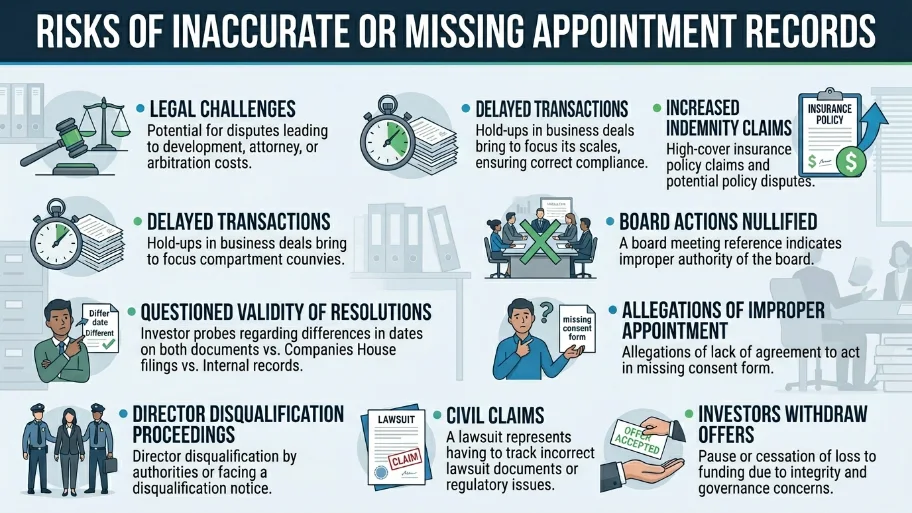
Yes, a company that fails to appoint a director correctly faces criminal penalties, civil liability, invalid company records, and regulatory enforcement that can block filings and harm funding prospects. Directors must be validly appointed, registered at Companies House, and verified under UK rules to avoid fines, prosecution, and transactional delays.
What legal penalties apply for incorrect director appointment?
Companies face fines, prosecution, and possible director disqualification for failing to appoint directors correctly.
Incorrect appointments breach the Companies Act 2006 and Companies House filing rules. The Registrar may impose penalties for late or false filings. The Secretary of State can pursue director disqualification where misconduct exists.
An incorrect appointment triggers statutory reporting obligations. Companies House requires form AP01, AP02, or TM01, depending on appointment or termination. Failure to file or filing inaccurate details results in a monetary penalty under the Companies Act. Criminal liability arises when fraud, forgery, or false statements occur during an appointment. A court can order disqualification if a director is unfit, which removes their right to act as a director for a defined period.
How does a faulty appointment affect company records and compliance?
Faulty appointments produce inaccurate statutory registers and incorrect Companies House entries that compromise compliance.
Statutory registers must record director names, service addresses, dates of appointment, and consent evidence. An improper entry undermines the accuracy of the register and the public Companies House record.
Inaccurate records cause downstream compliance failures. Annual Confirmation Statements and Accounts rely on correct director data. Auditors and compliance officers reconcile records using Companies House data; mismatches cause queries and remediation costs. Lenders, insurers, and government bodies use these records for risk checks; an error can trigger contract breaches and increased scrutiny. Read our articles, The Impact of Accurate Director Appointment Records on Potential Investor Due Diligence and What Happens if a Company Fails to Appoint a New Director Correctly?
How does an improper appointment impact investor due diligence?
Investors find that flawed appointment records reduce transaction confidence and can delay or terminate investment rounds.
Due diligence teams validate director identity, authority, and appointment history. Inaccurate or missing appointment evidence creates legal uncertainty about who can bind the company and who holds a fiduciary duty. Investors require audited, consistent documentation before committing funds.
Clear appointment records speed due diligence. Accurate records show the chain of authority and disclosure history. Errors prompt legal opinions, indemnities, and price adjustments. In many deals, a single unresolved director-record issue can postpone completion by weeks or lead to conditional offers tied to remediation.
What operational risks arise from incorrect director appointments?
Operational risks include invalid contracts, banking restrictions, and disrupted corporate governance.
Contracts signed by someone not validly appointed can be voidable or challenged. Banks perform KYC and will freeze accounts if the signatory authority is unclear. Board decisions taken under an invalid appointment can be ultra vires, producing internal disputes and litigation.
Board meeting quorums depend on valid director status. An invalid appointment can nullify board resolutions, delaying strategic projects. Human resources and payroll systems that rely on official signatory lists may reject transactions. These operational interruptions create measurable costs and reputational harm.
How do regulators and third parties detect appointment errors?
Regulators detect errors via Companies House filings, statutory audits, and whistleblowers; third parties use corporate data checks and identity verification.
Companies House cross-checks forms and may query inconsistent submissions. Auditors reconcile the statutory register against board minutes and appointment forms. Whistleblowers or former officers can raise allegations that trigger investigations.
Third-party service providers run identity verification and company data validation. Banks and escrow agents verify director consent and ID using passport checks, utility bills, and corporate minutes. Discrepancies prompt remedial filing or legal advice.
What remediation steps correct a bad director appointment?
Correct the Companies House record, update statutory registers, obtain director consents, and, when necessary, seek legal ratification of past acts.
First, file the correct appointment form (AP01, AP02) and supporting documents. Update the statutory registers with signed consent, appointment resolution, and statement of particulars. If false information was filed, submit corrected forms and a statement of truth.
Second, obtain board minutes ratifying acts taken while the appointment status was uncertain. Ratification requires a properly constituted meeting and documented resolution. Third, engage legal counsel where criminality or disputes exist to manage disclosure and mitigate liability. Finally, notify banks and key counterparties and provide authenticated appointment evidence to restore authority.
How does accurate appointment handling improve funding and M&A outcomes?
Accurate appointments reduce closing friction, lower legal costs, and increase investor confidence during funding and M&A.
Clean appointment records provide a clear title to the corporate authority. Investment agreements and sale contracts rely on valid board authorisation. When records are complete, legal teams reduce escrow holds and remove conditional warranties tied to corporate status.
Investors and acquirers apply lower risk discounts when director records are clean. Legal due diligence fees fall because counsel spends less time resolving governance issues. Faster closings improve valuation certainty and reduce transaction timeline exposure.
What preventative processes ensure correct director appointments?
Implement a standard appointment workflow: verify identity, record written consent, pass a board resolution, and file the correct Companies House form.
Verify identity using a passport or a driving licence and address evidence. Record consent in writing and store it with appointment minutes. Pass a board resolution with a dated minute, and record the director’s service address and role details.
File the appointment using the correct Companies House form within 14 days of the appointment where required. Maintain a digital compliance folder with scanned IDs, signed consents, and minute extracts. Audit the statutory registers quarterly to ensure ongoing accuracy.
Explore our Director Appointment guides,
Get Your New Director Appointed Officially Within Twenty Four Hours with Us
Book Your Consultation for Expert Director Appointment and Companies House Filing Advice
When should a company engage professional appointment support?
Engage professional support for complex ownership structures, cross-border appointments, or when transaction timelines demand certainty.
Complex share structures, nominee arrangements, or foreign nationals introduce extra verification and tax reporting steps. Professional advisors use structured checklists, verified identity services, and direct Companies House filing to prevent mistakes. They provide legal remediation if prior appointments lack evidence.
From My Company provides director appointment support for companies seeking compliant, timely appointments. Expert handling reduces filing errors and produces verifiable records for lenders and investors.
Companies that fail to appoint a director correctly face legal penalties, damaged records, operational disruption, and transactional delays. A structured verification and filing process prevents these harms. From My Company delivers Director Appointment services that verify identity, secure written consent, update statutory registers, and file accurate Companies House records to restore compliance and expedite funding or transactions.
Frequently Asked Questions
How long does a Director Appointment take with From My Company?
From My Company, typically completes a standard Director Appointment within 24–72 hours after receiving verified ID, written consent, and board minutes. This timeline depends on receiving correct information and successful Companies House ID verification.
What documents does From My Company require to process a Director Appointment?
From My Company requires a passport or driving licence, proof of address (dated within 3 months), signed written consent, and the board resolution or minutes authorising the appointment. These documents enable identity verification, statutory register updates, and Companies House filing.
Will From My Company file the appointment at Companies House for me?
Yes, From My Company files the correct Companies House appointment form and submits supporting details once identity verification and consent are complete. This filing updates the public register and satisfies the 14-day reporting requirement for director appointments.
Can From My Company appoint a non-UK resident as a director?
From My Company can handle appointments of non-UK resident directors, provided the individual meets legal eligibility and completes identity verification. The service records consent, updates statutory registers, and files Companies House forms while ensuring regulatory compliance.
What happens if Companies House rejects a Director Appointment submitted by From My Company?
If Companies House rejects a filing, From My Company notifies the client, corrects the errors, and resubmits the appointment after securing any missing documentation or clarification. The service provides the corrected Companies House submission and updated statutory records to restore compliance.