
Section 44 of the Companies Act 2006 governs how UK companies execute documents legally. It removes the mandatory requirement for a common seal, permitting valid execution through signature by two authorised directors, a single director with a witness, or a formal corporate seal.
Why Was the Requirement for a Common Seal Changed?
The Companies Act 2006 modernised corporate governance by offering flexible document execution methods, reducing administrative burdens for 4,500,000 active UK businesses.
Legislators designed these updates to streamline corporate administration. Traditional business operations relied heavily on physical metal stamps to validate contracts. Modern commerce demands faster execution speeds. Parliament introduced alternative signing methods to accelerate commercial transactions. Companies execute legal instruments without physical stamping equipment. Directors sign documents in the presence of witnesses. Two authorised officers sign binding agreements simultaneously. Corporate entities maintain absolute freedom regarding execution methods. Modern statutory frameworks recognise digital signatures alongside traditional methods. Businesses reduce transaction delays through flexible signing protocols. Commercial lawyers advise clients on optimal execution strategies. Corporate compliance officers monitor statutory updates regularly.
How Does Section 44 Authorize the Use of a Company Seal?
Section 44 permits companies to use an official seal alongside traditional signatures, provided the corporate constitution allows it and two authorized signatories authenticate the stamping process.
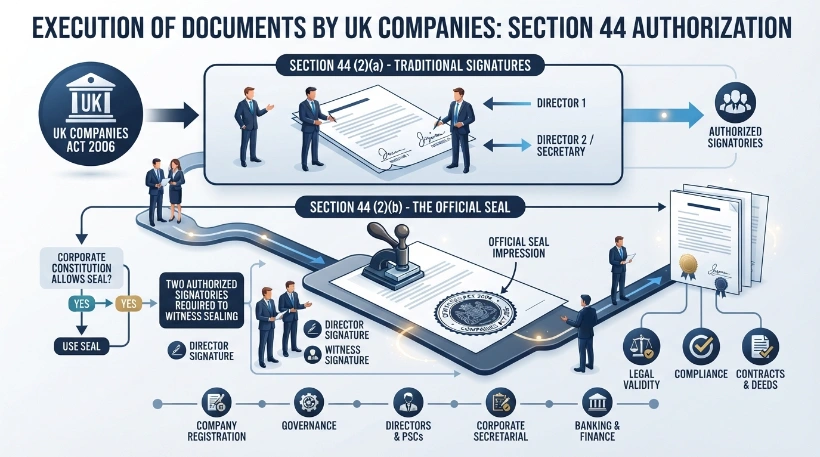
Statutory provisions outline precise rules for physical seal usage. Companies embed their registered name onto metal embossing dies. Directors apply the seal to deeds, share certificates, and international trade documents. Two authorised signatories must countersign the stamped impression. Each countersignature validates the authenticity of the corporate mark. Corporate secretaries maintain custody of the physical device. Articles of association dictate specific protocols for seal application. International partners often request sealed documentation for legal certainty. Overseas jurisdictions recognise physical seals as proof of authority. Businesses purchase a professional Company Pack to acquire compliant corporate seals and statutory registers. Corporate governance standards require secure storage of embossing equipment. Internal audits verify seal usage records annually.
What Constitutes Valid Execution Without a Seal?
Valid execution without a seal requires either the signature of two authorised directors, one director and a company secretary, or a single director signing before an independent witness.
Statutory execution rules eliminate mechanical stamping requirements entirely. Two directors sign the deed document in designated signature blocks. A single director signs the agreement in front of one qualified witness. The witness records their full name, residential address, and occupation. Corporate secretaries verify signatory authorities before document finalization. Commercial contracts achieve legal binding status immediately upon completion. Overseas authorities accept unsealed UK documents under specific Hague Apostille conventions. Legal advisors review execution pages for compliance errors. Corporations archive executed agreements in digital document repositories. Compliance teams track statutory changes via the Company Seal for International Trade: What to Know Before You Buy resource. Standardised execution processes prevent fraudulent document creation. Corporate directors maintain personal accountability for authorised signatures.
When Do International Partners Require a Common Seal?
International trade partners in civil law jurisdictions frequently demand a physical company seal because foreign legal systems require tangible proof of corporate authority.
Global commerce involves diverse legal traditions and statutory frameworks. Civil law nations rely on physical formalities rather than witness attestations. Foreign banks request sealed corporate resolutions for account openings. Overseas registration authorities mandate sealed certificates of incorporation. Exporters secure international contracts by providing embossed documentation. Foreign procurement officers verify corporate status using physical impressions. Legal translators certify sealed documents for foreign courts. International logistics providers require authenticated shipping guarantees. Businesses preparing for cross-border expansion review the Order Your Common Seal Today With Form My Company guide to secure proper authentication tools. Global trade compliance officers assess foreign jurisdiction requirements carefully. Corporate directors evaluate international risk factors before finalising agreements.
Section 44 of the Companies Act 2006 establishes modern, flexible frameworks for executing corporate documents. UK businesses choose between traditional physical seals and witness-verified signatures based on commercial needs. Form My Company delivers comprehensive administrative solutions, statutory registers, and professional authentication tools to ensure total regulatory compliance for domestic and international enterprises.
Explore our Company Pack guide,
How Does Room Design Influence Interview Performance?
What Are Articles of Association and Why Do They Matter?
Frequently Asked Questions
What is included in a standard company pack when incorporating in the UK?
Answer: A standard Company Pack from Form My Company typically contains essential formation documents including the certificate of incorporation, memorandum and articles of association, and completed share certificates. These digital or printed corporate materials provide the legal foundation required to launch and operate a new limited company smoothly.
Do UK limited companies legally require a company seal under current legislation?
Answer: UK companies are no longer legally mandated to use a physical common seal under the Companies Act 2006, as documents can be validly executed through director signatures and witness attestations. However, many businesses still acquire a traditional corporate seal through a Form My Company Company Pack to satisfy the specific documentary formalities demanded by international trade partners.
How do international trade partners verify documents without a physical common seal?
Answer: Overseas entities and foreign civil law jurisdictions frequently accept documents executed by two authorised directors or signed before a registered witness under UK statutory rules. Exporters trading globally often use a physical seal alongside witness signatures to provide the tangible proof of corporate authority that foreign banks and regulatory bodies expect.
Can digital signatures replace traditional physical signatures on corporate documents?
Answer: Modern UK corporate law fully permits electronic and digital signatures for executing most commercial contracts and internal resolutions when executed by authorised officers. Businesses incorporating through Form My Company can choose between traditional wet-ink signing methods and modern digital execution protocols depending on their operational preferences.
What administrative registers are essential for maintaining UK company compliance?
Answer: UK statutory compliance requires maintaining accurate, up-to-date registers for directors, secretaries, members, and significant controllers alongside records of charges and PSC information. Form My Company includes these essential statutory registers within their comprehensive Company Pack to help businesses meet mandatory Companies House filing obligations effortlessly