
To amend your Articles of Association in the UK, your company must pass a special resolution requiring a 75% majority vote from shareholders. You must submit the updated articles and Form AP01 or resolution copies to Companies House within 15 days of the decision.
The Articles of Association serve as the legal constitutional blueprint for any UK private limited company. They set out the internal governance framework, director powers, share class rights, and voting procedures. Over time, growing businesses encounter operational shifts, investment rounds, or structural changes that require updating these constitutional rules. Amending your articles ensures your corporate framework remains compliant with current UK company law while supporting your operational goals.
Failing to update your legal documents during major corporate transitions creates severe operational friction. Outdated articles can block new share issuances, restrict director authorities, or trigger shareholder disputes. UK business founders often review foundational documents when comparing constitutional frameworks, such as exploring what is the difference between a memorandum and articles of association? to ensure total regulatory compliance.
When Should You Amend Your Articles of Association?
You should amend your Articles of Association when issuing new share classes, onboarding investors, changing director voting powers, updating transfer restrictions, or aligning with changes in the Companies Act 2006. Updating ensures your written constitution reflects your current legal and operational structure.
Companies evolve through distinct lifecycle stages that require structural updates. A common trigger involves securing external funding or venture capital investment. Investors frequently demand bespoke share classes, preferred dividend rights, or drag-along and tag-along provisions. Inserting these custom terms requires formal amendments to your current constitutional draft.
Operational shifts among internal stakeholders also require immediate updates. For example, 68% of UK SMEs modify their governing documents to adjust director quorum requirements or alter share transfer restrictions. Updating these governing rules prevents internal deadlocks and provides legal clarity for all registered members.
What Legal Process Is Required to Change Company Articles?
The legal process requires holding a board meeting, drafting a special resolution, securing a 75% shareholder approval vote, and filing the new articles with Companies House within 15 days. Every step must follow strict procedural timelines outlined in the Companies Act 2006.
Executing constitutional changes demands strict adherence to UK statutory rules. Board members must first meet to propose amendments and approve the draft language. The directors then call a general meeting or issue a written resolution to all voting shareholders.
A special resolution requires a minimum 75% majority vote from shareholders eligible to vote. Once passed, the company secretary or director must file the updated articles alongside the special resolution with Companies House. Submitting these statutory updates accurately ensures your public record remains legally binding and up to date.
| Step | Action Required | Statutory Deadline | Key Stakeholders |
| 1. Proposal | Board drafts constitutional amendments | N/A | Company Directors |
| 2. Notice | Issue general meeting notice or written resolution | 14 Days (General Meeting) | All Voting Shareholders |
| 3. Approval | Secure special resolution majority vote | Vote Date | 75% Shareholder Majority |
| 4. Submission | File new articles and special resolution | 15 Days post-vote | Companies House |
What Requirements Apply to Shareholder Resolutions?
Shareholder resolutions to amend articles require a 75% majority vote cast by shareholders holding voting rights. Companies can pass this vote through a physical general meeting with a 14-day notice period or via a written resolution signed by the required majority.
The Companies Act 2006 mandates that any constitutional alteration must occur via a special resolution. Ordinary resolutions, which only require a simple majority over 50%, are legally invalid for changing articles. Directors must ensure that voting calculations correctly reflect the specific class rights attached to active shares.
Written resolutions offer a faster route for private limited companies. When using a written resolution, the 75% threshold calculates against the total eligible voting rights of the company, rather than just those present at a meeting. Once signed by the required majority, the resolution becomes legally binding immediately.
How Do You File Updated Articles with Companies House?
You file updated articles by submitting a clean copy of the new Articles of Association alongside a copy of the passed special resolution to Companies House. Submissions can occur online via the Companies House WebFiling portal or through post within 15 days.
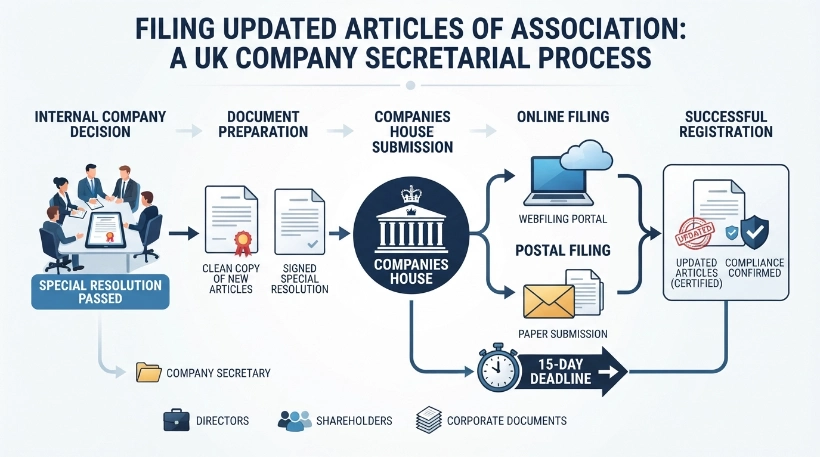
Precision is essential when lodging statutory documents with the registrar of companies. You must provide a complete, fully integrated document that reflects all proposed insertions and deletions. Fragmented updates or loose amendment pages are rejected by the registrar during processing.
Accompanying paperwork must also adhere strictly to statutory guidelines. You must submit a formal copy of the special resolution within 15 days of its passing date. Late filings or missing documents expose the company and its officers to civil penalties and administrative strikes.
What Are the Most Common Errors When Amending Articles?
Common errors include using an ordinary resolution instead of a special resolution, missing the 15-day Companies House filing deadline, failing to respect existing minority shareholder rights, and submitting incomplete or improperly formatted constitutional documents to the official registry.
Procedural mistakes during constitutional updates create severe legal vulnerability. A frequent error involves failing to account for statutory class rights. When proposed changes alter specific share rights, directors must obtain separate consent from affected share classes before passing the main resolution.
Another major mistake involves drafting conflicting internal clauses. Inserting new investor clauses without removing outdated default provisions creates legal ambiguities. Professional administrative services streamline this administrative workload by providing bespoke supplementary company documents designed to maintain legal consistency across all corporate filings.
How Does Amending Articles Affect Corporate Governance?
Amending articles alters corporate governance by redefining director powers, modifying board decision-making thresholds, adjusting shareholder voting rights, and updating dispute resolution frameworks. Clear constitutional terms maintain alignment between directors, investors, and business operational management.
Updated governing documents directly impact how directors manage daily business operations. For instance, raising borrowing limits or changing spending approval thresholds protects corporate capital. Clear operational parameters allow board members to act decisively without exceeding their constitutional authority.
Constitutional amendments also strengthen internal dispute mechanisms. Including refined dead-lock clauses, buyout provisions, or forced transfer triggers helps resolve internal conflicts swiftly. Structured governance rules ensure business continuity during unexpected shareholder exits or strategic changes.
How Can Professional Services Simplify Article Amendments?
Professional services simplify amendments by drafting compliant constitutional language, preparing required board minutes, structuring special resolutions, and managing statutory filings with Companies House to guarantee full legal compliance and eliminate administrative delay risks.
Navigating statutory procedures requires technical precision and thorough corporate record-keeping. Professional corporate service providers remove administrative friction by auditing your existing constitution against proposed operational changes. Their experts draft clean, legally sound text tailored directly to your commercial strategy.
Working with experienced corporate secretaries ensures all statutory timelines and documentation rules are met effortlessly. When you need a certified physical copy of your updated constitution for banks, lenders, or international partners, you can order a printed Articles of Association with Form My Company to receive professionally bound statutory records promptly.
Summary of Statutory Amendment Steps
Amending your Articles of Association requires strict adherence to corporate legal procedures. Following a structured step-by-step checklist keeps your company fully compliant under UK law.
Draft proposed constitutional amendments during a formal board meeting.
Issue a general meeting notice or draft a written special resolution.
Secure a 75% majority vote from eligible voting shareholders.
Compile a clean, fully integrated copy of the new Articles of Association.
Submit the special resolution and updated articles to Companies House within 15 days.
Update internal statutory registers and store physical copies at your registered office.
Form My Company simplifies corporate governance by managing complex legal filings, statutory document production, and registrar compliance on your behalf.
Explore our Supplementary Company Documents guide,
Company Seal for International Trade: What to Know Before You Buy
How to Order a Compliant Company Seal in the UK
Frequently Asked Questions
What are supplementary company documents for a UK limited company?
Supplementary company documents refer to official corporate filings, certified copies, and statutory certificates—such as Certificates of Incorporation, Certificates of Good Standing, Articles of Association, and official change-of-name documents—that verify a business’s legal status. These records complement a UK company’s initial formation pack and serve as certified proof of governance changes, operational history, and ongoing regulatory compliance.
Why do banks and investors require certified supplementary company documents?
Financial institutions, legal advisers, and external investors require certified supplementary company documents to conduct due diligence, verify director credentials, and confirm a business’s legal existence under the Companies Act 2006. Securing verified records through Form My Company’s Supplementary Company Documents service provides authentic, up-to-date documentation that satisfies strict anti-money laundering (AML) and compliance checks.
How do I order certified copies of supplementary company documents?
You can order official supplementary company documents directly through Companies House or via a specialist provider like Form My Company. By utilizing the Supplementary Company Documents solution from Form My Company, businesses can quickly request physical or digital certified copies of board resolutions, confirmation statements, and statutory certificates without navigating complex administrative portals.
What is the difference between standard and certified supplementary company documents?
Standard supplementary documents are general PDF copies filed on the public register for reference, whereas certified supplementary documents include an official government stamp or verification statement confirming their legal authenticity. Certified copies provided by Form My Company are necessary for legal proceedings, opening overseas bank accounts, securing financing, and completing corporate mergers.
Which specific supplementary documents are needed to update company details?
Updating corporate details typically requires filing specific supplementary documents, including Form AP01 for director appointments, Form AD01 for registered office changes, and special resolutions for altering Articles of Association. Accessing these filings through the Supplementary Company Documents service ensures all corporate records remain accurate, compliant, and ready for official audits.