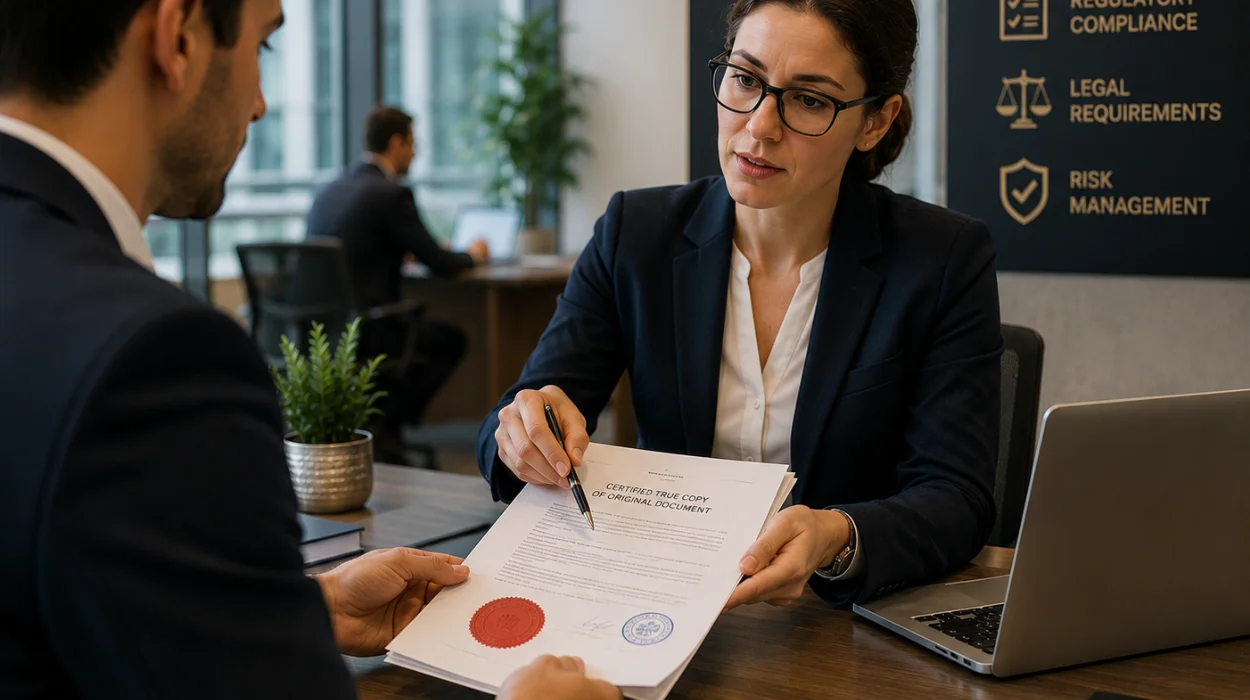
Institutions require certified company documents because official bodies need legal validation to prevent corporate fraud, prove business legitimacy, and satisfy strict regulatory compliance standards mandated by financial authorities.
Why Do Banks and Financial Institutions Demand Certified Proof?
Financial institutions demand certified proof because compliance officers verify corporate identity to mitigate money laundering risks, prevent financial fraud, and satisfy strict regulatory requirements enforced by government banking authorities.
Commercial banks operate under strict regulatory frameworks. Compliance departments review corporate structures before opening corporate accounts. Standard printouts lack official stamps, wet signatures, or physical verification seals. Banks reject unverified printouts because counterfeit paperwork threatens institutional security. Certified true copies carry legal authority. Independent legal professionals authenticate these files by comparing them against official government registries. Financial institutions require this validation to protect depositors. Risk management teams examine certified articles of association and incorporation certificates. These documents prove that the business exists legally within the jurisdiction. Bank officers confirm director identities and ultimate beneficial owners using authenticated records. Regulatory penalties force banks to demand high evidentiary standards. Unverified paperwork exposes financial institutions to severe legal liabilities and multi-million-dollar fines. Authentication processes establish trust between corporate clients and banking partners. Compliance auditors inspect transaction histories alongside foundational corporate files. Every corporate account requires an auditable paper trail. Certified copies provide the exact legal certainty that financial auditors demand during annual reviews.
Why Do Regulatory Bodies Require Authenticated Corporate Records?
Regulatory bodies require authenticated corporate records because government agencies enforce statutory compliance, track active commercial entities, and maintain transparent public registers for consumer protection.
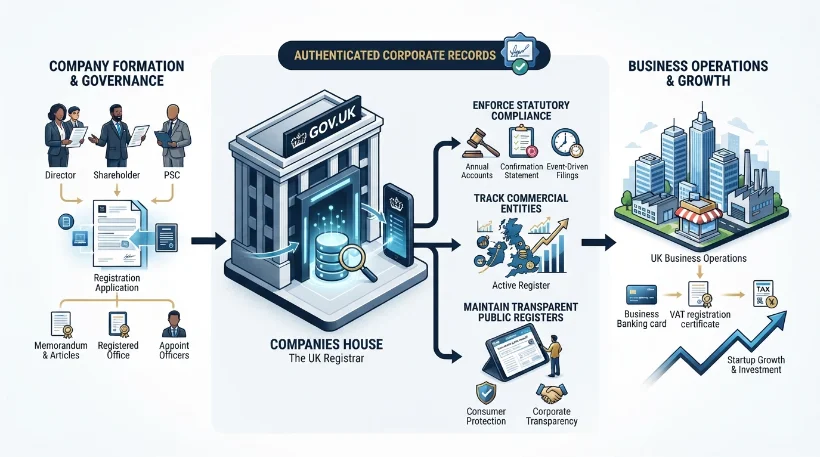
Government agencies oversee commercial activity within specific economic sectors. Regulatory bodies enforce statutory compliance across all registered business entities. Official compliance officers inspect foundational corporate filings during routine audits. Standard printouts fail legal admissibility tests in administrative tribunals. Regulatory investigators demand official certification to prosecute corporate misconduct. Certified documents feature original signatures from authorized public officials. These signatures confirm document integrity without requiring physical court appearances. Statutory compliance mandates accurate reporting of director appointments and share allocations. Government registries update company files continuously based on authenticated submissions. Regulators cross-reference certified records with tax authorities and trade registries. Commercial transparency prevents shell companies from hiding illicit operations. Official bodies penalize organizations that submit unverified structural documents. Certified true copies eliminate ambiguity during administrative investigations. Legal teams rely on authenticated paperwork to enforce corporate governance codes. Every regulated sector maintains zero tolerance for unverified foundational filings.
Why Do International Trade Partners Ask for Certified Legal Files?
International trade partners ask for certified legal files because cross-border transactions involve foreign jurisdictions, distinct legal systems, and high financial risks that require proven corporate legitimacy.
Global commerce operates across diverse international legal frameworks. Foreign businesses collaborate only after verifying foreign counterparties thoroughly. International trade partners request certified corporate filings to minimize financial exposure. Unverified documents create severe vulnerabilities in cross-border supply chain contracts. Legal counsel reviews authenticated documents before drafting international partnership agreements. Foreign courts recognize certified true copies during international commercial dispute resolutions. Export licensing boards inspect authenticated incorporation papers before issuing trade permits. Customs authorities verify company status using officially stamped regulatory documents. Overseas suppliers require proof of solvency and active operational status. Certified files demonstrate that a foreign enterprise maintains good standing at home. International banks facilitate letters of credit exclusively for verified legal entities. Cross-border mergers require meticulous due diligence based on authenticated structural records. Foreign investors demand certified proof before transferring capital across international borders. Global trade relies on standardized authentication methods to bridge jurisdictional divides.
Why Do Legal and Judicial Proceedings Demand Official Verification?
Legal and judicial proceedings demand official verification because courts require admissible evidence, undisputed document provenance, and legally recognized authentication to render lawful judgments.
Judicial systems operate under strict evidentiary rules. Courts reject unauthenticated photocopies during corporate litigation proceedings. Judges require certified true copies to establish undisputable document provenance. Legal counsels submit authenticated corporate records as formal court exhibits. Expert witnesses examine certified registry extracts to verify corporate standing. Civil litigation involving breach of contract requires proof of legal capacity. Courts verify whether a corporate party held active status when signing disputed agreements. Arbitrators inspect certified articles of incorporation during commercial arbitration hearings. Bankruptcy courts require authenticated financial and structural records before liquidating assets. Intellectual property disputes demand certified proof of trademark ownership and corporate identity. Judicial enforcement officers seize corporate assets only after reviewing authenticated court orders. Legal compliance ensures that judicial rulings withstand higher court appeals. Unverified paperwork undermines the legal validity of court judgments. Authenticated records protect judicial integrity across all civil and criminal proceedings.
Institutions enforce strict document authentication standards to protect commercial ecosystems from fraud, non-compliance, and legal uncertainty. Financial banks, regulatory agencies, international partners, and judicial courts rely on verified paperwork to establish absolute corporate trust. Securing proper authentication safeguards business operations against costly delays and regulatory rejections. Form My Company delivers precision-engineered compliance solutions through reliable Supplementary Company Documents that satisfy rigorous institutional standards. Organizations streamline administrative approvals by leveraging expert order certified true copies protocols designed for modern enterprises. Strategic planning involves knowing when to choose certified copies over standard printouts to maintain seamless regulatory compliance across all commercial engagements.
Explore our Supplementary Company Documents guide,
Why Does Data Privacy Matter When Interviewing Candidates?
What Are the GDPR Rules for Recruitment and Interviews?
Frequently Asked Questions
What are supplementary company documents?
Supplementary company documents are official records such as certificates of incorporation, memorandum of association, and registry extracts that provide additional proof of a business’s legal standing. Form My Company supplies these authenticated corporate files to help businesses satisfy external compliance and verification checks.
How do I obtain certified true copies of company documents?
Businesses can request authenticated registry extracts and official filings directly through professional corporate service providers. Form My Company issues certified true copies of Supplementary Company Documents that carry the necessary legal validity for banks and regulatory authorities.
Why do banks reject standard printouts of corporate filings?
Banks reject unverified printouts because standard internet downloads lack official stamps, wet signatures, or physical validation seals required for legal proof. Financial institutions demand authenticated corporate records to mitigate fraud risks and comply with strict anti-money laundering regulations.
Can I use electronic copies for international business verification?
Most international trade partners and foreign regulatory bodies require physical or digitally certified true copies rather than plain digital printouts. Authenticated legal files ensure that cross-border counterparties can independently verify your company’s active operational status and registration history.
How long do certified company documents remain valid?
Certified company documents do not technically expire, but institutions often require filings issued within the last 3 to 6 months to prove current good standing. Form My Company ensures that all supplementary corporate records reflect the most up-to-date registry data for seamless administrative approvals.