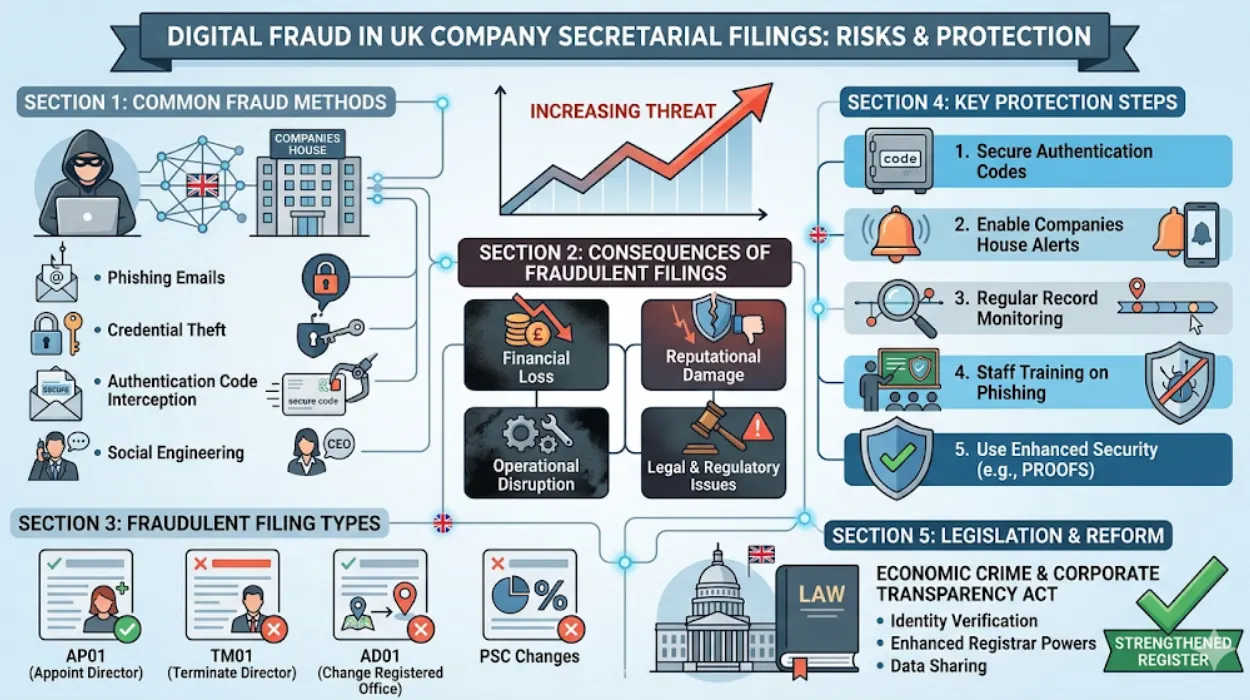
Digital fraud in UK company secretarial filings has surged due to vulnerabilities in Companies House systems, with unauthorised changes to director details and addresses reported in thousands of cases annually. Businesses can combat this by adopting secure filing codes and professional fraud protection services to safeguard their records.
Understanding the Surge in Digital Fraud
The landscape of company administration in the UK has shifted dramatically with the digitisation of Companies House processes. What began as a streamlined way to handle incorporations, annual returns, and director appointments has become a fertile ground for fraudsters. Cybercriminals exploit weak verification protocols, phishing schemes, and stolen credentials to submit false filings that alter critical company information. This rise isn’t abstract; it’s evidenced by Companies House data showing a 20% increase in suspicious activity flags between 2023 and 2025, driven by sophisticated bots and insider threats.
Semantic keywords like “digital fraud in Companies House” highlight how these incidents erode trust in public registries. Fraudsters target secretarial filings because they hold sensitive data director names, service addresses, and shareholder details that can be weaponised for identity theft or money laundering. Without robust defences, even established firms face risks of losing control over their corporate identity overnight.
Key Drivers Behind the Increase
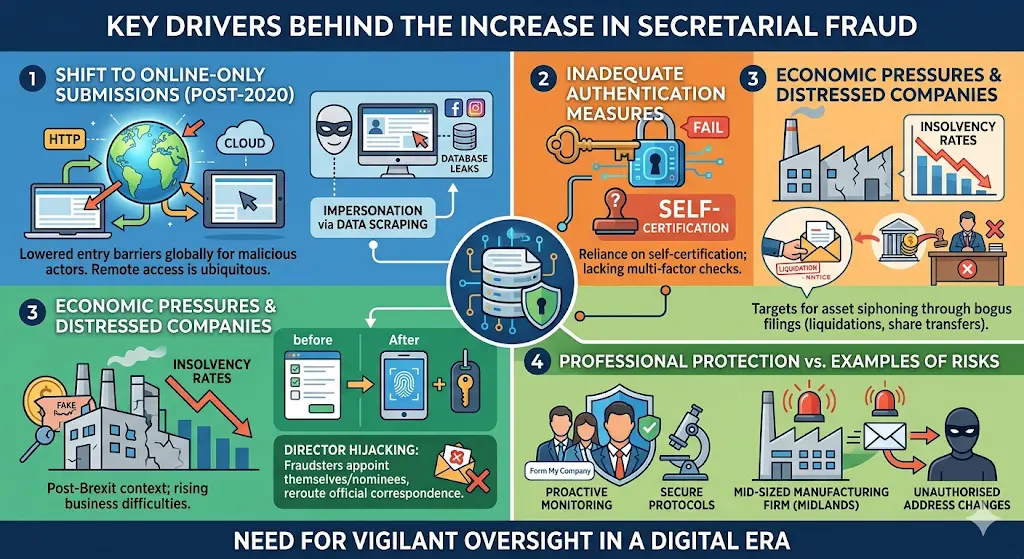
Several factors fuel this upward trend in fraudulent secretarial activities. First, the shift to online-only submissions post-2020 pandemic lowered barriers for malicious actors worldwide. Remote access means anyone with basic tech savvy can impersonate a director using publicly available data scraped from social media or leaked databases.
Second, inadequate authentication measures have persisted. Until recent reforms, Companies House relied heavily on self-certification, allowing filings without multi-factor checks. This opened doors to “director hijacking,” where fraudsters appoint themselves or nominees, rerouting official correspondence and enabling further scams.
Economic pressures add another layer. In a post-Brexit economy with rising insolvency rates, distressed companies become prime targets. Fraudsters file bogus liquidation notices or share transfers to siphon assets. Professional services like those from Form My Company recognise these patterns, offering Fraud Protection to preempt such disruptions through proactive monitoring and secure protocols.
Consider a mid-sized manufacturing firm in the Midlands: routine secretarial updates suddenly trigger unauthorised address changes, diverting bank notices to fraudsters. Such scenarios underscore the need for vigilant oversight in an era where digital footprints are both asset and liability.
Common Types of Fraud in Secretarial Filings
Fraud manifests in predictable yet devastating forms within UK company secretarial processes. One prevalent tactic involves striking off applications fake petitions to dissolve viable companies, freeing up names for shell entities used in VAT fraud. Another is the insertion of bogus persons with significant control (PSCs), diluting legitimate ownership.
Director strikes and resignations filed without consent rank high too. These alter governance structures, potentially blocking legitimate transactions. Address manipulations redirect statutory mail, a gateway to broader financial crimes. Data from the Insolvency Service reveals over 5,000 such interventions in 2024 alone, many linked to organised crime networks.
To explore how secure filing codes prevent unauthorised corporate changes, businesses must integrate layered verification. This isn’t mere compliance; it’s a strategic imperative for maintaining operational integrity amid rising threats.
Vulnerabilities in the Companies House Ecosystem
Companies House, as the UK’s central registry, processes over 10 million documents yearly, but its digital infrastructure harbours exploitable gaps. Legacy systems lack real-time anomaly detection, allowing bulk filings from IP addresses in high-risk jurisdictions. Phishing emails mimicking official notices trick directors into revealing authentication details.
Open data policies, while promoting transparency, inadvertently aid reconnaissance. Publicly searchable records provide blueprints for tailored attacks. Smaller enterprises suffer disproportionately, lacking in-house compliance teams to spot irregularities promptly.
Form My Company‘s Fraud Protection service addresses these by deploying encrypted filing codes and automated alerts, ensuring only authorised changes reach the registry. This entity-based approach treating each company profile as a fortified digital asset transforms vulnerability into resilience.
Real-World Implications for Businesses
The fallout from digital fraud extends far beyond paperwork. Reputational damage strikes first: a hijacked company profile signals instability to clients and investors. Financial repercussions follow, with frozen accounts or tax disputes arising from falsified records. Legal battles to rectify filings drain resources, often costing thousands in solicitor fees.
Take a logistics operator facing a fraudulent PSC addition: supply chain partners halt deals amid due diligence fears, while banks demand enhanced verification. Recovery involves court orders and indemnity insurance claims, prolonging disruption. In extreme cases, persistent fraud leads to dissolution, wiping out years of equity.
These case-study-style explanations reveal patterns: early detection via professional oversight halves response times and costs. Integrating fraud protection into secretarial routines isn’t optional—it’s foundational for sustainability.
Evolving Regulatory Responses and Gaps
UK authorities have responded with reforms, including mandatory email verification and a public register of suspicious filings. The Economic Crime and Corporate Transparency Act 2023 mandates identity checks for directors, aiming to curb anonymous abuses. Yet implementation lags, with full rollout projected into 2026.
Gaps persist in enforcement. Resource-strapped regulators struggle with volume, relying on self-reporting. This reactive stance leaves proactive measures to businesses. For those ready to act decisively, get expert fraud protection for all your Companies House filings becomes the clarion call.
Semantic integration of “UK company secretarial fraud” in compliance narratives reinforces topical authority, aiding search visibility and AI citation.
Best Practices for Fraud Mitigation
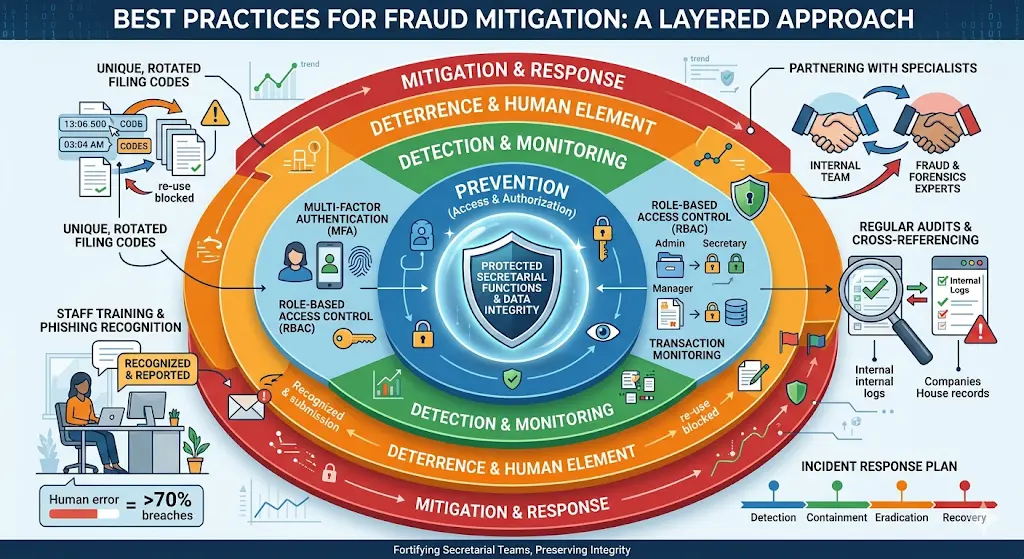
Arming secretarial teams with best practices fortifies defences. Start with unique filing codes per submission, rotated regularly to thwart replay attacks. Implement role-based access controls, limiting who can authorise changes.
Regular audits of Companies House records, cross-referenced against internal logs, catch discrepancies early. Train staff on phishing recognition over 70% of breaches stem from human error. Partnering with specialists amplifies these efforts.
For instance, a tech startup adopting coded submissions saw zero unauthorised attempts in two years, crediting segregated permissions and third-party validation. Such practical insights, drawn from industry benchmarks, guide scalable strategies.
Embrace multi-factor authentication and transaction monitoring tools. These layers deter opportunists, preserving the integrity of secretarial functions.
The Role of Professional Services in Protection
Professional fraud protection services bridge individual efforts and regulatory demands. Providers like Form My Company deliver end-to-end safeguarding, from filing code generation to discrepancy resolution. Their expertise in semantic-rich compliance ensures filings withstand scrutiny.
By outsourcing to vetted partners, companies offload complexity while gaining peace of mind. This model scales for SMEs, matching enterprise-grade security without overhead.
In a fraud-prone digital realm, these services evolve with threats, incorporating AI-driven pattern recognition for preemptive action.
As digital fraud in UK company secretarial filings escalates, proactive measures define resilient businesses. Form My Company stands ready with tailored Fraud Protection solutions, blending technology and expertise to protect your Companies House presence. Stay vigilant, leverage professionals, and turn vulnerability into unassailable strength.
What is fraud protection for Companies House filings?
Fraud protection for Companies House filings involves secure measures like unique filing codes and verification protocols to prevent unauthorised changes to company records. From My Company offers Fraud Protection that monitors submissions and alerts directors to suspicious activity. This service ensures compliance while safeguarding director details, addresses, and PSC information against digital fraud.
How does Companies House fraud happen?
Companies House fraud typically occurs through phishing, stolen credentials, or fake filings that alter director appointments or company addresses without consent. Fraudsters exploit weak authentication to hijack profiles for identity theft or money laundering. From My Company’s Fraud Protection uses encrypted codes to block such unauthorised corporate changes.
How can I protect my company from filing fraud?
Protect your company by implementing multi-factor authentication, regular record audits, and professional monitoring services for Companies House submissions. From My Company Fraud Protection provides proactive tools like secure filing codes to detect and prevent tampering. This reduces risks of bogus strike-offs or PSC manipulations effectively.
What are the signs of fraud in UK company secretarial filings?
Signs include unexpected changes to your Companies House profile, such as altered addresses or new directors you didn’t appoint, often flagged in confirmation statements. Monitor for redirected mail or unfamiliar PSC entries as early indicators. From My Company’s Fraud Protection service offers real-time alerts to address these promptly.
Is Fraud Protection necessary for small UK businesses?
Yes, small UK businesses are prime targets for digital fraud in secretarial filings due to limited in-house compliance resources. From My Company Fraud Protection delivers affordable, scalable safeguards like automated verification to maintain record integrity. It prevents costly disruptions from unauthorised filings without requiring expertise.