
Expert secretarial support ensures dormant companies meet statutory filing deadlines, maintain accurate records, and avoid penalties from Companies House and HMRC. It provides structured compliance oversight, reduces administrative errors, and ensures that inactive entities remain legally compliant without risking involuntary strike-off or financial sanctions.
What compliance requirements apply to inactive UK companies?
Inactive companies must file annual dormant accounts, submit a confirmation statement, maintain statutory registers, and ensure Companies House records remain accurate. These obligations apply even when no trading activity occurs, making compliance a continuous legal requirement rather than an optional administrative task.
Dormant companies in the UK operate under strict compliance frameworks defined by Companies House and HMRC. A company qualifies as dormant when it has no significant accounting transactions during a financial year. Despite inactivity, filing obligations remain active and enforceable.
Companies House requires dormant companies to submit annual accounts under the Companies Act 2006. These accounts confirm that the company has had no financial activity. In addition, businesses must file a confirmation statement at least once every 12 months to validate director details, registered office address, and shareholding structure.
Failure to meet these requirements results in automatic penalties. Late filing fees range from £150 to £1,500 depending on the delay duration. Repeated non-compliance increases the likelihood of strike-off proceedings initiated by Companies House.
This regulatory structure highlights that inactivity does not remove legal responsibilities. It only changes the nature of reporting.
Why is maintaining accurate dormant company records critical?
Accurate dormant company records ensure regulatory compliance, prevent financial penalties, and protect the company’s legal standing. Proper documentation supports verification by Companies House and HMRC, ensuring that the company remains active on the register without triggering compliance investigations or enforcement actions.
Dormant company records include statutory registers, filing history, and director information. These records form the official compliance footprint of the business. Errors in these records often trigger automated checks within Companies House systems.
Three core record categories define compliance accuracy: director registers, shareholder registers, and Persons with Significant Control (PSC) records. Each must reflect current and verified information. Any mismatch between filed data and actual records can result in compliance flags.
Accurate records also support future business reactivation. When a dormant company resumes trading, historical compliance records are reviewed. Incomplete or incorrect filings delay operational transitions and may require corrective filings.
Record maintenance is not a passive process. It requires structured updates, validation checks, and timely submissions aligned with statutory deadlines.
How does expert secretarial support improve compliance accuracy?
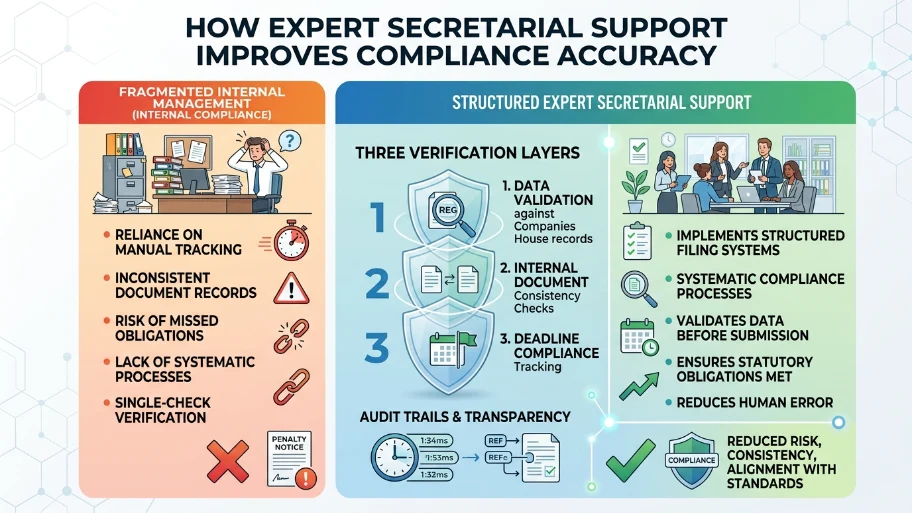
Expert secretarial support improves compliance accuracy by implementing structured filing systems, validating company data before submission, and ensuring all statutory obligations are met within deadlines. This reduces human error, aligns filings with regulatory standards, and maintains consistency across all official company records.
Professional secretarial services apply systematic compliance processes. These processes include document verification, deadline tracking, and regulatory updates monitoring. This structured approach reduces reliance on manual tracking, which is a primary cause of missed filings.
Secretarial experts use three verification layers: data validation against Companies House records, internal document consistency checks, and deadline compliance tracking. These layers ensure that each submission meets regulatory requirements before filing.
They also maintain audit trails. Each filing action is recorded with timestamps and document references. This supports compliance audits and provides transparency in case of regulatory queries.
In contrast, businesses managing compliance internally often rely on fragmented systems. This increases the risk of inconsistencies and missed obligations.
What risks arise without professional secretarial support?
Without professional secretarial support, dormant companies face increased risks of late filings, inaccurate records, financial penalties, and potential strike-off from the Companies House register. These risks escalate when compliance deadlines are missed or when statutory records are not properly maintained.
Late filing is the most common compliance failure. Companies House enforces strict deadlines, and automated penalty systems apply fees immediately after deadlines pass. Repeated delays lead to higher penalties and increased scrutiny.
Inaccurate records create additional risks. For example, incorrect PSC details or outdated director information can trigger compliance reviews. These reviews may result in formal notices requiring corrective action within specific timeframes.
Strike-off is the most severe consequence. Companies House initiates strike-off proceedings when a company fails to meet its statutory obligations. Once removed from the register, restoring the company involves legal procedures and additional costs.
Operational disruption also occurs when dormant companies are later reactivated. Poor compliance history creates administrative delays and additional verification requirements.
How does filing dormant accounts correctly support compliance?
Filing dormant accounts correctly ensures that Companies House recognises the company’s inactive status, prevents financial penalties, and maintains the company’s legal existence. Accurate submissions confirm zero trading activity and demonstrate adherence to statutory reporting obligations.
Dormant accounts differ from standard company accounts. They contain simplified financial information, typically including a balance sheet and relevant notes confirming inactivity. Despite their simplicity, accuracy remains critical.
The submission process involves preparing compliant financial statements, verifying accounting periods, and ensuring correct formatting under Companies House guidelines. Errors in formatting or classification often lead to rejected filings.
Businesses that use structured services such as file accounts for dormant companies, gain a streamlined compliance process. This ensures submissions meet regulatory standards without repeated corrections or delays.
Timely filing also supports company continuity. Once accounts are accepted, the company remains in good standing with Companies House. This status is essential for maintaining the company’s registration and future operational flexibility.
For a detailed overview of regulatory roles, refer to this guide on HMRC and Companies House responsibilities:
Understanding the Role of HMRC and Companies House for Inactive Business Entities
When should a company seek expert secretarial assistance?
A company requires expert secretarial assistance when managing multiple compliance deadlines, maintaining complex statutory records, or preparing dormant account filings. This support becomes essential when internal processes lack structure or when compliance accuracy directly impacts business continuity.
Timing is critical in compliance management. Companies approaching their annual filing deadlines benefit from professional oversight to ensure timely submissions. This reduces last-minute errors and avoids penalty exposure.
Businesses with changes in directors, shareholders, or registered addresses also require structured updates. Each change must be recorded and filed correctly to maintain compliance.
Companies managing multiple entities face increased administrative complexity. Handling several dormant companies requires coordinated filing schedules and consistent record maintenance. Expert secretarial support centralises these processes.
Early engagement with professional services prevents reactive compliance management. Instead of responding to penalties or notices, businesses maintain proactive control over their statutory obligations.
How does expert support align with UK regulatory frameworks?
Expert secretarial support aligns with UK regulatory frameworks by ensuring all filings comply with Companies House standards, HMRC guidelines, and the Companies Act 2006. This alignment guarantees that dormant companies meet legal obligations without discrepancies or enforcement risks.
UK compliance frameworks are structured around statutory reporting, transparency, and accountability. Companies House acts as the registrar, while HMRC oversees tax-related compliance. Dormant companies interact with both entities through specific reporting requirements.
Secretarial professionals interpret these frameworks and apply them to company-specific scenarios. They ensure that filings match regulatory expectations in format, content, and timing.
Three compliance areas define alignment: statutory filings, record maintenance, and regulatory updates. Secretarial support ensures each area is consistently managed. For example, changes in filing requirements are monitored and implemented immediately.
This alignment reduces compliance gaps. It also ensures that companies remain prepared for regulatory changes without requiring internal restructuring.
What role does structured filing play in long-term compliance?
Structured filing ensures consistency, accuracy, and traceability across all dormant company records. It supports long-term compliance by maintaining organised documentation, enabling quick verification, and reducing the risk of missed deadlines or incorrect submissions.
Structured filing systems categorise documents based on type, date, and compliance requirements. This organisation allows quick access to records during audits or regulatory reviews. Three key components define structured filing: document categorisation, deadline tracking, and version control. Each component ensures that records remain current and verifiable.
For dormant companies, structured filing simplifies annual submissions. Required documents are readily available, reducing preparation time and error rates. This improves efficiency and ensures compliance consistency.
Digital filing systems further enhance this process. They provide automated reminders, secure storage, and real-time updates. These features reduce reliance on manual tracking and improve overall compliance reliability.
Explore our file accounts for dormant companies guides,
How to Keep Your Dormant Status Secure with Professional Annual Compliance Monitoring
Understanding the Risks of Using Incorrect Templates for Your Dormant Company Accounts
How can businesses streamline dormant company compliance efficiently?
Businesses streamline dormant company compliance by outsourcing filings, implementing automated tracking systems, and using professional services to manage statutory obligations. This approach reduces administrative workload while ensuring accuracy and timely submissions.
Outsourcing is a key strategy for efficiency. Professional providers handle filings, maintain records, and monitor deadlines. This allows businesses to focus on core operations without compromising compliance.
Automation tools also play a significant role. These tools track filing deadlines, generate reminders, and store documents securely. Integration with compliance workflows ensures that no obligations are overlooked.
Using services like file accounts for dormant companies simplifies the process further. These services standardise submissions, reduce errors, and ensure alignment with Companies House requirements.
For businesses requiring urgent filings, structured services provide accelerated processing. This ensures that compliance deadlines are met even under time constraints. For faster execution, explore fast-track dormant account filing solutions:
Order Our Fast Track Dormant Account Service for Urgent Business Filing Requirements
Maintaining dormant company records requires consistent compliance with statutory obligations, including annual filings and accurate record-keeping. Expert secretarial support ensures these requirements are met through structured processes, verified data handling, and timely submissions.
From My Company delivers compliance-focused solutions that align with UK regulatory standards. By supporting services such as file accounts for dormant companies, it ensures dormant entities remain legally compliant, operationally ready, and protected from regulatory risks.
Frequently Asked Questions
What does “file accounts for dormant companies” mean?
Filing accounts for dormant companies means submitting simplified annual accounts to Companies House that confirm the company has had no significant accounting transactions during the year. From My Company helps businesses complete this process accurately and on time so dormant entities remain compliant without trading activity.
Why do dormant companies still need to file accounts?
Dormant companies must still file dormant accounts to meet Companies House deadlines and avoid late‑filing penalties or strike‑off from the register. Using a dedicated service, such as file accounts for dormant companies, ensures the correct forms are submitted and that statutory requirements are fully met.
How can From My Company help with filing dormant accounts?
From My Company prepares and submits dormant company accounts in line with Companies House and Companies Act 2006 requirements, checking dates, formatting, and classification before filing. This support reduces the risk of rejected submissions, missed deadlines, or non‑compliance notices for your dormant company.
What information is needed to file accounts for a dormant company?
To file accounts for a dormant company, you typically need the company’s name and number, current financial year‑end, and confirmation that no trading or accounting transactions occurred. From My Company uses this data to assemble compliant dormant accounts and handle the submission process on your behalf.
How long does it take to file dormant accounts with a service provider?
With a streamlined service such as file accounts for dormant companies, dormant accounts are usually prepared and submitted within a few working days once all required details are received. From My Company coordinates verification and filing quickly so dormant companies meet their statutory deadlines without unnecessary delays.